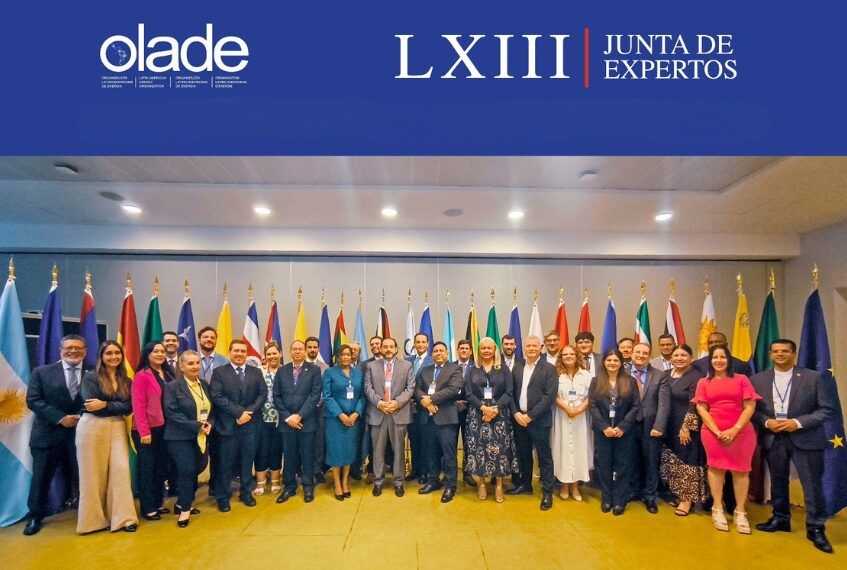
The Latin American and Caribbean Energy Organization (OLACDE) and Panama’s National Energy Secretariat held, in Panama City on June 16 and 17, a series of high-level meetings that marked a milestone for sustainable energy development in Latin America and the Caribbean.
The Panamanian capital hosted three strategic events: OLACDE’s 63rd Board of Experts Meeting, the II Seminar on Battery Energy Storage Systems (BESS), and the official launch of the National Energy Information System (siePANAMÁ).
The activities were attended by delegations from twenty OLACDE member countries, permanent observers, private-sector representatives, multilateral organizations, and technical partners, reflecting a shared commitment to modernizing electricity systems and strengthening regional energy governance.
During the opening, authorities highlighted that Latin America and the Caribbean were facing a critical moment requiring an accelerated energy transition, while ensuring the security, resilience, and sustainability of national and regional electricity systems. In this context, technical integration, strategic planning, and the intelligent use of energy information stood out as fundamental pillars.
The first event on the agenda was OLACDE’s 63rd Board of Experts, a consultative body that brought together vice ministers and energy directors from member countries. This Board’s purpose was to provide technical advice to the Organization’s Ministerial Meeting scheduled for October 2–3 in Santiago, Chile, by evaluating strategic proposals and coordinating regional policies. In its 2025 edition, the Board convened representatives from 27 Member States, consolidating its role as a space for building technical consensus and aligning national visions around energy integration, climate financing, gender equity, emerging technologies, and a just transition.
In parallel, the II Battery Energy Storage Systems (BESS) Seminar was held, organized by OLACDE in collaboration with the Central American Integration System (SICA) and sponsored by Huawei. This technical gathering addressed the challenges and opportunities in using BESS systems as a tool to increase renewable energy penetration, strengthen grid resilience, and reduce emissions from the energy sector. The seminar included panels on regulatory models, safety standards, grid-forming technologies, smart grids, and pilot experiences implemented in countries across the region. The discussions highlighted that energy storage is an essential component for decarbonization and the modernization of energy matrices in Latin America and the Caribbean, while also strengthening national technical capacities and opening new possibilities for regional technological cooperation.
The third event was the launch of siePANAMÁ, a national energy information platform developed with OLACDE’s technical support and based on the SIEN Toolkit, which had already been implemented in thirteen countries across the region. The platform is overseen by the Inter-Institutional Committee on Energy Information, led by Panama’s National Energy Secretariat, and represents substantial progress in transparency, open data, and governance. siePANAMÁ enables public access to official information on energy balances, supply and demand, prices, emission factors, regulations, and energy infrastructure, with interoperability standards and methodological standardization that facilitate its use by governments, businesses, academia, and citizens. The system strengthens the country’s institutional capacities and integrates it into a regional energy information network aligned with international best practices.
During the meeting, OLACDE’s Executive Secretary, Andrés Rebolledo, noted that it was gratifying to see the active participation of numerous countries, which turned this gathering into a catalyst for advancing toward a more sovereign, inclusive, and sustainable energy matrix. He emphasized that 2025 represented a strategic opportunity to rethink the regional energy model. “At the Latin American and Caribbean Energy Organization (OLACDE), we promote a just energy transition, grounded in technical-political dialogue and regional cooperation as fundamental pillars of the process,” he said.
Pro Tempore President Keisha Reid, Deputy Permanent Secretary of Barbados’ Ministry of Energy and Business, thanked Panama for its hospitality and all delegates for their active participation in this 63rd OLACDE Board of Experts meeting. She highlighted the continuity of an agenda geared toward a just energy transition, one of the most important commitments for our region.
For his part, Panama’s National Secretary of Energy, Juan Manuel Urriola, reaffirmed the country’s commitment to regional energy integration and to strengthening modern governance based on data, technical cooperation, and political dialogue. “This meeting represented a decisive step toward more sustainable, resilient, and sovereign energy systems,” he stated.
These meetings reaffirmed OLACDE’s role as a technical platform for multilateral coordination and reflected the willingness of its Member States to build a common energy agenda for Latin America and the Caribbean, based on cooperation, shared knowledge, and sustainable development.