Final report of the thematic roundtables
- Background
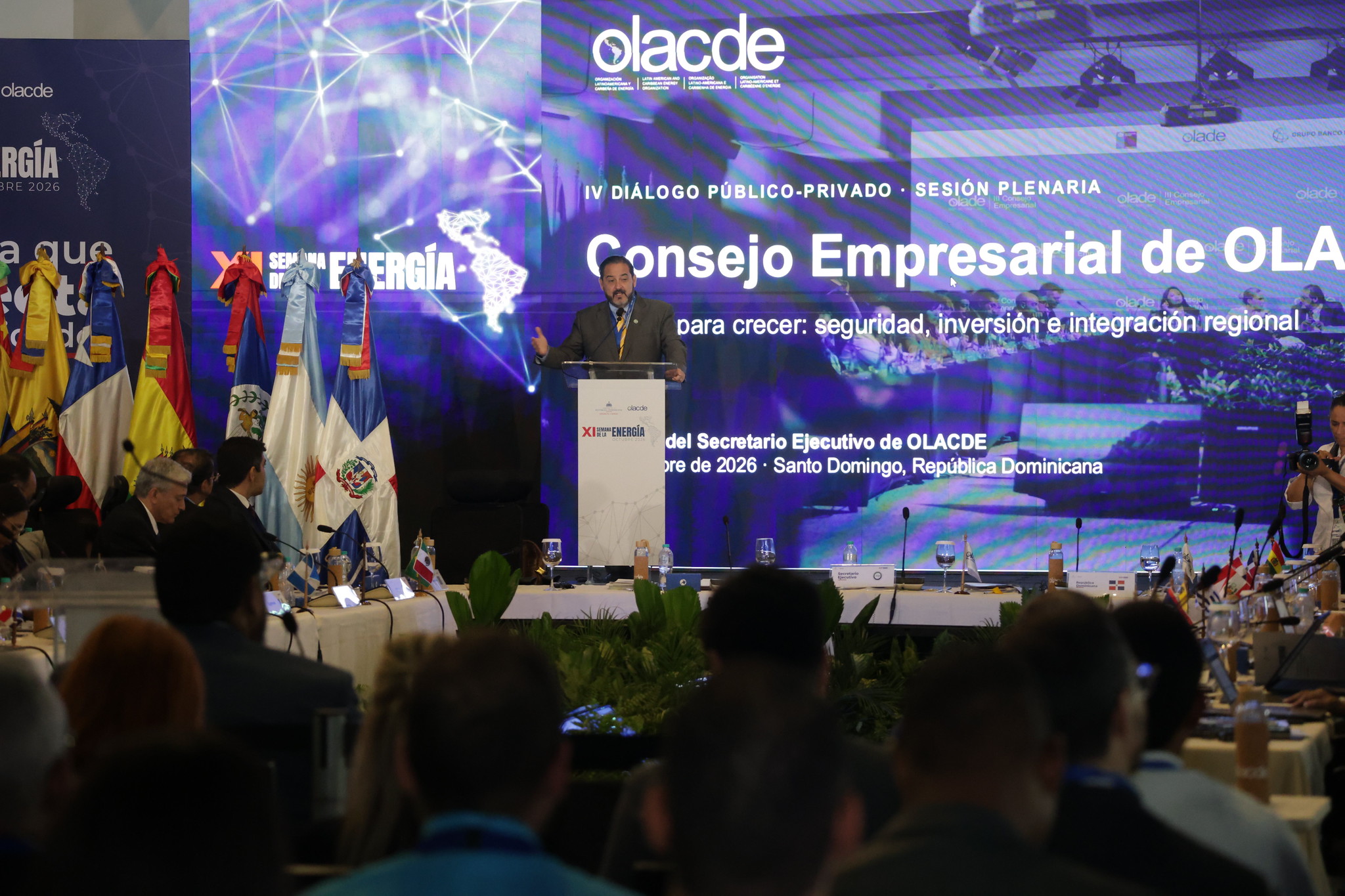
On October 8, 2026, the OLACDE Business Council held its fourth session in Santo Domingo, Dominican Republic, as part of the Fourth Public–Private Dialogue. The Council was established by Ministerial Decision LIII/D/572, adopted at the 53rd Meeting of Ministers (Montevideo, 2023), and has become the region’s leading forum for dialogue on energy among governments, the private sector, and multilateral and financial institutions. The session brought together more than 80 participants, including energy authorities from OLACDE member countries and representatives of nearly 60 companies, associations, and multilateral and financial institutions.
The session comprised four thematic roundtables, each co-moderated by OLACDE and a strategic partner: Hydrocarbons and Natural Gas, with the Association of Oil, Gas and Renewable Energy Companies of Latin America and the Caribbean (ARPEL); Decarbonization, with the World Economic Forum (WEF); Renewable Energy, with the International Renewable Energy Agency (IRENA); and Energy Security and Regional Integration, with the Caribbean Centre for Renewable Energy and Energy Efficiency (CCREEE). Each roundtable followed a results-oriented methodology, supported by a technical briefing note and guiding questions. Specific conclusions and recommendations were agreed upon and are summarized below. The roundtable outcomes were presented at the Ministerial Meeting on Friday, October 9, 2026.
- Conclusions by roundtable
i. Hydrocarbons and Natural Gas
Co-moderated by OLACDE and the Association of Oil, Gas and Renewable Energy Companies of Latin America and the Caribbean (ARPEL)
- Hydrocarbons will remain part of the regional energy mix
Natural gas plays a key role in energy security, owing to its availability and efficiency, and provides backup for diversified energy m - Shared responsibility for decarbonization
Governments call on industry to contribute to decarbonization targets by adopting technologies such as leak detection and the identification of losses in production and transportation. - Stable regulatory frameworks and efficient permitting
Industry calls on governments to establish stable, long-term regulatory frameworks, streamline permitting for exploration and facilities, and harmonize regulations governing quality and firm and interruptible products to facilitate trade and improve project bankability. - The region as a source of global energy security
Latin America and the Caribbean has the potential to establish itself as a reliable energy supplier to global markets. - OLACDE’s role
OLACDE is called upon to promote the standardization of permitting procedures and regulatory dialogue, and to position the region as a secure source of energy to attract investment.
ii. Decarbonization
Co-moderated by OLACDE and the World Economic Forum (WEF)
- Turn regional potential into bankable projects.
Latin America and the Caribbean has the resources, technologies, and capabilities needed to develop clean fuels, but the main challenge is converting these opportunities into tangible investments. Financing is not necessarily the primary bottleneck; rather, the challenge lies in structuring viable projects with sound business models, identified demand, long-term contracts, regulatory predictability, and appropriate risk-sharing mechanisms. - Advance regional integration through hubs and corridors to build scale and demand.
Fragmented markets, regulations, and supply chains constrain clean-fuel development. Aggregating demand, promoting compatible certification schemes, and developing production and supply hubs, alongside regional logistics and energy corridors, are essential. These initiatives would connect supply and demand, leverage complementarities among countries, generate economies of scale, and strengthen regional competitiveness, particularly in shipping and aviation. - Prioritize decarbonization pathways to strengthen energy security and competitiveness.
The transition requires prioritizing options according to their emissions-reduction potential, economic feasibility, technological maturity, and contribution to energy security, while taking each country’s circumstances into account. This means advancing electrification wherever feasible and complementing it with clean fuels in hard-to-electrify sectors, avoiding one-size-fits-all technological approaches and directing investment toward the highest-impact solutions. - Accelerate implementation through phased solutions and public–private coordination.
The urgency of climate action requires deploying available technologies today rather than waiting for ideal future solutions. This calls for flexible strategies, the use of existing infrastructure, predictable regulatory frameworks, and stronger coordination among governments, businesses, and productive sectors. The priority must be to translate decarbonization commitments into concrete projects, investments, and verifiable emissions reductions.
The report is available for download here: English, Spanish and Portuguese.
The roundtable also provided an opportunity to launch the joint World Economic Forum–OLACDE report, Scaling Clean Fuels in Latin America and the Caribbean, developed with analytical support from Bain & Company. Drawing on consultations with 45 experts from 34 organizations across 18 countries, the report highlights the region’s potential to become a global leader in clean fuels and identifies concrete measures to overcome investment barriers, strengthen regional cooperation, and accelerate large-scale deployment.
iii. Renewable Energy
Co-moderated by OLACDE and the International Renewable Energy Agency (IRENA)
- Rules that ensure a level playing field
Adapt regulations originally designed for conventional systems so that new technologies can deliver their benefits to energy systems and consumers, while providing stable signals to investors. - Reduce risks that increase investment costs
Allocate each risk to the party best equipped to manage it, combining predictable contracts with guarantees and hedging instruments that improve bankability and lower the cost of capital. - Shorten project development timelines
Delays arise from the cumulative effects of planning, land management, engineering, procurement, and construction processes; stronger institutional coordination is needed. - Planning adapted to new technologies
Establish comprehensive, long-term planning for demand, generation, grids, storage, and interconnections, taking into account climate change impacts and leveraging digitalization tools. - Strengthen technical and institutional capacity
Train qualified professionals and strengthen institutions capable of planning, regulating, and processing approvals efficiently, in cooperation with companies, universities, and training centers. - Advance integration processes
Cross-border energy exchanges expand investment opportunities, make it possible to use surpluses, and reduce renewable energy curtailment, provided predictable rules and clear commercial mechanisms are in place. OLACDE can contribute as a regional convening platform, fostering dialogue among countries and sector stakeholders to identify opportunities and facilitate progress in energy integration.
iv. Energy Security and Regional Integration
Co-moderated by OLACDE and the Caribbean Centre for Renewable Energy and Energy Efficiency (CCREEE)
- Financing strategic projects for regional energy security, particularly in the Caribbean
Promote financing for strategic interconnection, resilience, and diversification projects through innovative instruments, including blended and contingent financing, risk-sharing mechanisms, storage incentives, and protection mechanisms against extreme weather events and climate change impacts. This should build on proven good practices from other countries and encourage the harmonization of regulations and requirements that facilitate investment in smaller economies, particularly in the Caribbean. - Cooperation among multilateral organizations, countries, and financial institutions
Strengthen cooperation instruments and coordination among multilateral and regional organizations, countries, and multinational financial institutions. Cooperation includes technical assistance and training to prepare comprehensive projects integrating renewables, battery storage, and hydrocarbons; the exchange of data and good practices; and the preparation of white papers on energy security. - Planning that incorporates the costs of energy security and the transition
Promote cooperation, integration, and regional development through energy-planning instruments that move beyond fragmented approaches toward a more integrated, coherent, and strategic energy transition, ensuring that projections explicitly account for the costs of energy security and the transition. Advance technological mechanisms and tools to support this effort, including models featuring resilience scenarios, digitalization, and cybersecurity.