
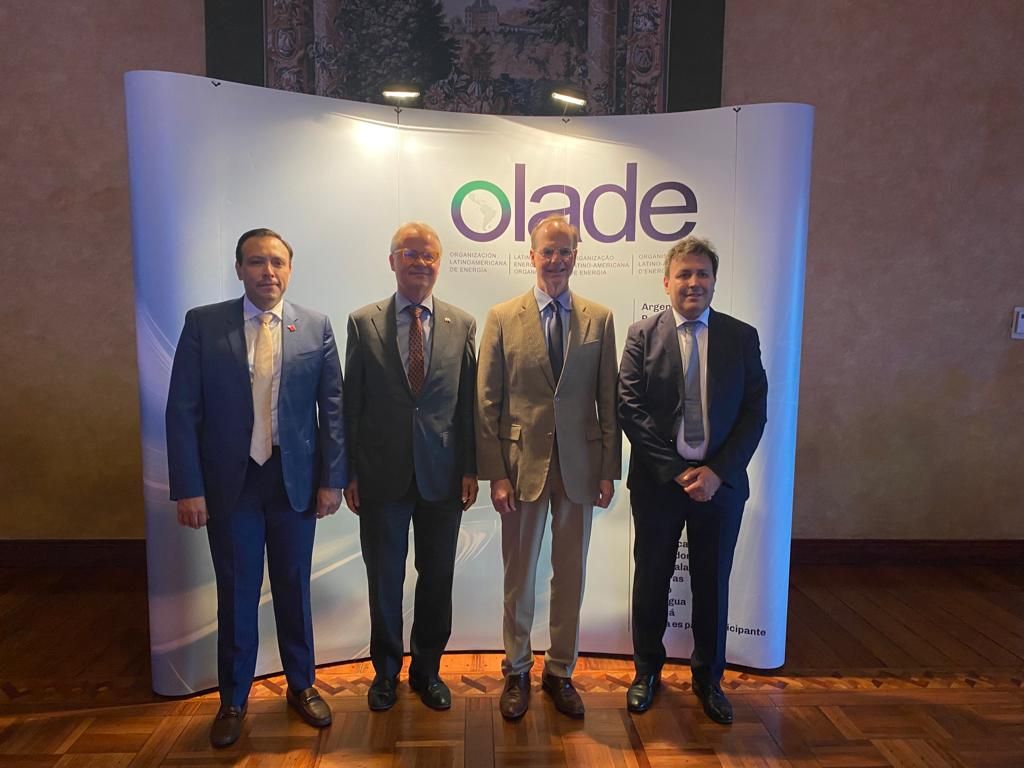
OLACDE organized meeting to discuss global energy security

The Latin American and Caribbean Energy Organization, OLACDE, brought together businessmen, government officials and academics in Quito to analyze world energy trends.

The keynote address was delivered by Paul Simmons of Yale University, who presented the realities of energy security and the global status of energy transition initiatives.

On the afternoon of May 3, 2022, in the city of Quito, at the Rancho San Francisco, members of the business community met to analyze, through the voices of three experts, the reality of global energy security.

The event was inaugurated by Alfonso Blanco, Executive Secretary of OLACDE. In his speech, he spoke about the impact of the current political situation in Europe on the world economy and highlighted the reality of the American continent and its efforts to advance in an energy transition:

“Despite many adversities, Latin America and the Caribbean has made progress. It is the region with the highest participation of renewable sources in the energy matrix; 30% of the primary energy supply matrix is of renewable origin in our region, while in the rest of the world it is 13%. This is an aspect that we must take into consideration,” explained OLACDE’s executive secretary.   Furthermore, he added that “Latin America and the Caribbean is taking steps to improve the living conditions of its population in terms of energy access, since today more than 97% of its inhabitants have access to energy and 18 million are not connected to the grid, when 20 years ago more than 66 million did not have electricity.”

For his part, Philipp Schauer, German Ambassador to Ecuador, highlighted the strategies that his country has implemented to encourage the use of clean energy, such as green hydrogen, and that could serve as a reference for initiatives in other regions. “The energy transition aims to make it possible to abandon nuclear energy. It should make Germany less dependent on oil and gas imports, we know that a sustainable energy policy can also be successful from an economic point of view, and we also want to be an example to follow,” the German ambassador emphasized.

He also highlighted the current situation: “The outlook is mixed. The share of renewable energies in electricity production has increased, reaching 44%…Thanks to progress in the electricity sector, CO2 emissions have fallen by more than 32% compared to 1990 and energy efficiency has increased by 3% per year. But there are challenges that persist,” he concluded.

The keynote address was given by Paul Simmons, Director of the Jackson Institute for Global Affairs at Yale University in the United States, who presented the state of energy security and energy transitions. In his speech he referred to the energy “trilemma”: 1) Energy security/reliability; 2) Economic growth; 3) Environmental sustainability, including climate change concerns. Against this background, he analyzed the current situation of oil, gas and renewable energies. He explained that: “The last century has witnessed multiple transitions to and from different fuels and technologies. The current challenge is one of scale: global energy use is ten times greater than in 1919… and it keeps increasing.”

He reflected on the fact that, while fossil fuels remain the primary source of energy globally, wind and solar are growing rapidly in the electricity sector. This is very important, but limited, Simmons clarified, “since electricity represents only 20% of global energy demand, so progress must be made in decarbonizing all sectors, not just electricity generation.”

Simmons pointed out that the role of companies is also key, “there are several points of climate pressure on them, which mark the relationship with their stakeholders,” he explained.

The meeting sparked great interest due to the trajectory of the speakers and was a space for reflection and exchange of concerns regarding the opportunities and challenges that the energy transition presents for the world and particularly for Ecuador.
 

Share this news

OLACDE organized meeting to discuss global energy security

Newsletter summary

The Latin American and Caribbean Energy Organization, OLACDE, brought together businessmen, government officials and academics in Quito to analyze world energy trends.

Capacity building & knowledge

We advance high-level technical training programs that foster experience-sharing and develop the human and institutional capacities required to drive energy transformations across our region.

Our academic programs offer executive courses, postgraduate diplomas, master’s degrees, and innovative initiatives focused on key areas such as the energy transition, conventional and renewable energy, electromobility, and regional integration.

OLACDE builds a regional network of energy expertise, connecting governments, young professionals, academics, and industry experts to foster collaborative solutions through technical cooperation and talent development to address future energy and climate challenges.

Technical cooperation & climate finance

We strengthen South-South and triangular cooperation as key drivers to accelerate energy transitions across Latin America and the Caribbean. OLACDE unites efforts among governments, multilateral organizations, academic institutions, and the private sector to mobilize financing, technical expertise, and innovative solutions tailored to our regional context.

We advance strategic initiatives aimed at directing resources toward decarbonization, conventional energy, renewables, and energy justice projects—building a more efficient, inclusive, and sustainable regional cooperation architecture.

Regional energy community

We are building a regional energy community with a global outlook, positioning Latin America and the Caribbean as a pivotal player on the international stage. OLACDE amplifies regional representation in key multilateral energy, trade, and climate forums by fostering strategic alliances and international cooperation.

Through flagship events such as Energy Week and new spaces for high-level dialogue, we champion a collective voice that attracts investment, drives technical partnerships, and unlocks sustainable development opportunities across our region

Energy transition & strategic projects

We foster a regional energy transition built on sustainability, energy security, and social inclusion. OLACDE supports Member Countries in adopting emerging technologies—such as energy efficiency, storage solutions, green hydrogen, electromobility, and grid digitalization—to accelerate the sector’s decarbonization.

Our approach promotes strategic projects that strengthen energy resilience across Latin America and the Caribbean, reducing emissions while building a cleaner, more competitive energy infrastructure. Key regional initiatives, including OEMLAC, position our region as a benchmark for climate innovation and sustainable energy development.

Energy information and data

We develop regional platforms dedicated to energy intelligence, technical analysis, and strategic data systems that empower both public and private decision-making across the sector. OLACDE drives digital transformation in energy by leveraging artificial intelligence, georeferencing, and advanced analytical tools to map regional energy trends.

The integration of systems such as SieLAC, along with new regional digital platforms, consolidates reliable, up-to-date technical data—enabling modern, interoperable, and evidence-based energy planning.

Regional energy integration

We foster cooperation across the regional energy sector by prioritizing infrastructure development, cross-border collaboration, and regulatory alignment to enhance energy security in Latin America and the Caribbean. OLACDE coordinates strategic projects in power grid interconnections, natural gas integration, and joint energy planning to build resilient, sustainable partnerships.

Working alongside the governments of our 27 Member States, regional blocs, multilateral institutions, and key public and private stakeholders, we drive initiatives that introduce innovative energy exchange mechanisms, strengthen national capacities, and accelerate a unified regional energy transition.