
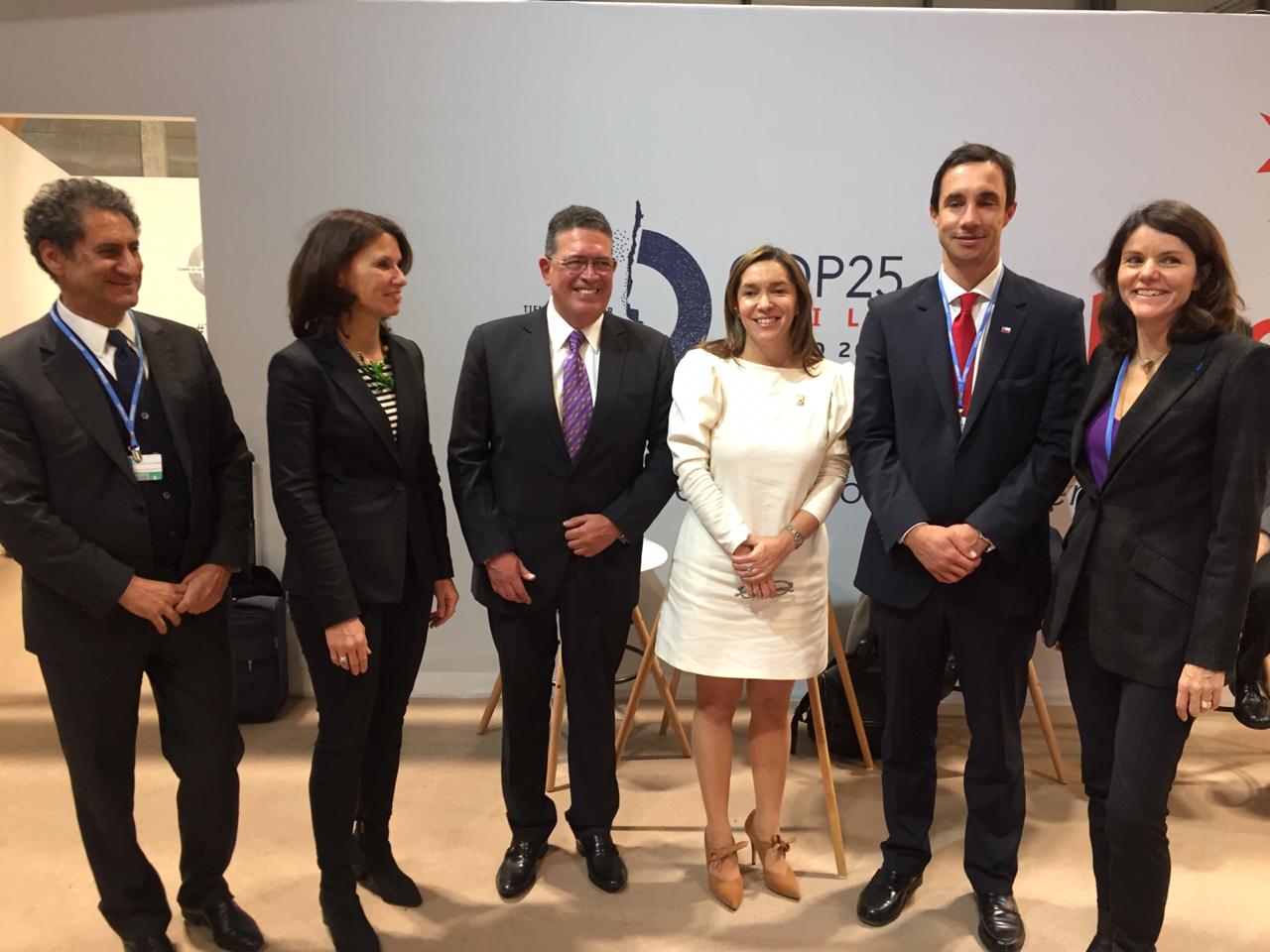
At COP25, 10 countries in Latin America and the Caribbean are committed to contribute to reach 70% of renewable energy in the region

During the United Nations Conference on Climate Change 2019 (COP25), which takes place in Madrid-Spain, 10 countries in Latin America and the Caribbean commit themselves to contribute to achieve the regional goal of 70% renewable energy for the year 2030. Initiative presented by Colombia where The Latin American and Caribbean Energy Organization (OLACDE) has provided data and discussion platforms to begin the preparation of a work plan for the implementation of this agreement, assuming technical coordination.

This regional goal was initially presented by the Colombian delegation during the XLIX Meeting of Ministers of OLACDE, held in November in Lima-Peru.

There it was explained that Latin America and the Caribbean currently has a 56% share of renewable sources, including hydroelectric power. What is intended to be achieved through this initiative is to increase this percentage to 70% with priority to non-conventional renewable energy, which is equivalent to 312 GW of installed renewable energy capacity.

“It must be noted that the commitment is regional, it is not an individual commitment. Individual goals can be differentiated understanding the conditions and participation of each of the countries and the context of each country’s matrix,” said the adviser to the Vice Ministry of Energy from Colombia, Miguel Lotero Robledo, during the XLIX Meeting of Ministers of OLACDE.

This initiative in which Chile, Colombia, Costa Rica, Dominican Republic, Ecuador, Guatemala, Haiti, Honduras, Paraguay and Peru participate, is open for the participation of other countries in the region, and seeks to work together to promote renewable energy , in order to support the fulfillment of the goals defined in the Paris Agreement.

This regional goal, led by Colombia, was officially launched on the Energy Day at COP25, organized by Chile, and was mainly attended by Latin American energy ministers.
The Minister of Energy of Chile, Juan Carlos Jobet, indicated that “this goal is possible to raise because we are one of the richest and most diverse regions in terms of natural resources. In Latin America and the Caribbean there are the largest reserves of water on the planet, the largest area of arable land – 576 million hectares – and 70% of all forms of existing flora and fauna. And, in addition, we are blessed with abundant unconventional energy sources.”

In this context, the Minister of Energy and Mines of Colombia, María Fernanda Suárez, said that “today we are 10 countries that are signing this agreement that we have by 2030 70% of renewable energy, currently the region has a percentage of 55%. We have committed to increase installed capacity, prioritizing non-conventional renewable energies and promoting the exchange of experiences in order to reach at least 512GW of renewable energy by 2030 of which 78GW must come from additional capacity ”.

Minister Suarez also added that the new sources are generating common challenges such as the need to make the network more flexible, develop carbon markets and move forward in the regulatory framework.

On behalf of OLACDE, the Director of Integration, Access and Energy Security, Medardo Cadena, said that “this agreement is very important for the region because with definable and measurable objectives, over time, they will contribute not only to combat effects of climate change but also to reduce energy poverty in the region. We must not lose sight of the fact that there are 18 million people in the region who do not have access to energy in acceptable conditions. Then, the incorporation of renewables gives us the necessary instruments to face this regional challenge.”
Share this news

At COP25, 10 countries in Latin America and the Caribbean are committed to contribute to reach 70% of renewable energy in the region

Newsletter summary

During the United Nations Conference on Climate Change 2019 (COP25), which takes place in Madrid-Spain, 10 countries in Latin America and the Caribbean commit themselves to contribute to achieve the regional goal of 70% renewable energy for the year 2030. Initiative presented by Colombia where The Latin American and Caribbean Energy Organization (OLACDE) has provided […]

Knowledge and Training

We promote advanced technical training programs that facilitate the exchange of experiences, as well as the development of the human and institutional capacities needed to support the energy transformations in our region.

Our academic offering includes executive programs, postgraduate diplomas, master’s degrees, and innovative initiatives focused on topics such as energy transition, conventional energy, renewable energy, e-mobility, and regional integration.

OLACDE creates a regional network focused on energy knowledge that connects governments, young professionals, academics, and sector experts to drive collaborative solutions through technical cooperation and talent development to address future energy and climate challenges.

Technical cooperation and financing

We strengthen South-South and triangular cooperation ties as drivers to accelerate energy transitions in Latin America and the Caribbean. OLACDE brings together efforts among governments, multilateral organizations, academic institutions, and the private sector to mobilize financing, technical capacities, and innovative solutions tailored to our regional reality.

We promote strategic initiatives aimed at directing resources toward projects focused on decarbonization, conventional energy, renewable energy, and energy justice, with the objective of establishing a more efficient, inclusive, and sustainable regional cooperation architecture.

Regional Energy Community

We are building a regional energy community with a global outlook that seeks to position Latin America and the Caribbean as a key player on the international stage. OLACDE strengthens its representation in major multilateral forums related to energy, trade, and climate by fostering strategic alliances and promoting international cooperation.

Through events such as Energy Week, together with new spaces for international dialogue, we promote a collective voice that helps attract financial investment and create new opportunities for sustainable development across our region.

Energy Transition and Strategic Projects

We drive an energy transition based on principles of sustainability, energy security, and social inclusion. OLACDE supports countries in adopting new technologies related to energy efficiency, energy storage, green hydrogen, electromobility, and grid digitalization to accelerate the sector’s decarbonization process.

Our approach also includes promoting strategic projects that strengthen energy resilience at the regional level, contributing to emission reductions while consolidating a cleaner and more competitive energy infrastructure. Initiatives such as OEMLAC position our region as a leading reference in climate innovation and sustainable energy transition.

Energy information and data

We develop regional platforms dedicated to energy information, technical analysis, and strategic data systems that strengthen both public and private decision-making in the sector. OLACDE promotes the digital transformation of the sector through the use of artificial intelligence, georeferencing, and advanced tools for regional energy analysis.

The integration of systems such as SieLAC, together with new regional platforms, allows for the consolidation of reliable and up-to-date technical information, facilitating modern, interoperable, and evidence-based energy planning.

Regional Energy Integration

We promote cooperation in the regional energy sector, focused on collaboration, infrastructure development, and regulatory harmonization, with the objective of strengthening energy security in Latin America and the Caribbean. OLACDE coordinates projects related to electrical interconnection, gas integration, and regional energy planning, seeking to create efficient and sustainable partnerships.

Through cooperation with the governments of our 27 member countries, regional blocs, multilateral institutions, and both public and private stakeholders, we drive strategic initiatives that promote regulatory harmonization and new energy exchange mechanisms, in order to enhance national capacities and accelerate an integrated energy transition at the regional level.