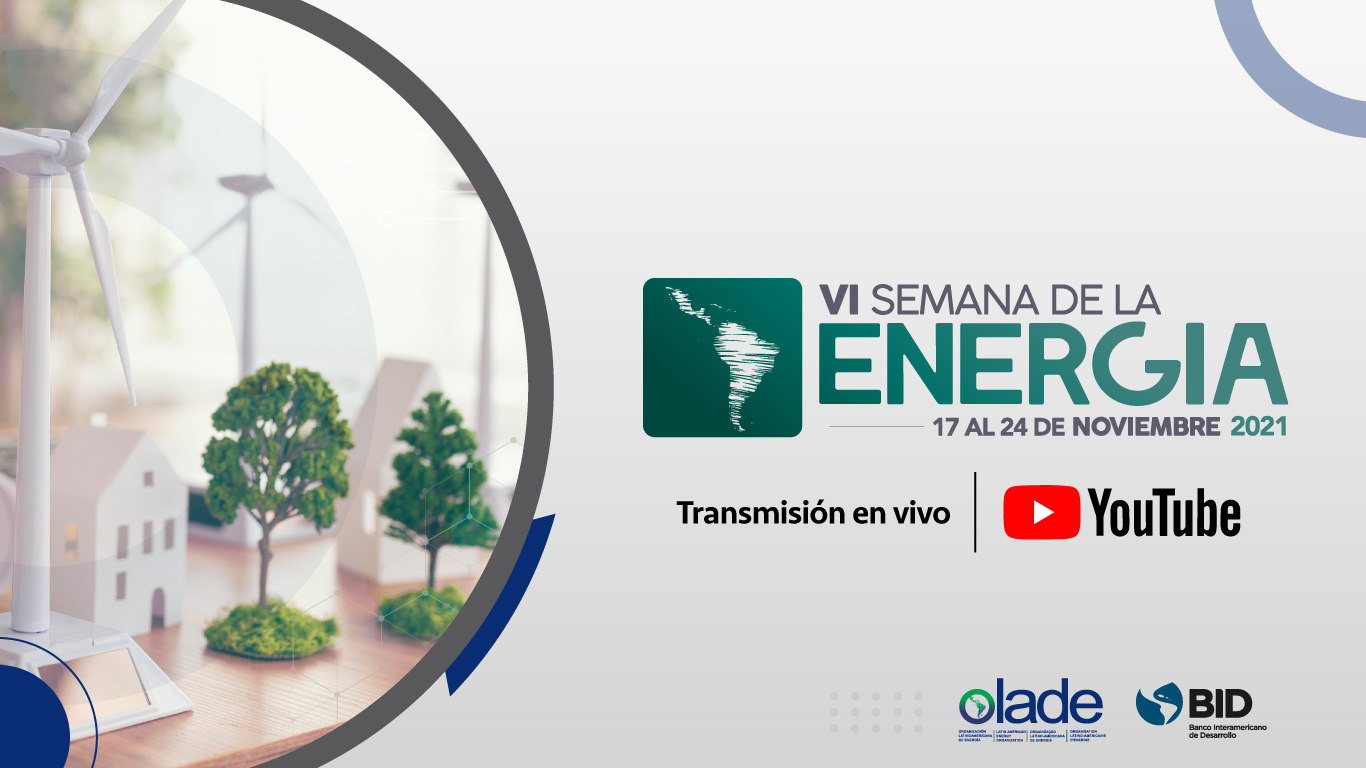
The VI Energy Week takes as its main pillar the importance of energy transition and integration at the regional level

November 17, 2021.- The opening session of the VI edition of the Energy Week was attended by the executive secretary of The Latin American and Caribbean Energy Organization (OLACDE), Alfonso Blanco Bonilla and the manager of the Infrastructure and Energy sector of the Inter-American Development Bank (IDB), Ariel Yépez, who agreed on the importance of energy transition and integration at the regional level.

The first words of the inauguration were given by the executive secretary of OLACDE, Alfonso Blanco, who reported some data on the Energy Outlook for Latin America and the Caribbean, a publication developed by OLACDE.

“We have achieved that 61% of the installed capacity in terms of power generation comes from renewable energies, even in the context of a pandemic, and we are measuring this at the level of the year 2020, we achieved that our region incorporated more than 5 GWh from solar and wind energy.”

He also reported that in the same year of operation, more than 10 GWh of generation from liquid fuels and coal have been eliminated in the region.

In this same context, he added “these actions have contributed to an important advance of almost 2 percentage points in the participation of renewable energies in the installed capacity of power generation.”

He pointed out that this action “is completely in line with what we have set ourselves in the RELAC initiative, which is to try to reach an installed capacity of 70% for Latin America and the Caribbean by 2030.”

Another important fact he mentioned in his speech was that this year “practically 10 countries have included green hydrogen in their agenda as part of the sector’s long-term planning.”

Regarding energy integration, he stated that this aspect plays an important role in the future development of Latin America and the Caribbean.

“We are proposing a series of platforms to advance in terms of integration, but clearly if we want to have the most developed energy sector possible, we have to increasingly incorporate energy integration into our agenda. We have to be clear that the new energy systems with high penetration of renewable energy with greater digitization, modernization in different terms, require much more dynamic regional markets to be increasingly efficient.”

For his part, the IDB Infrastructure and Energy sector manager, Ariel Yépez, said that the Bank has five priority areas as part of the 2025 vision: regional integration, support for SMEs “to strengthen the regional productive apparatus”, digital transformation (particularly in the energy sector), gender equality and actions against climate change.

“The IDB has prioritized its financing in energy efficiency programs, renewable energy, diversification of the energy matrix, development of new technologies such as green hydrogen and the decarbonization of other sectors of the economy such as electromobility,” he explained.

At the end of the inauguration, the day’s roundtables were held to discuss topics related to digitization and innovation in the energy sector, such as sustainable transportation, bioenergy and biofuels, sustainable cities and the integration of new technologies in the current scenario in the Latin American and Caribbean region.

The following are some of the dialogues of the day:

Guadalupe González, Director of Electricity of the National Energy Secretariat of Panama: “We are developing a distributed generation strategy, because we see a high relationship with electric mobility and the installation of solar roofs in houses to make that balance.”

“To introduce the new technologies it is necessary that multiple actors are participating. The energy policy is the first step of the foundation to give direction to the issue, but we need everyone’s support.”

Luiz Horta, professor at the Federal University of Itajubá (UNIFEI): “Latin American countries have particularly interesting conditions to produce biofuels without competing with food security, a complementary possibility to generation with renewables such as wind and photovoltaic”

Alexandra Arias, expert of the Regional Center for Renewable Energy and Energy Efficiency and representative of the Regional Electricity Integration Commission (CIER): Next week a regional report will be presented with information on the regulatory and normative issues that exist in each of the countries.

In the following links you can follow the rest of the dialogues developed on the first day of the VI Energy Week

VI Energy Week – 17/11 – TOMORROW – Panel I: Innovation in the Energy Sector

VI Energy Week – 17/11 – AFTERNOON – Panel I: Innovation in the Energy Sector

Share this news

The VI Energy Week takes as its main pillar the importance of energy transition and integration at the regional level

Newsletter summary

The opening session of the VI edition of the Energy Week was attended by the executive secretary of The Latin American and Caribbean Energy Organization (OLACDE), Alfonso Blanco Bonilla and the manager of the Infrastructure and Energy sector of the Inter-American Development Bank (IDB), Ariel Yépez, who agreed on the importance of energy transition and integration at the regional level.

Capacity building & knowledge

We advance high-level technical training programs that foster experience-sharing and develop the human and institutional capacities required to drive energy transformations across our region.

Our academic programs offer executive courses, postgraduate diplomas, master’s degrees, and innovative initiatives focused on key areas such as the energy transition, conventional and renewable energy, electromobility, and regional integration.

OLACDE builds a regional network of energy expertise, connecting governments, young professionals, academics, and industry experts to foster collaborative solutions through technical cooperation and talent development to address future energy and climate challenges.

Technical cooperation & climate finance

We strengthen South-South and triangular cooperation as key drivers to accelerate energy transitions across Latin America and the Caribbean. OLACDE unites efforts among governments, multilateral organizations, academic institutions, and the private sector to mobilize financing, technical expertise, and innovative solutions tailored to our regional context.

We advance strategic initiatives aimed at directing resources toward decarbonization, conventional energy, renewables, and energy justice projects—building a more efficient, inclusive, and sustainable regional cooperation architecture.

Regional energy community

We are building a regional energy community with a global outlook, positioning Latin America and the Caribbean as a pivotal player on the international stage. OLACDE amplifies regional representation in key multilateral energy, trade, and climate forums by fostering strategic alliances and international cooperation.

Through flagship events such as Energy Week and new spaces for high-level dialogue, we champion a collective voice that attracts investment, drives technical partnerships, and unlocks sustainable development opportunities across our region

Energy transition & strategic projects

We foster a regional energy transition built on sustainability, energy security, and social inclusion. OLACDE supports Member Countries in adopting emerging technologies—such as energy efficiency, storage solutions, green hydrogen, electromobility, and grid digitalization—to accelerate the sector’s decarbonization.

Our approach promotes strategic projects that strengthen energy resilience across Latin America and the Caribbean, reducing emissions while building a cleaner, more competitive energy infrastructure. Key regional initiatives, including OEMLAC, position our region as a benchmark for climate innovation and sustainable energy development.

Energy information and data

We develop regional platforms dedicated to energy intelligence, technical analysis, and strategic data systems that empower both public and private decision-making across the sector. OLACDE drives digital transformation in energy by leveraging artificial intelligence, georeferencing, and advanced analytical tools to map regional energy trends.

The integration of systems such as SieLAC, along with new regional digital platforms, consolidates reliable, up-to-date technical data—enabling modern, interoperable, and evidence-based energy planning.

Regional energy integration

We foster cooperation across the regional energy sector by prioritizing infrastructure development, cross-border collaboration, and regulatory alignment to enhance energy security in Latin America and the Caribbean. OLACDE coordinates strategic projects in power grid interconnections, natural gas integration, and joint energy planning to build resilient, sustainable partnerships.

Working alongside the governments of our 27 Member States, regional blocs, multilateral institutions, and key public and private stakeholders, we drive initiatives that introduce innovative energy exchange mechanisms, strengthen national capacities, and accelerate a unified regional energy transition.