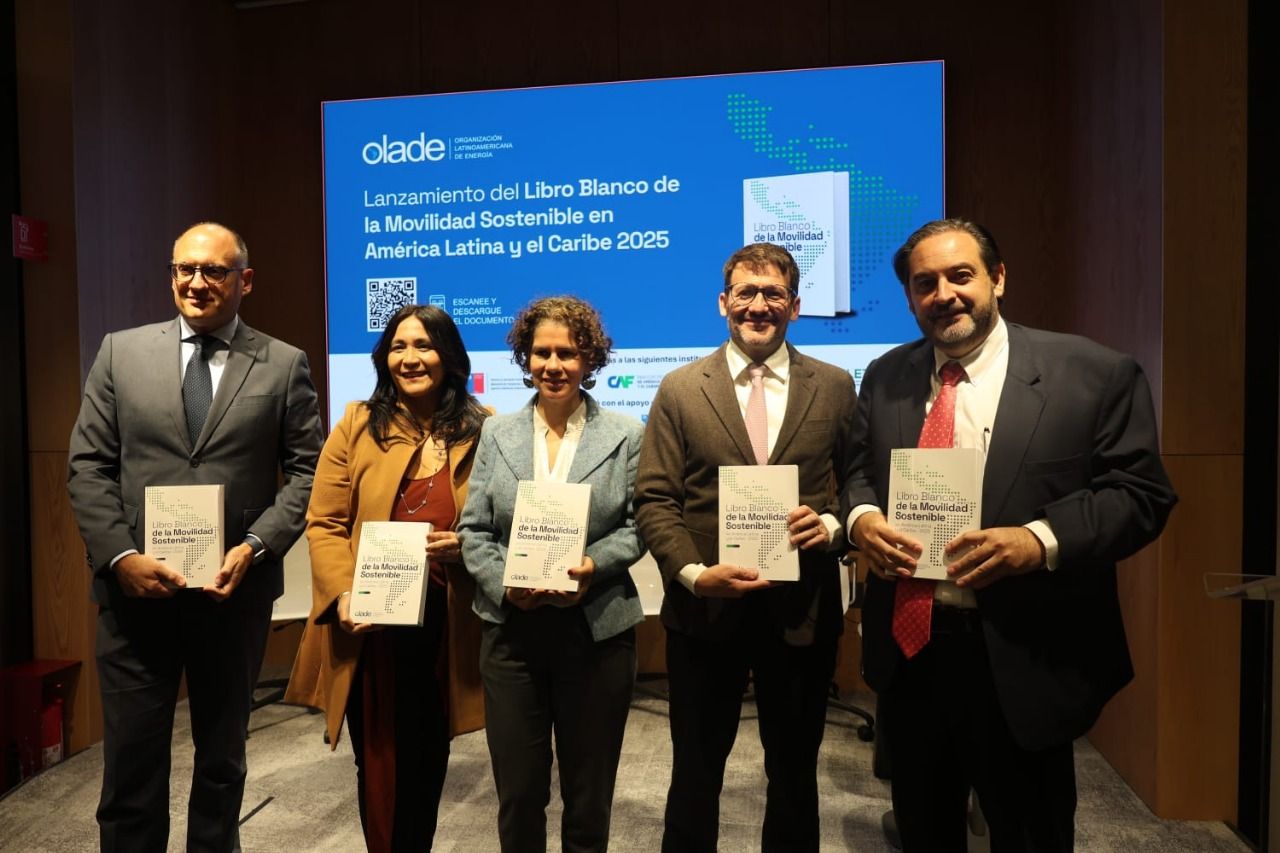
OLACDE presents the White Paper on Sustainable Mobility

In Santiago, Chile, the Latin American and Caribbean Energy Organization (OLACDE) presented the White Paper on Sustainable Mobility, a publication that brings together data, experiences, and proposals for advancing toward cleaner, more efficient, and more inclusive transportation in Latin America and the Caribbean. The event was held as part of the 10th Energy Week, organized by Chile’s Ministry of Energy and OLACDE, with the participation of leaders, experts, and decision-makers from the public and private sectors across the region.

During the presentation, OLACDE’s Executive Secretary, Andrés Rebolledo, stressed that “transportation accounts for nearly 40% of energy consumption in the region. A central part of decarbonization plays out there,” adding that sustainable mobility “offers unique opportunities to drive innovation, generate green jobs, and improve quality of life in our cities.”

The White Paper shows that Chile has achieved notable growth in electromobility, particularly in public transportation. In 2024, the number of light electric vehicles tripled compared to 2023, cementing the country’s position as one of the region’s leaders in incentives. According to the report, in 2022 Chile had 800 electric buses and 10 electric depots, and it is expected to reach 4,406 units and 55 charging points by 2025, bringing 68% of its public fleet to electric technology. This progress stems from a model of progressive tenders, the latest of which requires 100% of buses to be electric.

The document not only highlights progress in electromobility but also proposes a comprehensive vision of sustainable transportation, spanning from the electrification of public transit to the use of biofuels, sustainable aviation fuels (SAF), and green hydrogen.

At the regional level, the light electric vehicle fleet grew from 17,541 units in 2020 to 444,071 in 2024, placing Chile seventh in Latin America. Brazil leads in absolute figures, with nearly 125,000 units sold in 2024, more than double the 2023 figure. In relative terms, Costa Rica (15%), Uruguay (13%), and Colombia (7.5%) are the countries with the largest electric market share.

In terms of electric vehicles per capita, the five countries with the highest numbers at the close of 2024 were Uruguay, Costa Rica, Brazil, Guatemala, and Mexico. This growth is directly linked to effective public policies, such as tax incentives, tax exemptions, and direct subsidies, which have energized the market, particularly in the private-vehicle segment.

The report also reveals sustained expansion of electric public transportation in the region. As of December 2024, Latin America and the Caribbean had close to 6,700 electric buses, 32% more than in 2023, with an average annual growth rate of 33.5% since 2017. Chile and Colombia lead this process, followed by Brazil and Mexico. However, other countries such as Belize, Costa Rica, and Paraguay are advancing more slowly, reflecting gaps that require regional attention.

The White Paper on Sustainable Mobility emphasizes that the challenges go beyond the adoption of electric cars, requiring accessible and standardized charging infrastructure, robust regulatory frameworks, sustainable and scalable financing, and integrated urban and energy planning.

Share this news

OLACDE presents the White Paper on Sustainable Mobility

Newsletter summary

In Santiago, Chile, the Latin American and Caribbean Energy Organization (OLACDE) presented the White Paper on Sustainable Mobility, a publication that brings together data, experiences, and proposals for advancing toward cleaner, more efficient, and more inclusive transportation in Latin America and the Caribbean. The event was held as part of the 10th Energy Week, organized […]

Capacity building & knowledge

We advance high-level technical training programs that foster experience-sharing and develop the human and institutional capacities required to drive energy transformations across our region.

Our academic programs offer executive courses, postgraduate diplomas, master’s degrees, and innovative initiatives focused on key areas such as the energy transition, conventional and renewable energy, electromobility, and regional integration.

OLACDE builds a regional network of energy expertise, connecting governments, young professionals, academics, and industry experts to foster collaborative solutions through technical cooperation and talent development to address future energy and climate challenges.

Technical cooperation & climate finance

We strengthen South-South and triangular cooperation as key drivers to accelerate energy transitions across Latin America and the Caribbean. OLACDE unites efforts among governments, multilateral organizations, academic institutions, and the private sector to mobilize financing, technical expertise, and innovative solutions tailored to our regional context.

We advance strategic initiatives aimed at directing resources toward decarbonization, conventional energy, renewables, and energy justice projects—building a more efficient, inclusive, and sustainable regional cooperation architecture.

Regional energy community

We are building a regional energy community with a global outlook, positioning Latin America and the Caribbean as a pivotal player on the international stage. OLACDE amplifies regional representation in key multilateral energy, trade, and climate forums by fostering strategic alliances and international cooperation.

Through flagship events such as Energy Week and new spaces for high-level dialogue, we champion a collective voice that attracts investment, drives technical partnerships, and unlocks sustainable development opportunities across our region

Energy transition & strategic projects

We foster a regional energy transition built on sustainability, energy security, and social inclusion. OLACDE supports Member Countries in adopting emerging technologies—such as energy efficiency, storage solutions, green hydrogen, electromobility, and grid digitalization—to accelerate the sector’s decarbonization.

Our approach promotes strategic projects that strengthen energy resilience across Latin America and the Caribbean, reducing emissions while building a cleaner, more competitive energy infrastructure. Key regional initiatives, including OEMLAC, position our region as a benchmark for climate innovation and sustainable energy development.

Energy information and data

We develop regional platforms dedicated to energy intelligence, technical analysis, and strategic data systems that empower both public and private decision-making across the sector. OLACDE drives digital transformation in energy by leveraging artificial intelligence, georeferencing, and advanced analytical tools to map regional energy trends.

The integration of systems such as SieLAC, along with new regional digital platforms, consolidates reliable, up-to-date technical data—enabling modern, interoperable, and evidence-based energy planning.

Regional energy integration

We foster cooperation across the regional energy sector by prioritizing infrastructure development, cross-border collaboration, and regulatory alignment to enhance energy security in Latin America and the Caribbean. OLACDE coordinates strategic projects in power grid interconnections, natural gas integration, and joint energy planning to build resilient, sustainable partnerships.

Working alongside the governments of our 27 Member States, regional blocs, multilateral institutions, and key public and private stakeholders, we drive initiatives that introduce innovative energy exchange mechanisms, strengthen national capacities, and accelerate a unified regional energy transition.