Workshop co-hosted by OLACDE, Enel Foundation, and the Harvard Environmental Economics Program
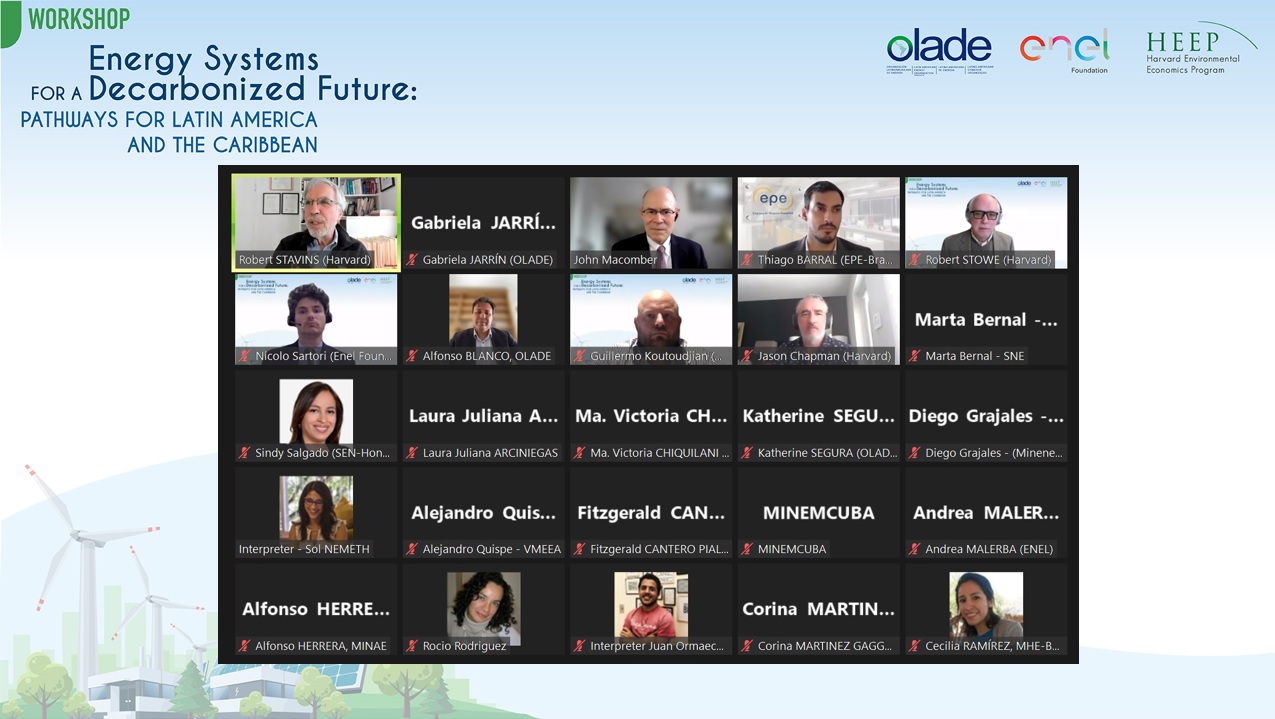
CAMBRIDGE MA. –Energy policy leaders from 21 Latin American and Caribbean countries participated in a virtual workshop Tuesday and Wednesday (January 25-26) focusing on energy policy options aimed at decarbonization and sustainable development for all. The workshop was co-hosted by OLACDE (Organización Latinoamericana y Caribeña de Energía), Enel Foundation, and the Harvard Environmental Economics Program.
The workshop, “Energy Systems for a Decarbonized Future: Pathways for Latin America and the Caribbean,” was designed to support energy and climate policymakers in the region by deepening their understanding of global trends on energy issues and enhancing their capacity to leverage that knowledge to advance decarbonization efforts throughout the region.
Workshop sessions included “The Paris Agreement after COP-26,” “Building Climate Resilience in the Energy Sector in Latin America and the Caribbean,” “Decarbonization in the Energy Sector: Latin America and the Caribbean,” and “Net Zero by 2050: Is it Possible in the Region?”
Countries represented included Argentina, Belize, Bolivia, Brazil, Chile, Colombia, Costa Rica, Cuba, Dominican Republic, Ecuador, El Salvador, Guatemala, Guyana, Honduras, Jamaica, Panama, Paraguay, Peru, Trinidad and Tobago, Uruguay, and Venezuela. Speakers included academics, policy experts, and government officials from the Enel Foundation, the Energy Research Office for the Government of Brazil, Harvard Business School, Harvard Kennedy School, the Inter-American Development Bank, the Ministry of Energy for Chile, OLACDE, and the Universidade Federal do Rio de Janeiro.
“We are enthusiastic about creating alliances with the academia and the main regional and global knowledge centers and agencies. OLACDE´s culture is to create synergies with the different stakeholders.” said Alfonso Blanco Bonilla, Executive Secretary, OLACDE. “Global climate actions are necessary. We are experiencing a global climate emergency that requires our immediate response,” he added. “Along the way, we have discovered that the Harvard Kennedy School and Enel Foundation are the recognized knowledge centers and partners with the global leadership to support our decision makers and technical experts in the ambitious regional climate change actions.” “We want to work together and closely with those who promote changes and the transformation the world needs,” concluded Alfonso Blanco Bonilla.
“We are thrilled to have brought together so many committed policymakers and thought leaders from the region to reason about the great opportunities that lie ahead in delivering a decarb future making sure to leave no one behind,” said Carlo Papa, Managing Director, Enel Foundation. “Moving forward we will continue to support energy and climate policymakers’ knowledge sharing as they seek additional ideas and resources to invoke clean energy solutions.”
“Government leaders in Latin American and the Caribbean are committed to creating a better future for their citizens by taking action now to address climate change,” said Robert Stavins, Director, Harvard Environmental Economics Program and A.J. Meyer Professor of Energy and Economic Development, Harvard Kennedy School. “By gaining a deeper knowledge of the evolving global energy and climate landscape, clean-energy finance, and mitigation and adaptation solutions, workshop participants are now better equipped to make the critical decisions they will have to make in coming months and years.”
ABOUT ENEL FOUNDATION
Based in Rome, Enel Foundation endorses the promotion of multi flag capacity building programs, training, and dissemination initiatives regarding the power sector, socioeconomics, sustainable development, and innovation issues, at the crossroads of climate change and energy transition with a special focus on social sciences, policy & regulation, and technologies. An endeavour also committed to bridging the gap between the academic and the corporate world, bringing together universities, public and private research bodies, businesses, associations, et al.
ABOUT THE HARVARD ENVIRONMENTAL ECONOMICS PROGRAM
The Harvard Environmental Economics Program (HEEP) develops innovative answers to today’s complex environmental issues, by providing a venue to bring together faculty and graduate students from across Harvard University engaged in research, teaching, and outreach in environmental, energy, and natural resource economics and related public policy. The program sponsors research projects, convenes workshops, and supports graduate education to further understanding of critical issues in environmental, natural resource, and energy economics and policy around the world. The university-wide initiative is based in the Harvard Kennedy School’s Mossavar-Rahmani Center for Business and Government.
ABOUT OLACDE
The Latin American Energy Organization (OLACDE) is an intergovernmental public body of cooperation, coordination and technical advisory, established on November 2, 1973 by signing the Lima Agreement, ratified by 27 countries in Latin America and the Caribbean, with the fundamental objective of promoting the integration, conservation, rational use, commercialization and defense of the region’s energy resources.