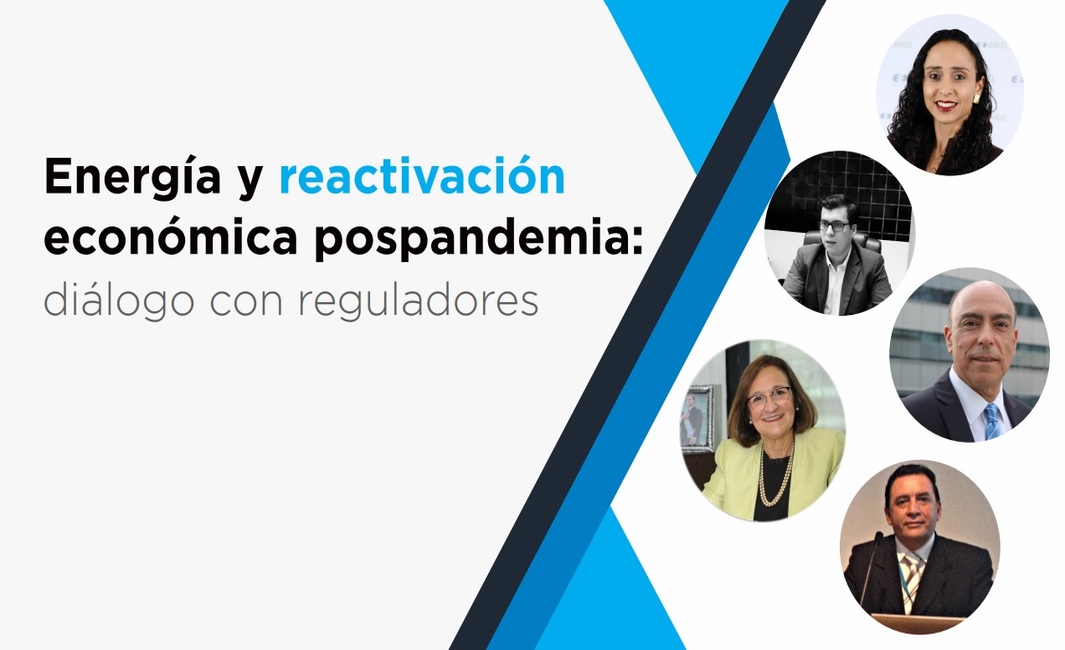
Dialogue with regulators from Brazil, Chile, El Salvador, Peru and Uruguay.

Dialogue with regulators from Brazil, Chile, El Salvador, Peru and Uruguay.

“In this context in which the economies of our countries have been terribly hit by the pandemic, the energy sector has proven to rise to the occasion and with great effort has maintained the continuity of services.”

“Today Uruguay has a highly diversified generation park that meets the country’s demand and creates a climate to attract investments with high commitment to contribute to decarbonization. We are also working on a regulatory modernization process on issues such as electric mobility in public transport”

”The Peruvian matrix has almost 50-50 between natural gas and water and that has meant that during this confinement not only the hydroelectric plant, but also the renewables operate at 100% in the hours they could operate and the natural gas does not operate. These technologies can operate alone without the need for an add-on ”.

“The sectorial model of Brazil was built in a different scenario under a predominance of hydroelectric plants and strong regulation. However, in recent years we have been discussing a broad modernization process, considering issues such as technological innovation”.

“With the pandemic, we have seen the need to advance in more technological issues: customer relationships, smart measurements. The pandemic has shown us the need to accelerate these issues”.

“It is important to review regulations that allow synergy between the distribution and commercialization activity and how this can be transferred to the population.”

“It was clearly commented that there have been challenges in the short term to address the issue of the pandemic. These challenges are related to the attention to users through tariff schemes that allow to continue receiving the service despite the restrictions that companies and users may be facing in the part of their income to be able to pay for these services”. “Regulators agree on three main concepts: the purpose of regulation is to promote competition, seek improvement in the quality of services and guarantee that the electricity service reaches the end user at the lowest possible cost.”
Share this news

Dialogue with regulators from Brazil, Chile, El Salvador, Peru and Uruguay.

Newsletter summary

Dialogue with regulators from Brazil, Chile, El Salvador, Peru and Uruguay.

Capacity building & knowledge

We advance high-level technical training programs that foster experience-sharing and develop the human and institutional capacities required to drive energy transformations across our region.

Our academic programs offer executive courses, postgraduate diplomas, master’s degrees, and innovative initiatives focused on key areas such as the energy transition, conventional and renewable energy, electromobility, and regional integration.

OLACDE builds a regional network of energy expertise, connecting governments, young professionals, academics, and industry experts to foster collaborative solutions through technical cooperation and talent development to address future energy and climate challenges.

Technical cooperation & climate finance

We strengthen South-South and triangular cooperation as key drivers to accelerate energy transitions across Latin America and the Caribbean. OLACDE unites efforts among governments, multilateral organizations, academic institutions, and the private sector to mobilize financing, technical expertise, and innovative solutions tailored to our regional context.

We advance strategic initiatives aimed at directing resources toward decarbonization, conventional energy, renewables, and energy justice projects—building a more efficient, inclusive, and sustainable regional cooperation architecture.

Regional energy community

We are building a regional energy community with a global outlook, positioning Latin America and the Caribbean as a pivotal player on the international stage. OLACDE amplifies regional representation in key multilateral energy, trade, and climate forums by fostering strategic alliances and international cooperation.

Through flagship events such as Energy Week and new spaces for high-level dialogue, we champion a collective voice that attracts investment, drives technical partnerships, and unlocks sustainable development opportunities across our region

Energy transition & strategic projects

We foster a regional energy transition built on sustainability, energy security, and social inclusion. OLACDE supports Member Countries in adopting emerging technologies—such as energy efficiency, storage solutions, green hydrogen, electromobility, and grid digitalization—to accelerate the sector’s decarbonization.

Our approach promotes strategic projects that strengthen energy resilience across Latin America and the Caribbean, reducing emissions while building a cleaner, more competitive energy infrastructure. Key regional initiatives, including OEMLAC, position our region as a benchmark for climate innovation and sustainable energy development.

Energy information and data

We develop regional platforms dedicated to energy intelligence, technical analysis, and strategic data systems that empower both public and private decision-making across the sector. OLACDE drives digital transformation in energy by leveraging artificial intelligence, georeferencing, and advanced analytical tools to map regional energy trends.

The integration of systems such as SieLAC, along with new regional digital platforms, consolidates reliable, up-to-date technical data—enabling modern, interoperable, and evidence-based energy planning.

Regional energy integration

We foster cooperation across the regional energy sector by prioritizing infrastructure development, cross-border collaboration, and regulatory alignment to enhance energy security in Latin America and the Caribbean. OLACDE coordinates strategic projects in power grid interconnections, natural gas integration, and joint energy planning to build resilient, sustainable partnerships.

Working alongside the governments of our 27 Member States, regional blocs, multilateral institutions, and key public and private stakeholders, we drive initiatives that introduce innovative energy exchange mechanisms, strengthen national capacities, and accelerate a unified regional energy transition.