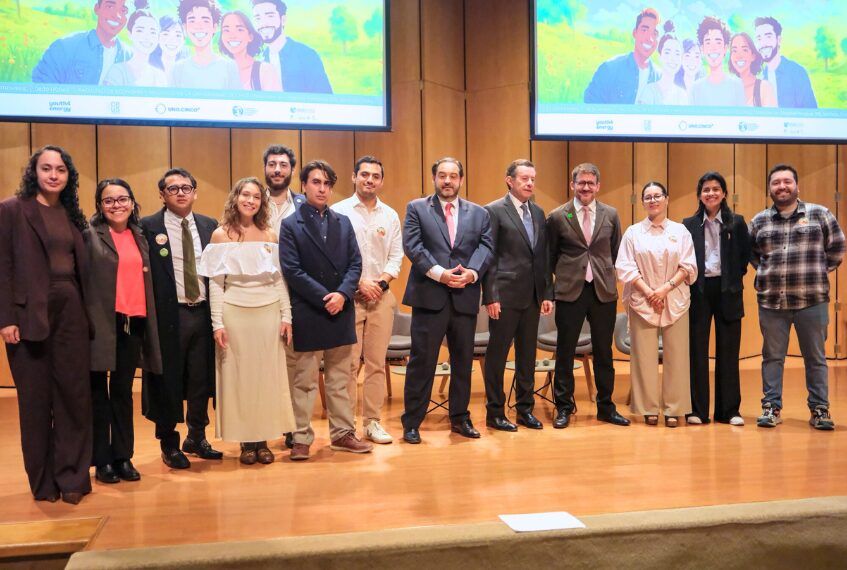
The Faculty of Economics and Business of the University of Chile (FEN UCHILE) hosted, on September 29, 2025, the First Youth in Energy Meeting for Latin America and the Caribbean, held as part of the 10th Energy Week.
Innovation in energy, energy policy, and international collaboration were among the topics addressed at this first meeting, driven by the Latin American and Caribbean Energy Organization (OLACDE), together with Chile’s Ministry of Energy and the University of Chile.
The large gathering, which brought together young people from across the region, opened with remarks from Chile’s Minister of Energy, Diego Pardow, who noted that “the energy transition is, essentially, a change in the way energy is produced,” adding that Chile has made significant progress in this area, “which is an opportunity we must know how to seize.”
Aimed at young people from age 15 and up, as well as organizations interested in the energy sector, the meeting sought to help build a sustainable future, creating a space for dialogue on the main energy challenges facing young people, while also promoting the creation of collaborative networks for sustainability-focused projects.
OLACDE’s Executive Secretary, Andrés Rebolledo, congratulated the young people on organizing the event and highlighted “the importance of discussing what the challenges are and why it is necessary to keep this dialogue going. Listening to young voices to shape the energy agenda is a priority.”
For her part, the University of Chile’s Director of Innovation, Anahí Urquiza, said that “we are very pleased to host this dialogue among different actors. We are also happy and proud to build collaboratively with organizations of young leaders committed to climate change and the energy transition.”
The Dean of FEN, José de Gregorio, stressed that “it is very positive that young people are beginning to reflect without prejudice on our future, because we have many challenges ahead.”
The day continued with the keynote talk “Young Voices: The Transformation of Latin America and the Caribbean,” delivered by Georgina Núñez, vice president of the Governing Board of the OAS’s Young Americas Business Trust. Several panels on the key challenges and opportunities in the energy field followed.
The first, “Ideas that Spark the Future: Young People Leading the Energy Transition,” featured Catalina Sandoval (Reborn, Chile), Larissa Sierra (UNDP, Honduras), Jeffrey Núñez (Dominican Republic), and Guillermo Largo (Ecuador).
In “Innovation in Just Transitions: How Do We Build Resilient, Sustainable, and Inclusive Energy Systems?,” panelists included Dasla Pando (UCHILE Energy Center), Williams Quiroga (IP CFT Santo Tomás), Esteban Van Dam (500 RPM, Argentina), and Constanza Levicán (Suncast, Chile).
The panel “Transition for Whom? Energy Justice in Dispute” brought together Natalia Mapua (Aianca pela Governança Energética, Brazil), Josefina Guacte (Wecheche Ka Itrofillmongeen, Chile), Yanderi Pausayu (Colombia), Everilda Pérez (Guatemala), and Sebastián Orellana (Energy Poverty Network, Chile).
Finally, “Regional and International Collaboration: Strategic Alliances for the Future” featured Jopyce Méndez (OLACDE and Youth Climate Justice Fund), Mikaelle Farías (COP30, Brazil), Laura Restrepo (Colombia), and Valentina Lincaqueo (OLACDE, Chile).
One of the speakers, Guillermo David Largo, from Quito, Ecuador, noted that “this space for dialogue is very important because it allows for a diversification of views on the different energy mixes that exist in our countries. We are looking for collective solutions that contribute to the development of each nation.”
Mikaelle Farías, from Brazil, in turn said that “when we talk about energy, we need young people from everywhere to build diversified development that incorporates different points of view and, in this way, is truly inclusive.”
To close the meeting, the keynote session “Geopolitics of Energy in the 21st Century” was held, led by Astrid Cazalbón, from the Latin American Observatory of Energy Geopolitics (OLAGE) at the Federal University of Latin American Integration (UNILA).
Finally, OLACDE’s Director of Integration, Access, and Energy Security, Gloria Alvarenga, gave closing remarks highlighting OLACDE’s commitment to young leadership in the regional energy agenda.
The event, which was also supported by CLG Chile, Youth4Energy, CEUS Chile, OLAGE, and NGO Uno.Cinco, was held as part of the 10th Energy Week, an initiative driven by OLACDE’s 27 member countries, together with businesses, academia, international agencies, and civil society.