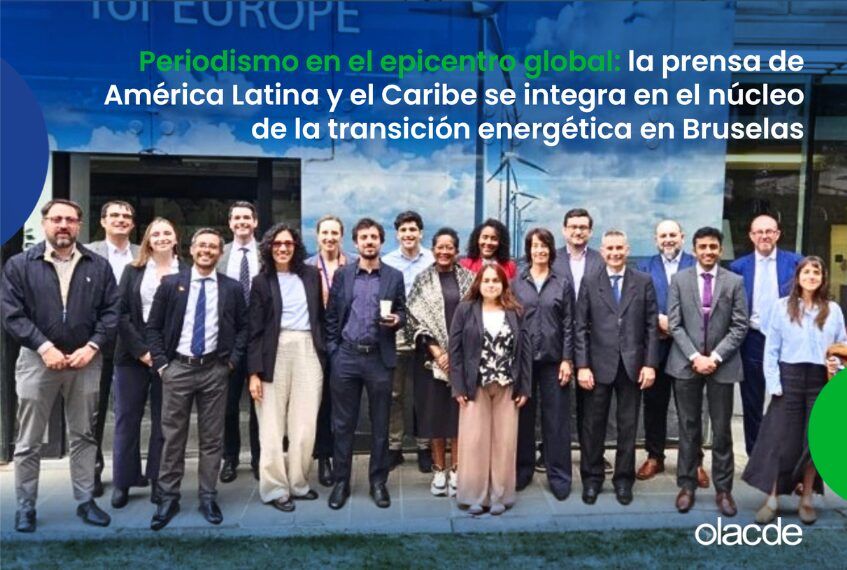
Journalism at the Global Epicenter: Latin American and Caribbean Press Steps Into the Core of the Energy Transition in Brussels

From June 7 to 12 of this year, the Belgian capital became the meeting point for a strategic journalistic network focused on a sustainable future. As part of the Study Tour EU Climate Dialogues 2 (EUCDs2)—a joint initiative between the European Union (EU), German cooperation agency GIZ, and OLACDE—a delegation of 15 journalists from Latin America and the Caribbean came together at the heart of European policymaking to gain direct access to the institutional, technical, and governance spaces where the policies guiding the planet’s decarbonization are designed.

This collective gathering not only provided access to cutting-edge information, but also consolidated a specialized press corps capable of discussing and reporting firsthand on the trends shaping the roadmap for the global energy transition.

For the Latin American and Caribbean Energy Organization (OLACDE), taking part in this high-level gathering in Brussels was not only an exercise in in-depth journalistic coverage, but also the consolidation of a key institutional bridge. The European Union, in its role as a permanent observer of OLACDE, extended this invitation with a clear purpose: to connect Europe’s regulatory and industrial leadership with our region’s renewable potential, turning the bilateral relationship into a true strategic alliance for a climate-neutral future.

Direct access to the sources of global change

Over an intense week of technical and political immersion, the agenda gave the press delegation entry into the core of European Commission decision-making. At a decisive moment for the global energy future, where rising demand calls for immediate cooperation, the tour opened the doors to key venues such as the European Sustainable Energy Week (EUSEW) and enabled face-to-face dialogue with the officials, industry leaders, and innovators driving the European Green Deal and the REPowerEU strategy.

The working sessions ranged from analysis of carbon markets and regulatory frameworks for renewable hydrogen, to a review of new critical minerals value chains and the development of sustainable aviation fuels. This was not merely a theoretical review; on-the-ground technical visits allowed us to see firsthand how European infrastructure and integration systems are evolving to address three simultaneous challenges: supply security, industrial competitiveness, and climate urgency.

From suppliers to partners: the new diplomacy of strategic minerals

One of the clearest and most high-profile messages to emerge from the working sessions in Brussels was a shift in paradigm. Latin American and Caribbean countries are no longer seen solely as suppliers of raw materials, but as indispensable partners for joint development.

Our region holds an exceptional competitive advantage: it has one of the cleanest electricity matrices on the planet—with close to 70% coming from renewable sources—and is home to massive reserves of critical minerals such as lithium, nickel, cobalt, and rare earths, essential for manufacturing clean technologies, storage systems, and electric vehicles. The European approach, embodied in investment strategies such as the Global Gateway, seeks to ensure that recent announcements of strategic projects in the region translate into the creation of local value chains, technology transfer, innovation, and quality job creation within the supplying countries.

From this perspective, concepts once confined to technical debate—such as strategic autonomy and supply chain resilience—have moved to the center of international economic policy.

OLACDE and regional integration at the decision-making table

As the organization responsible for coordinating and energetically integrating its 27 member countries, OLACDE’s presence at this Study Tour reaffirms the importance of keeping the region fully connected to the world’s main decision-making centers.

The energy transition can no longer be defined solely by the technical capacity to generate clean gigawatts; it requires shared visions, harmonized regulatory frameworks, and strong international alliances. Strengthening political and technical dialogue between Latin America, the Caribbean, and the European Union, aligned with the goals of the Paris Agreement, is the fundamental path toward building shared solutions that ensure a just, secure, sustainable, and inclusive energy transition.

Learning firsthand how global climate policy is woven together in Brussels leaves us with clear certainties: the planet’s energy future is being written jointly, and our region is a leading actor at that design table.
Share this news

Journalism at the Global Epicenter: Latin American and Caribbean Press Steps Into the Core of the Energy Transition in Brussels

Newsletter summary

From June 7 to 12 of this year, the Belgian capital became the meeting point for a strategic journalistic network focused on a sustainable future. As part of the Study Tour EU Climate Dialogues 2 (EUCDs2)—a joint initiative between the European Union (EU), German cooperation agency GIZ, and OLACDE—a delegation of 15 journalists from Latin […]

Knowledge and Training

We promote advanced technical training programs that facilitate the exchange of experiences, as well as the development of the human and institutional capacities needed to support the energy transformations in our region.

Our academic offering includes executive programs, postgraduate diplomas, master’s degrees, and innovative initiatives focused on topics such as energy transition, conventional energy, renewable energy, e-mobility, and regional integration.

OLACDE creates a regional network focused on energy knowledge that connects governments, young professionals, academics, and sector experts to drive collaborative solutions through technical cooperation and talent development to address future energy and climate challenges.

Technical cooperation and financing

We strengthen South-South and triangular cooperation ties as drivers to accelerate energy transitions in Latin America and the Caribbean. OLACDE brings together efforts among governments, multilateral organizations, academic institutions, and the private sector to mobilize financing, technical capacities, and innovative solutions tailored to our regional reality.

We promote strategic initiatives aimed at directing resources toward projects focused on decarbonization, conventional energy, renewable energy, and energy justice, with the objective of establishing a more efficient, inclusive, and sustainable regional cooperation architecture.

Regional Energy Community

We are building a regional energy community with a global outlook that seeks to position Latin America and the Caribbean as a key player on the international stage. OLACDE strengthens its representation in major multilateral forums related to energy, trade, and climate by fostering strategic alliances and promoting international cooperation.

Through events such as Energy Week, together with new spaces for international dialogue, we promote a collective voice that helps attract financial investment and create new opportunities for sustainable development across our region.

Energy Transition and Strategic Projects

We drive an energy transition based on principles of sustainability, energy security, and social inclusion. OLACDE supports countries in adopting new technologies related to energy efficiency, energy storage, green hydrogen, electromobility, and grid digitalization to accelerate the sector’s decarbonization process.

Our approach also includes promoting strategic projects that strengthen energy resilience at the regional level, contributing to emission reductions while consolidating a cleaner and more competitive energy infrastructure. Initiatives such as OEMLAC position our region as a leading reference in climate innovation and sustainable energy transition.

Energy information and data

We develop regional platforms dedicated to energy information, technical analysis, and strategic data systems that strengthen both public and private decision-making in the sector. OLACDE promotes the digital transformation of the sector through the use of artificial intelligence, georeferencing, and advanced tools for regional energy analysis.

The integration of systems such as SieLAC, together with new regional platforms, allows for the consolidation of reliable and up-to-date technical information, facilitating modern, interoperable, and evidence-based energy planning.

Regional Energy Integration

We promote cooperation in the regional energy sector, focused on collaboration, infrastructure development, and regulatory harmonization, with the objective of strengthening energy security in Latin America and the Caribbean. OLACDE coordinates projects related to electrical interconnection, gas integration, and regional energy planning, seeking to create efficient and sustainable partnerships.

Through cooperation with the governments of our 27 member countries, regional blocs, multilateral institutions, and both public and private stakeholders, we drive strategic initiatives that promote regulatory harmonization and new energy exchange mechanisms, in order to enhance national capacities and accelerate an integrated energy transition at the regional level.