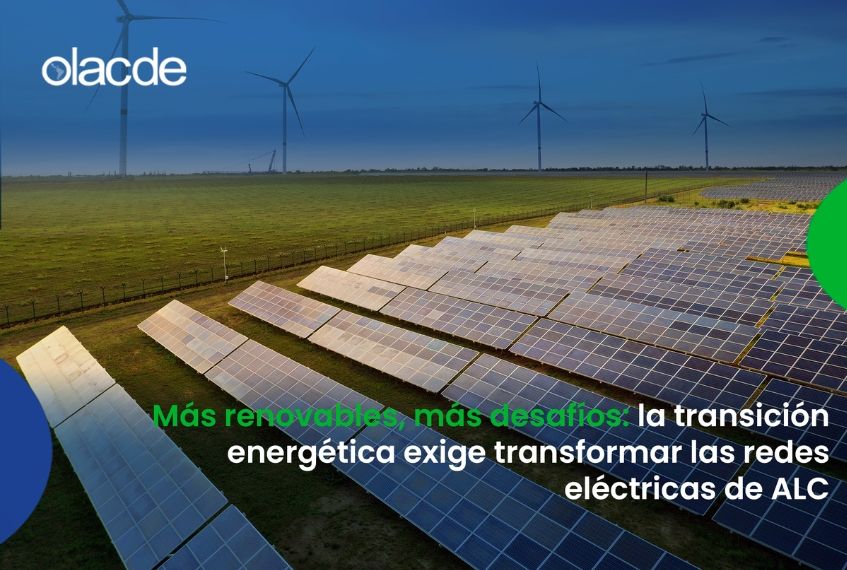
Latin America and the Caribbean is moving steadily toward an electricity mix with a greater share of renewable energy. However, the rapid rollout of solar and wind generation poses an immediate challenge: adapting power systems to operate safely, stably, and continuously in the face of increasingly variable supply.
This is the main conclusion of Technical Note No. 20 from the Latin American and Caribbean Energy Organization (OLACDE), prepared in collaboration with the Technological University of Pereira. The report examines how the integration of inverter-based resources is transforming the operation, planning, and control of grids in the region.
Grid stability: a new operational paradigm
The study warns that replacing conventional generation with inverter-connected technologies reduces the natural inertia of the power system, increasing its vulnerability and requiring new control strategies to preserve stability.
To mitigate this impact, the report proposes the use of advanced inverters capable of emulating the behavior of traditional synchronous machines, combined with battery storage systems and next-generation control tools. However, the report notes that this emulation requires both specialized controls and a physical energy backup, so these capabilities must be planned for from the design, planning, and economic evaluation stages of projects.
OLACDE also emphasizes that current infrastructure was built under a centralized, rigid model, and therefore faces severe limitations in absorbing large volumes of clean energy. This calls for an urgent update of operating criteria, protection methodologies, and planning frameworks.
Outdated infrastructure facing a new energy reality
The report identifies four priority technical challenges for the regional grid:
- Overvoltages during hours of high solar radiation and low demand.
- Voltage drops when renewable generation suddenly decreases.
- Greater grid sensitivity to abrupt power variations.
- The need for new grid codes that take advantage of the flexibility of power electronic inverters.
Another critical issue is the obsolescence of traditional protection systems. Designed to detect the high short-circuit currents of large thermal and hydraulic generators, these schemes lose effectiveness with inverters, which thermally limit such currents and hinder timely fault detection.
To address this, the study proposes migrating to smart, adaptive protection systems. These new schemes must be able to assess dynamic variables such as power flow direction, frequency, and voltage—key aspects for the operation of active grids and microgrids.
This transformation also calls for more precise analytical tools. The Technical Note highlights the importance of adopting quasi-dynamic models and electromagnetic transient (EMT) simulations to complement conventional (RMS) studies, allowing for accurate capture of the rapid response of power electronics.
Regulation and regional technological development
The report concludes that the success of the energy transition in Latin America and the Caribbean will depend on both technological advancement and the modernization of regulatory frameworks.
Experiences in countries such as Brazil, Chile, Colombia, Peru, and Uruguay show a variety of approaches, ranging from transmission expansion and storage regulation to the use of high-voltage direct current (HVDC) systems, synchronous compensators, and new control methodologies.
Finally, OLACDE poses a strategic challenge for the region: strengthening local capabilities in power electronics, automation, software, and control systems. Developing a regional industry in these areas would not only reduce external technological dependence but also foster cooperation among countries and turn grid modernization into a driver of industrial competitiveness.
Read the full technical note at the following link: