The 11th Energy Week brought together representatives from the Inter-American Development Bank (IDB), the World Bank, the International Energy Agency (IEA), and the Ivy Foundation to examine how geopolitical tensions, technological competition, and the restructuring of supply chains are reshaping the global energy landscape. The region faces new opportunities thanks to its abundant natural resources, but also the challenge of translating this advantage into investment, greater value added, and stronger decision-making capacity.
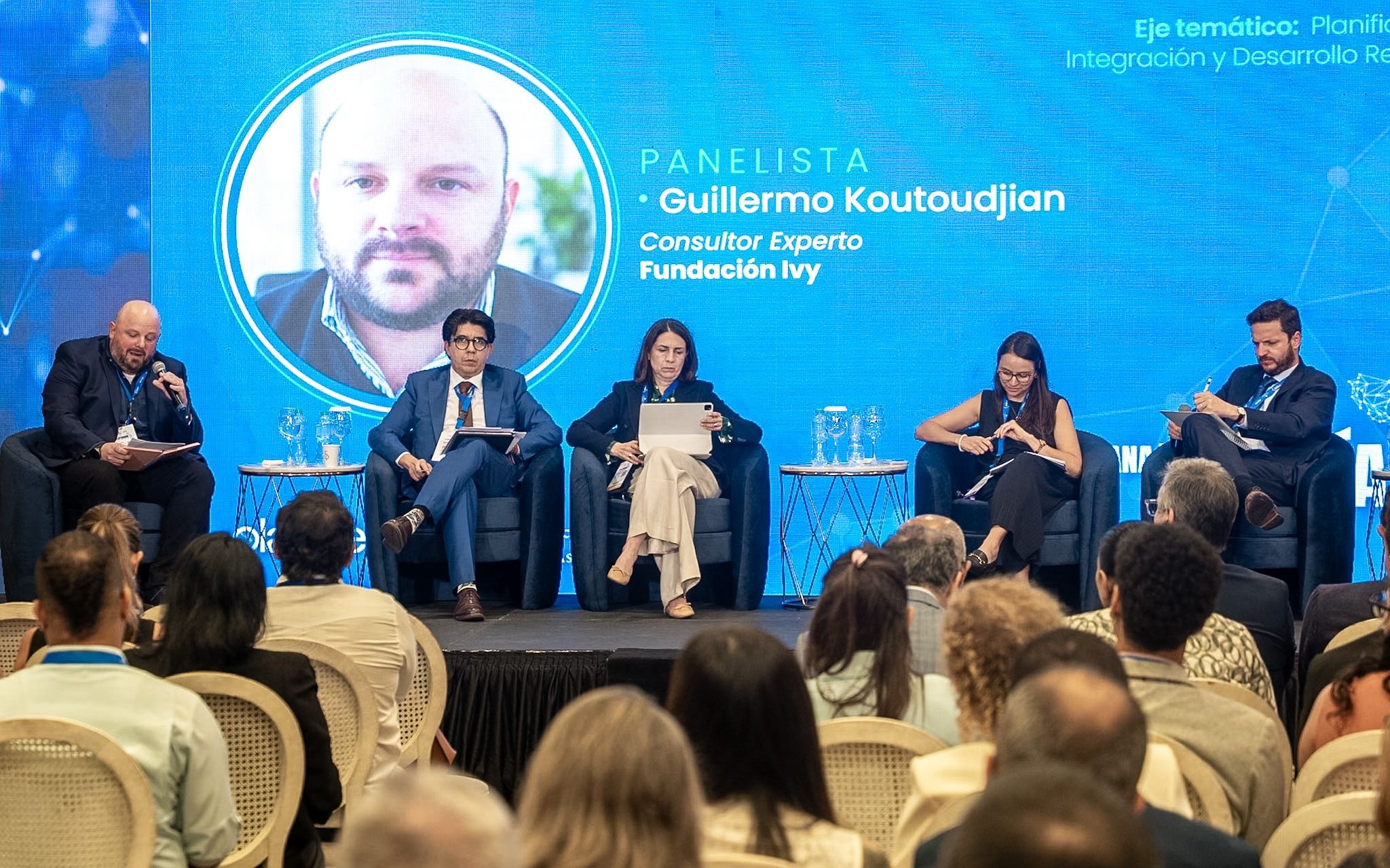
Santo Domingo, October 2026. Moderated by Guido Maiulini, Head of Strategic Advisory at OLACDE, the high-level session “Latin America and the Caribbean in the New Global Geopolitical Landscape” focused on how global shifts are reshaping investment priorities, energy supply security, and industrial strategies, as well as the opportunities available for the region to strengthen its position.
Guillermo Koutoudjian, Expert Consultant at the Ivy Foundation, stated that the international system is moving toward strategic competition dominated by the United States and China, in which energy, technologies, and critical minerals are playing an increasingly important role. In this context, he emphasized that Latin America is gaining strategic relevance due to its resources, geographic location, and status as a zone of peace, while warning of the risk of repeating an economic model centered on the export of raw materials.
Representing the World Bank, Gabriela Elizondo Azuela, Energy Practice Manager for Latin America and the Caribbean, noted that the new geopolitical landscape coincides with the resurgence of industrial policies and a growing pursuit of energy sovereignty. She emphasized that the region needs strong institutions and enhanced capacities to negotiate strategic partnerships and attract investment. “Together, we will be stronger in Latin America,” she stated.
Marcelino Madrigal, Chief of the Energy Division at the Inter-American Development Bank (IDB), emphasized that the region must accelerate electrification, improve energy efficiency and storage, and develop value chains linked to its strategic resources. “We have the resources; the institutions and the rules are largely up to us,” he summarized.
For her part, Alejandra Bernal-Guzmán, Clean Energy Transition Programme Officer for Latin America at the International Energy Agency (IEA), emphasized that energy source diversification, renewable energy, and greater preparedness for supply disruptions will be critical to energy security. She also noted that Latin America can establish itself as a reliable supplier of hydrocarbons, critical minerals, and low-emission products if it succeeds in expanding into processing and manufacturing activities.
In his closing remarks, Maiulini called for combining pragmatism with greater regional ambition. He noted that the energy sector can serve as a catalyst for a more competitive economy, with more high-quality jobs and greater social integration, provided that the region makes better use of its resources and strengthens its capacities.
He also highlighted that Latin America and the Caribbean’s status as a zone of peace represents a strategic advantage that can be further enhanced through greater energy integration. Deepening this integration from Mexico to Tierra del Fuego would enable the region to leverage complementarities, build more secure energy systems, reduce costs and emissions, and expand development opportunities across the region.