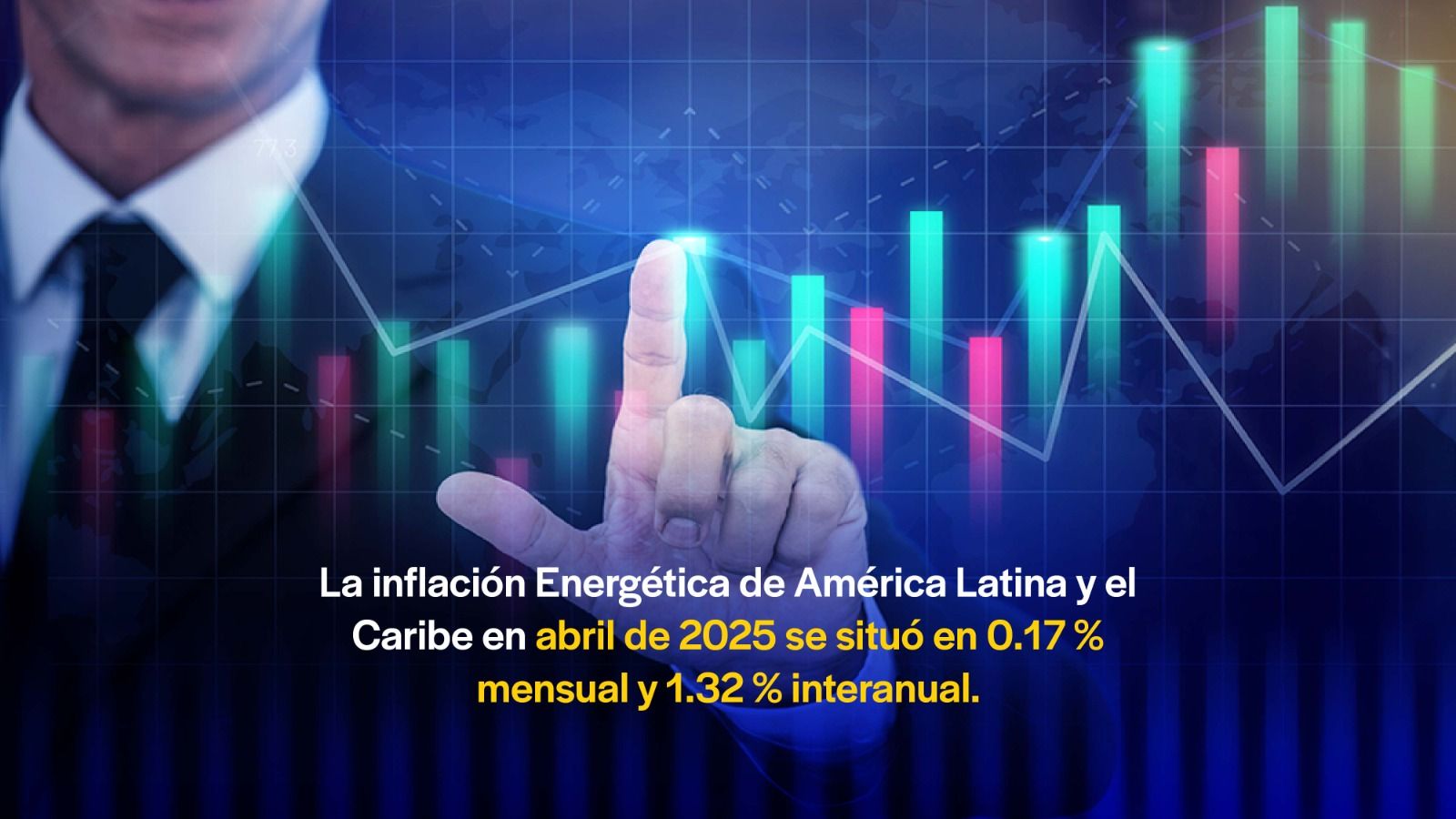
The Latin American Energy Organization (OLACDE) presents the Energy Inflation for Latin America and the Caribbean (IE-LAC) for April 2025, which stood at 0.17% month-on-month and 1.32% year-on-year.
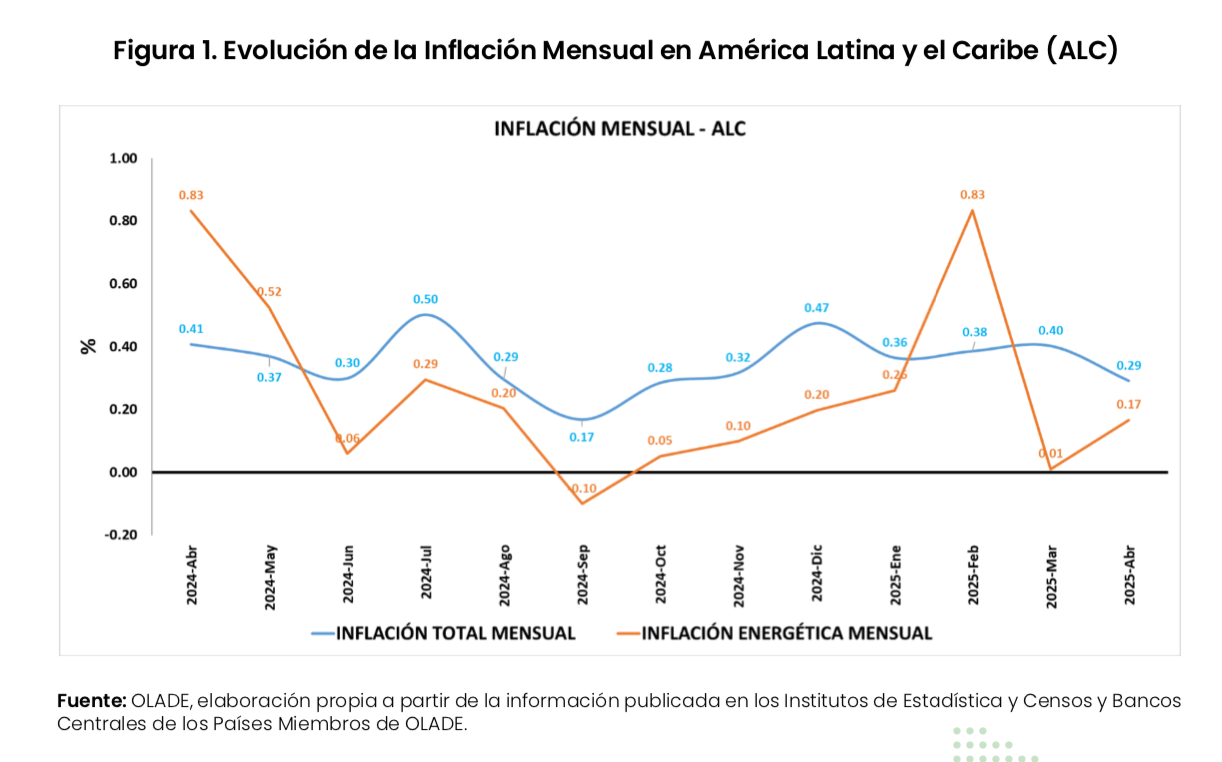
Monthly energy inflation in April 2025 was 0.17%, an increase from March of the same year. This growth is due to the fact that 11 of the 20 countries analyzed recorded positive monthly energy inflation values, ranging between 0.04% and 9.81%, while 9 countries recorded negative values within a much narrower range, between -0.02% and -3.16%.
By contrast, monthly total inflation fell between March and April of this year, from 0.40% to 0.29%. See Figure 1.
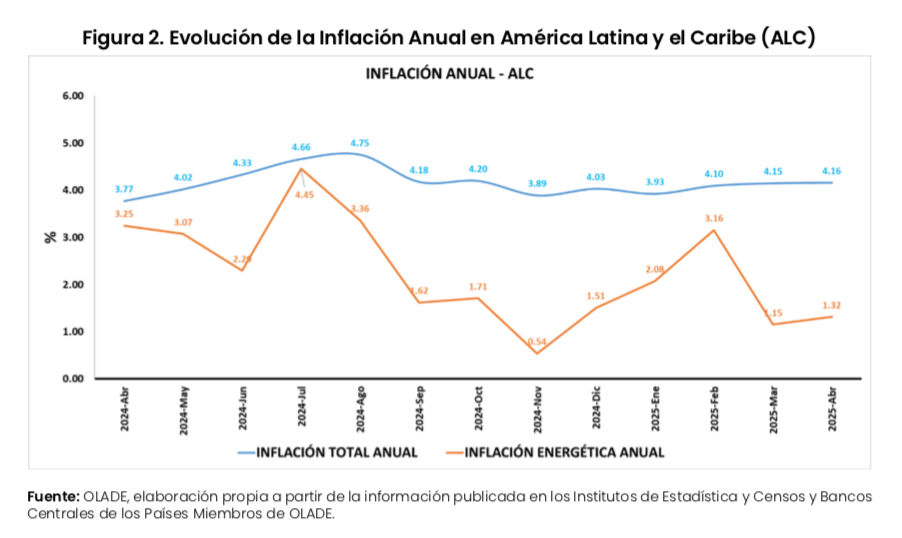
Annual energy inflation in Latin America and the Caribbean in April 2025 stood at 1.32%, lower than the April 2024 figure (3.25%), which is consistent with the annual decline in the international price of oil over these 12 months, which, according to OPEC, fell from US$ 89.19 per barrel in April 2024 to US$ 69.24 per barrel in April 2025. As for total inflation, it maintains the slight upward trend recorded over the past three months. See Figure 2
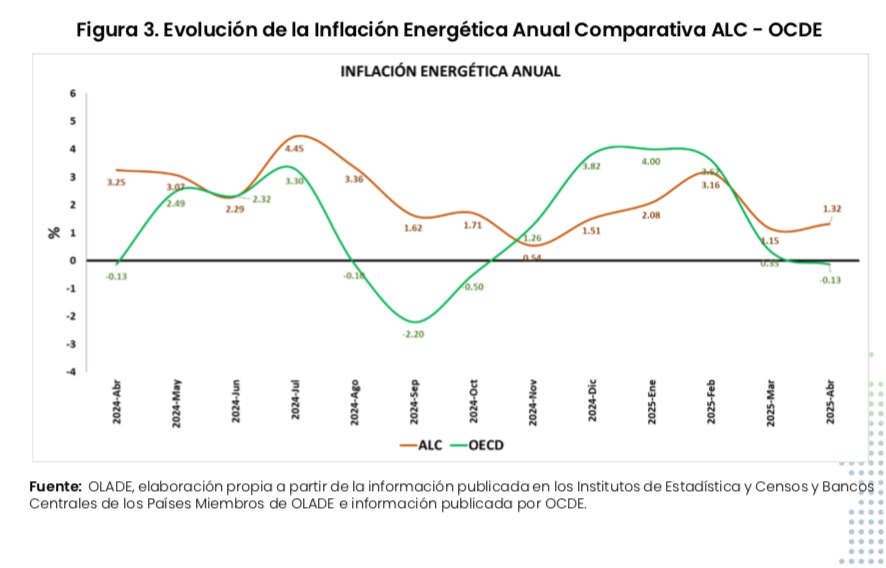
For the second consecutive month, annual energy inflation in the Latin America and Caribbean region is higher than in the OECD region, with 1.32% for LAC in April 2025 versus -0.13% for the OECD in the same month, after having remained below it between November 2024 and February 2025.
In the OECD region, from February 2025 through April of the same year, the annual energy inflation trend has been declining, as 26 of the 38 countries in this region recorded negative annual energy inflation in April 2025.
This presents the contrast between the evolution of monthly energy inflation in Latin America and the Caribbean (LAC) calculated by OLACDE and global energy prices, as estimated by the International Monetary Fund. Figure 4 shows the evolution of four price indices: crude oil, natural gas, coal, and LAC energy inflation. The analysis period covers January 2023 to April 2025, all indexed to a January 2023 base.
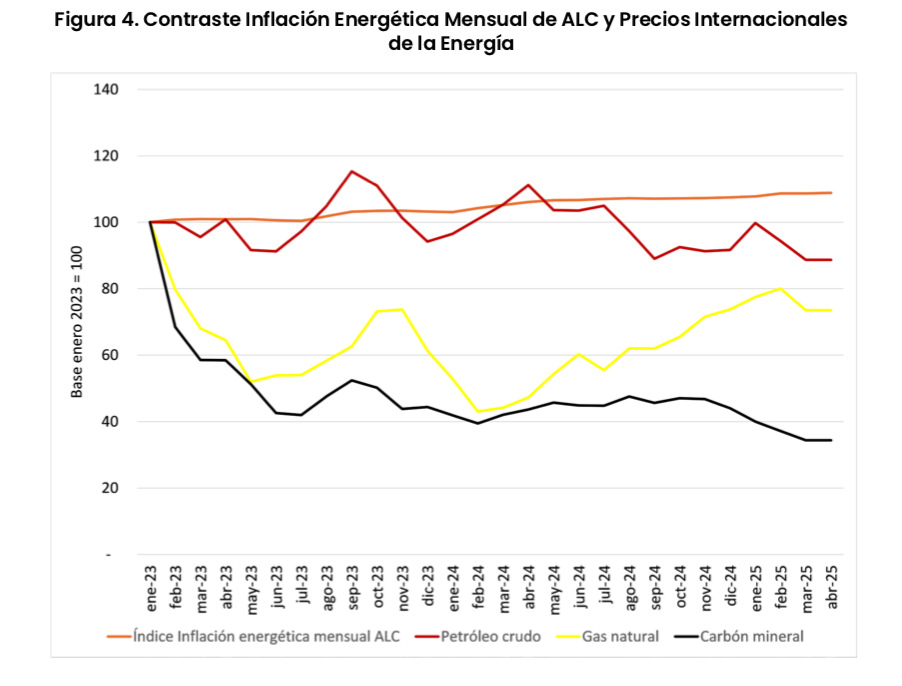
One of the main conclusions that can be drawn from the figure above is that international nominal prices for crude oil, natural gas, and coal all trended downward over the period analyzed. In fact, in April 2025, all three indices were below the value observed in January 2023. The LAC index, on the other hand, does not appear to follow this trend; in fact, the latest value for April 2025 is 8.8% higher than the January 2023 value.
This result suggests that there is room for LAC public energy policy to enable consumers to benefit from lower international energy prices, without discouraging investment in the sector.
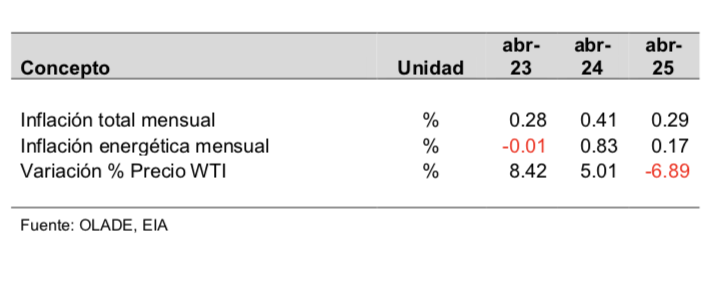
Finally, the following table presents inflation as of April of each year. This exercise is useful because it removes the seasonal component that time-series price data can present.