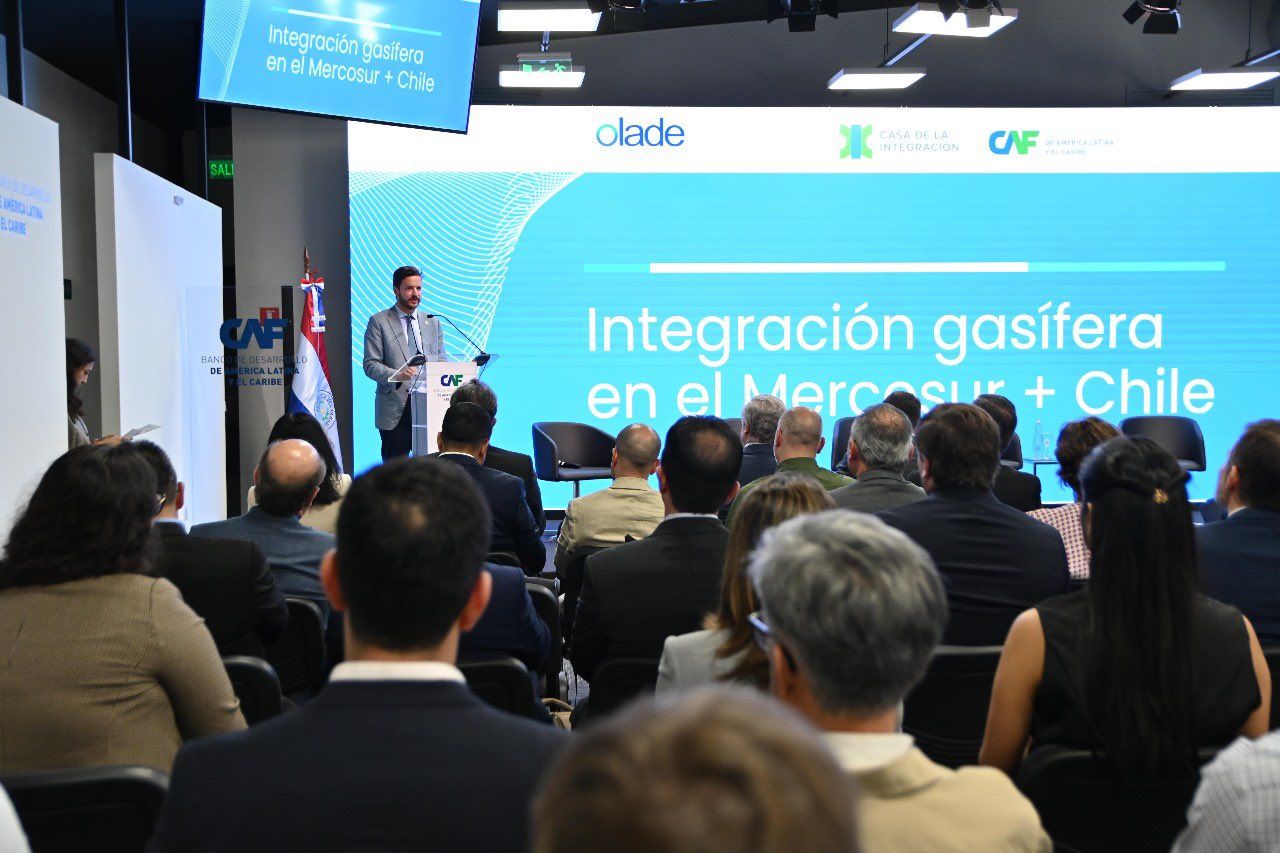
The Latin American and Caribbean Energy Organization (OLACDE) and CAF -development bank of Latin America and the Caribbean- organized a technical meeting in Asunción focused on the future of natural gas in the Mercosur countries and Chile.
The event marked the closing of the third phase of the Regional Gas Integration Project, which focused on characterizing the challenges of regulatory and normative convergence among the region’s countries, with a view to deepening exchanges in the short term, driving the development of new infrastructure, and advancing toward the construction of a regional gas market. The consolidated diagnosis of the situation and challenges facing the regional gas transport system was also presented.
The event, which included an opening session and two panel discussions, was preceded by various working sessions that fostered dialogue and consensus between the public and private sectors of the Mercosur countries and Chile. Among these sessions, the first Forum of Regulators stood out, with representatives from Foreign Ministries and Regulatory Agencies, as well as the second session of OLACDE’s Private Council within the framework of the project.
During the opening, Jorge Srur, CAF’s Southern Region Manager, noted that “it is a great pleasure to support this project, which shows how ideas turn into concrete actions. Today, by presenting the third stage of this technical cooperation, we confirm that natural gas must play a leading role in energy sustainability and the development of our region.” He added: “at CAF we have reaffirmed our strategic commitment to this sector, and we are pleased to see other international financial institutions returning to invest in these projects. We welcome the agenda this forum is driving and hope to accelerate progress to make up for lost time, always with the highest standards of technical quality and environmental care, because regional energy integration is key to our common future.”
Guido Maiulini, Head of Strategic Advisory at OLACDE, said that “the energy transitions in our region are diverse and are taking place in a context of accelerated technological change, extreme weather events, and geopolitical tensions. In this scenario, energy integration, in addition to being a matter of efficiency, is a true exercise in solidarity and collective security. We have the chance to reap shared returns if we stop thinking in terms of isolated projects and move toward regional energy systems that, in turn, allow us to take the leap to integrated markets.”
“In these sessions we have achieved tangible progress, and I am confident that we can continue deepening this process with the strong involvement of the countries, OLACDE’s technical support, and CAF’s financial backing. Our region needs to build agreements that, sooner rather than later, translate not only into technical, economic, and regulatory consensus, but also into new infrastructure to achieve energy matrices that are more affordable, safer, more competitive, and less polluting,” he concluded.
Meanwhile, Mauricio Bejarano, Deputy Minister of Mines and Energy of Paraguay, stated “Energy integration has gone from being a wish to a necessity, and this Project is essentially the preparation of the technical, regulatory, financial, and infrastructure studies that the Mercosur region plus Chile needs in order to integrate through natural gas. For our country, especially with the flagging of our bi-oceanic pipeline, this aligns perfectly with what we intend as a nation.”
Afterward, representatives from governments, energy sector companies, and international organizations shared their perspectives in the panels: “Gas Regulation for a Regional Market” and “Gas and Electricity in Southern Cone Energy Integration.”
Based on the findings of the study presented, the various dialogue sessions underscored the need to strengthen technical and operational coordination. To that end, participants urged aligning operational criteria based on recent export experiences.
In analyzing the integration experiences of the 1990s in the Southern Cone and the European Union, it was noted that trust and contractual security are essential elements. This requires developing multilateral treaties that strengthen private initiative.
The importance of maximizing the competitiveness of the entire value chain over the long term was also highlighted. This objective must balance legal certainty with each nation’s regulatory sovereignty in order to achieve harmonious and lasting integration.
Among the challenges identified are: ensuring long-term supply security, creating early warning and monitoring mechanisms for the regional gas system, and laying the groundwork for a multilateral agreement that drives regional integration.
Finally, it was proposed to chart a roadmap leading to the progressive formation of an integrated and efficient regional market.