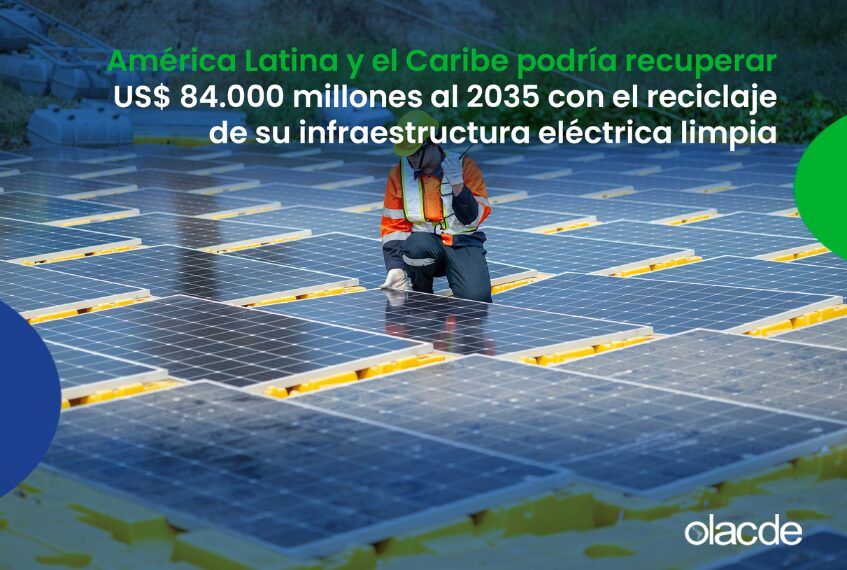
LAC Could Recover US$84 Billion by 2035 by Recycling Its Clean Electrical Infrastructure

The region’s shift toward renewable sources, which accounted for 67.4% of electricity generation in 2025, is opening up a new area of concern: managing the waste from its own infrastructure. Although the boom in solar and wind technology began only a decade ago and most equipment currently in operation has not yet reached the end of its useful life, premature failures and technological renewal are accelerating the disposal of panels, wind turbines, and batteries.

This scenario has led several countries to design plans, programs, and regulations for recycling reusable components. The goal is to mitigate environmental impacts throughout the life cycle of these technologies, preventing heavy metals, plastics, and corrosive or toxic substances from affecting soil, air, and water.

The Technical Note from the Latin American and Caribbean Energy Organization (OLACDE) explains that the generation of this waste represents a circular economy opportunity whose potentially recoverable economic value could reach US$209 billion by 2050 through material recycling, reuse, and recovery strategies. This perspective broadens the sector dialogue, adding the need to assess the economic potential of secondary resources rather than looking solely at the physical volume of waste.

The region currently has 150 million solar panels in operation and 16,000 wind turbines, which, combined with the rapid growth of batteries and solar and wind power, makes it possible to project the scale of accumulated material volumes toward mid-century:

• 81 million tons of total materials will be embedded in transition technologies.
• 36 million tons will be steel, equivalent to 63% of the region’s current annual production of that metal.
• 4 million tons will be copper, a volume close to 40% of the region’s annual production.
• 10 million tons will be aluminum, nearly triple Latin America and the Caribbean’s current annual production.

The study indicates that recovering these components would reduce the need for new extractive activities, lower emissions associated with mining, and strengthen the security of supply for resources considered critical worldwide.

Artificial intelligence in the circular economy

The technical note points out that artificial intelligence acts as a key enabler in managing these assets. Digital tools and predictive systems enable continuous monitoring of devices, which facilitates efficient maintenance scheduling, extends equipment lifespan, and automates their classification for refurbishment or recycling processes.

In the specific case of lithium batteries used in electric mobility, algorithms analyze operating history to determine when a module can be assigned to a second life in stationary storage applications. This alternative extends the device’s overall life cycle and delays the need for its final disposal.

An industrial opportunity for the region

OLACDE argues that the circular economy opens up an opportunity for the region’s industrial development. Recovering critical materials could reduce dependence on virgin raw materials, decrease strategic imports, create new regional value chains, generate specialized employment, and strengthen supply security for the energy sector of the future.

However, the document warns that developing this industry will require strengthening specific regulatory frameworks, extended producer responsibility schemes, and traceability and reverse logistics systems, since these capabilities are still incipient in most countries in the region.

The sustainability of the sector does not end with the installation of wind farms, solar plants, or batteries; it will depend on the region’s ability to efficiently transform technological waste into new productive resources.

Read the technical note at the following link: https://www.olacde.org/publicaciones/nota_tecnica_19/
Share this news

LAC Could Recover US$84 Billion by 2035 by Recycling Its Clean Electrical Infrastructure

Newsletter summary

The region’s shift toward renewable sources, which accounted for 67.4% of electricity generation in 2025, is opening up a new area of concern: managing the waste from its own infrastructure. Although the boom in solar and wind technology began only a decade ago and most equipment currently in operation has not yet reached the end […]

Knowledge and Training

We promote advanced technical training programs that facilitate the exchange of experiences, as well as the development of the human and institutional capacities needed to support the energy transformations in our region.

Our academic offering includes executive programs, postgraduate diplomas, master’s degrees, and innovative initiatives focused on topics such as energy transition, conventional energy, renewable energy, e-mobility, and regional integration.

OLACDE creates a regional network focused on energy knowledge that connects governments, young professionals, academics, and sector experts to drive collaborative solutions through technical cooperation and talent development to address future energy and climate challenges.

Technical cooperation and financing

We strengthen South-South and triangular cooperation ties as drivers to accelerate energy transitions in Latin America and the Caribbean. OLACDE brings together efforts among governments, multilateral organizations, academic institutions, and the private sector to mobilize financing, technical capacities, and innovative solutions tailored to our regional reality.

We promote strategic initiatives aimed at directing resources toward projects focused on decarbonization, conventional energy, renewable energy, and energy justice, with the objective of establishing a more efficient, inclusive, and sustainable regional cooperation architecture.

Regional Energy Community

We are building a regional energy community with a global outlook that seeks to position Latin America and the Caribbean as a key player on the international stage. OLACDE strengthens its representation in major multilateral forums related to energy, trade, and climate by fostering strategic alliances and promoting international cooperation.

Through events such as Energy Week, together with new spaces for international dialogue, we promote a collective voice that helps attract financial investment and create new opportunities for sustainable development across our region.

Energy Transition and Strategic Projects

We drive an energy transition based on principles of sustainability, energy security, and social inclusion. OLACDE supports countries in adopting new technologies related to energy efficiency, energy storage, green hydrogen, electromobility, and grid digitalization to accelerate the sector’s decarbonization process.

Our approach also includes promoting strategic projects that strengthen energy resilience at the regional level, contributing to emission reductions while consolidating a cleaner and more competitive energy infrastructure. Initiatives such as OEMLAC position our region as a leading reference in climate innovation and sustainable energy transition.

Energy information and data

We develop regional platforms dedicated to energy information, technical analysis, and strategic data systems that strengthen both public and private decision-making in the sector. OLACDE promotes the digital transformation of the sector through the use of artificial intelligence, georeferencing, and advanced tools for regional energy analysis.

The integration of systems such as SieLAC, together with new regional platforms, allows for the consolidation of reliable and up-to-date technical information, facilitating modern, interoperable, and evidence-based energy planning.

Regional Energy Integration

We promote cooperation in the regional energy sector, focused on collaboration, infrastructure development, and regulatory harmonization, with the objective of strengthening energy security in Latin America and the Caribbean. OLACDE coordinates projects related to electrical interconnection, gas integration, and regional energy planning, seeking to create efficient and sustainable partnerships.

Through cooperation with the governments of our 27 member countries, regional blocs, multilateral institutions, and both public and private stakeholders, we drive strategic initiatives that promote regulatory harmonization and new energy exchange mechanisms, in order to enhance national capacities and accelerate an integrated energy transition at the regional level.