Latin America and the Caribbean need more resilient, interconnected power grids to prevent blackouts

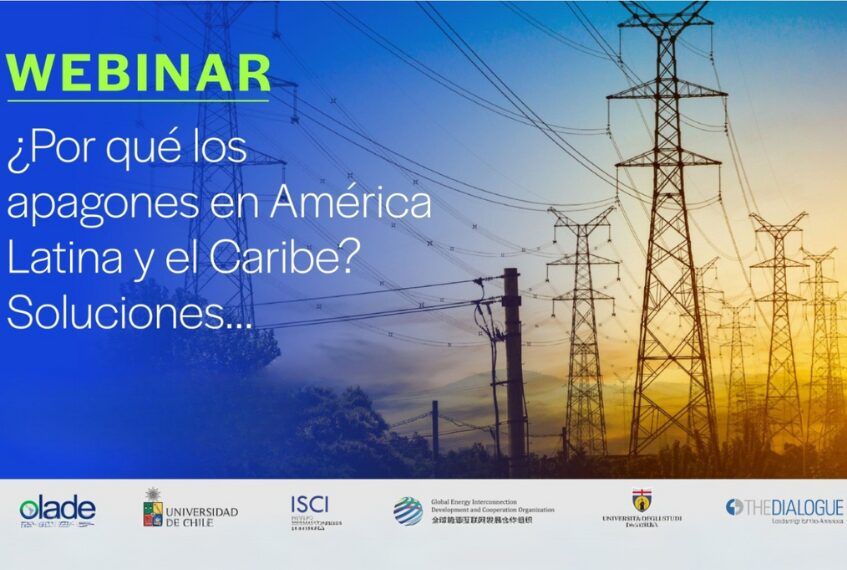
The Latin American and Caribbean Energy Organization (OLACDE) organized the webinar “Why the Blackouts in Latin America? Solutions…”, a high-level technical forum that brought together international experts to analyze the causes of recent power outages in the region and promote resilient, sustainable, and regionally integrated strategies.

The virtual event featured representatives from the Global Energy Interconnection Development and Cooperation Organization (GEIDCO), the University of Chile, the University of Genoa, the Inter-American Dialogue, and energy authorities from across the region. During the event, it became clear that blackouts in Latin America and the Caribbean are not isolated incidents, but rather the result of critical factors such as a lack of investment in transmission, climate vulnerability, outdated infrastructure, and lagging regulatory frameworks.

Andrés Rebolledo, OLACDE’s Executive Secretary, noted that the event aims to foster technical reflection and coordinated action: “We are living through a crucial moment between the transition to clean energy and an urgent energy security agenda. The region needs to exchange experiences and collectively build solutions.”

In his opening remarks, Fitzgerald Cantero, OLACDE’s Director of Studies, Projects, and Information, emphasized: “Blackouts should be understood not only as a technical problem, but as a structural challenge that affects quality of life, economic development, and the security of millions of people.”

Dr. Cheng, GEIDCO’s Executive Secretary, stressed that grid resilience is an urgent necessity, highlighting the importance of moving toward digital, smart, and regionally interconnected grids capable of responding to extreme events. GEIDCO shared simulations of recent blackouts in Chile, Argentina, Panama, and Cuba, identifying root causes and presenting concrete solutions.

Professor Rodrigo Moreno of the Institute of Complex Engineering Systems at the University of Chile emphasized that “There is no such thing as 100% reliable electricity supply. Failures are inevitable, and their impact can paralyze everything from transportation and communications to commerce and political stability.”

Daniele Mestriner, a researcher at the University of Genoa, shared the European and Italian experience in managing massive blackouts and restoring power systems, highlighting technological solutions such as HVDC links, regional coordination, and hybrid restart protocols. He noted that the Italian model, based on control centers, autonomous plants, and international cooperation, can serve as a reference for strengthening the resilience and modernization of power grids in Latin America and the Caribbean.

For his part, Alfonso Blanco of the Inter-American Dialogue warned of a growing gap between the expansion of electrification and available infrastructure: “Electrification is advancing faster than infrastructure. We need adaptive regulatory frameworks, in-depth planning, and greater investment in transmission to address climate change.”

The event is part of a series of OLACDE initiatives aimed at strengthening regional energy resilience.

Full webinar at the following link:

ESP: https://www.youtube.com/watch?v=xTvRQb0fbyk

ENG: https://www.youtube.com/watch?v=vA7Y0XZBQN0
 

Share this news

Latin America and the Caribbean need more resilient, interconnected power grids to prevent blackouts

Newsletter summary

The Latin American and Caribbean Energy Organization (OLACDE) organized the webinar “Why the Blackouts in Latin America? Solutions…”, a high-level technical forum that brought together international experts to analyze the causes of recent power outages in the region and promote resilient, sustainable, and regionally integrated strategies. The virtual event featured representatives from the Global Energy […]

Knowledge and Training

We promote advanced technical training programs that facilitate the exchange of experiences, as well as the development of the human and institutional capacities needed to support the energy transformations in our region.

Our academic offering includes executive programs, postgraduate diplomas, master’s degrees, and innovative initiatives focused on topics such as energy transition, conventional energy, renewable energy, e-mobility, and regional integration.

OLACDE creates a regional network focused on energy knowledge that connects governments, young professionals, academics, and sector experts to drive collaborative solutions through technical cooperation and talent development to address future energy and climate challenges.

Technical cooperation and financing

We strengthen South-South and triangular cooperation ties as drivers to accelerate energy transitions in Latin America and the Caribbean. OLACDE brings together efforts among governments, multilateral organizations, academic institutions, and the private sector to mobilize financing, technical capacities, and innovative solutions tailored to our regional reality.

We promote strategic initiatives aimed at directing resources toward projects focused on decarbonization, conventional energy, renewable energy, and energy justice, with the objective of establishing a more efficient, inclusive, and sustainable regional cooperation architecture.

Regional Energy Community

We are building a regional energy community with a global outlook that seeks to position Latin America and the Caribbean as a key player on the international stage. OLACDE strengthens its representation in major multilateral forums related to energy, trade, and climate by fostering strategic alliances and promoting international cooperation.

Through events such as Energy Week, together with new spaces for international dialogue, we promote a collective voice that helps attract financial investment and create new opportunities for sustainable development across our region.

Energy Transition and Strategic Projects

We drive an energy transition based on principles of sustainability, energy security, and social inclusion. OLACDE supports countries in adopting new technologies related to energy efficiency, energy storage, green hydrogen, electromobility, and grid digitalization to accelerate the sector’s decarbonization process.

Our approach also includes promoting strategic projects that strengthen energy resilience at the regional level, contributing to emission reductions while consolidating a cleaner and more competitive energy infrastructure. Initiatives such as OEMLAC position our region as a leading reference in climate innovation and sustainable energy transition.

Energy information and data

We develop regional platforms dedicated to energy information, technical analysis, and strategic data systems that strengthen both public and private decision-making in the sector. OLACDE promotes the digital transformation of the sector through the use of artificial intelligence, georeferencing, and advanced tools for regional energy analysis.

The integration of systems such as SieLAC, together with new regional platforms, allows for the consolidation of reliable and up-to-date technical information, facilitating modern, interoperable, and evidence-based energy planning.

Regional Energy Integration

We promote cooperation in the regional energy sector, focused on collaboration, infrastructure development, and regulatory harmonization, with the objective of strengthening energy security in Latin America and the Caribbean. OLACDE coordinates projects related to electrical interconnection, gas integration, and regional energy planning, seeking to create efficient and sustainable partnerships.

Through cooperation with the governments of our 27 member countries, regional blocs, multilateral institutions, and both public and private stakeholders, we drive strategic initiatives that promote regulatory harmonization and new energy exchange mechanisms, in order to enhance national capacities and accelerate an integrated energy transition at the regional level.