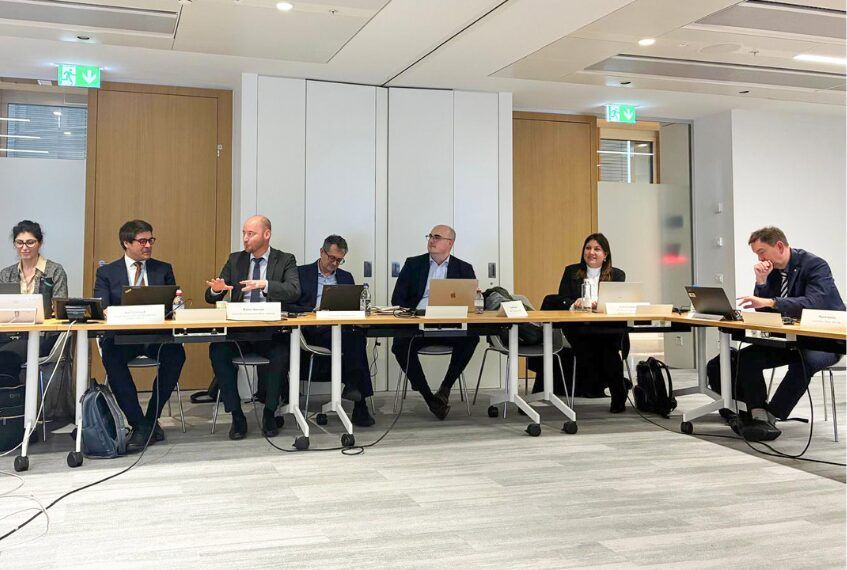
The Latin American and Caribbean Energy Organization (OLACDE) took part in the High-Level Dialogue on Sustainable Development Goal 7 (SDG 7), held in Geneva and organized by the United Nations Department of Economic and Social Affairs (UN-DESA), as part of the preparatory process for the 2026 High-Level Political Forum (HLPF), where global progress on sustainable energy access will be assessed.
Representing OLACDE, the Director of Integration, Access and Energy Security, Gloria Alvarenga, took part in the dialogue’s working session, where she highlighted that, for Latin America and the Caribbean, SDG 7 is not solely an energy target but a fundamental pillar for economic development, social equity and the resilience of the region’s countries.
During her remarks, she noted that Latin America and the Caribbean have one of the cleanest electricity matrices in the world, with 67% renewable generation and electricity access exceeding 97%. However, she warned that significant gaps still persist in supply reliability, energy affordability and access to modern energy services, especially in rural and indigenous communities and vulnerable populations.
In this context, she stressed that the region’s current challenge is no longer solely expanding electricity coverage, but ensuring that energy is affordable, reliable and equitable. She also emphasized the need to accelerate investment to close the structural gaps limiting the integration of renewable energy, recalling that the region will require approximately 1,000 GW of new installed capacity and around 1.5 trillion dollars in investment to meet decarbonization pathways and move toward sustainable energy systems.
The Director also highlighted that regional energy integration and South-South cooperation will be key tools for reducing costs, strengthening the resilience of energy systems and moving toward transformative solutions that accelerate progress on SDG 7 in the region.
OLACDE’s participation in this dialogue is part of the Organization’s commitment to strengthening universal energy access, regional energy security and the transition toward more sustainable energy systems, within the framework of the 2030 Agenda and amid an international context marked by new climate, economic and geopolitical challenges.