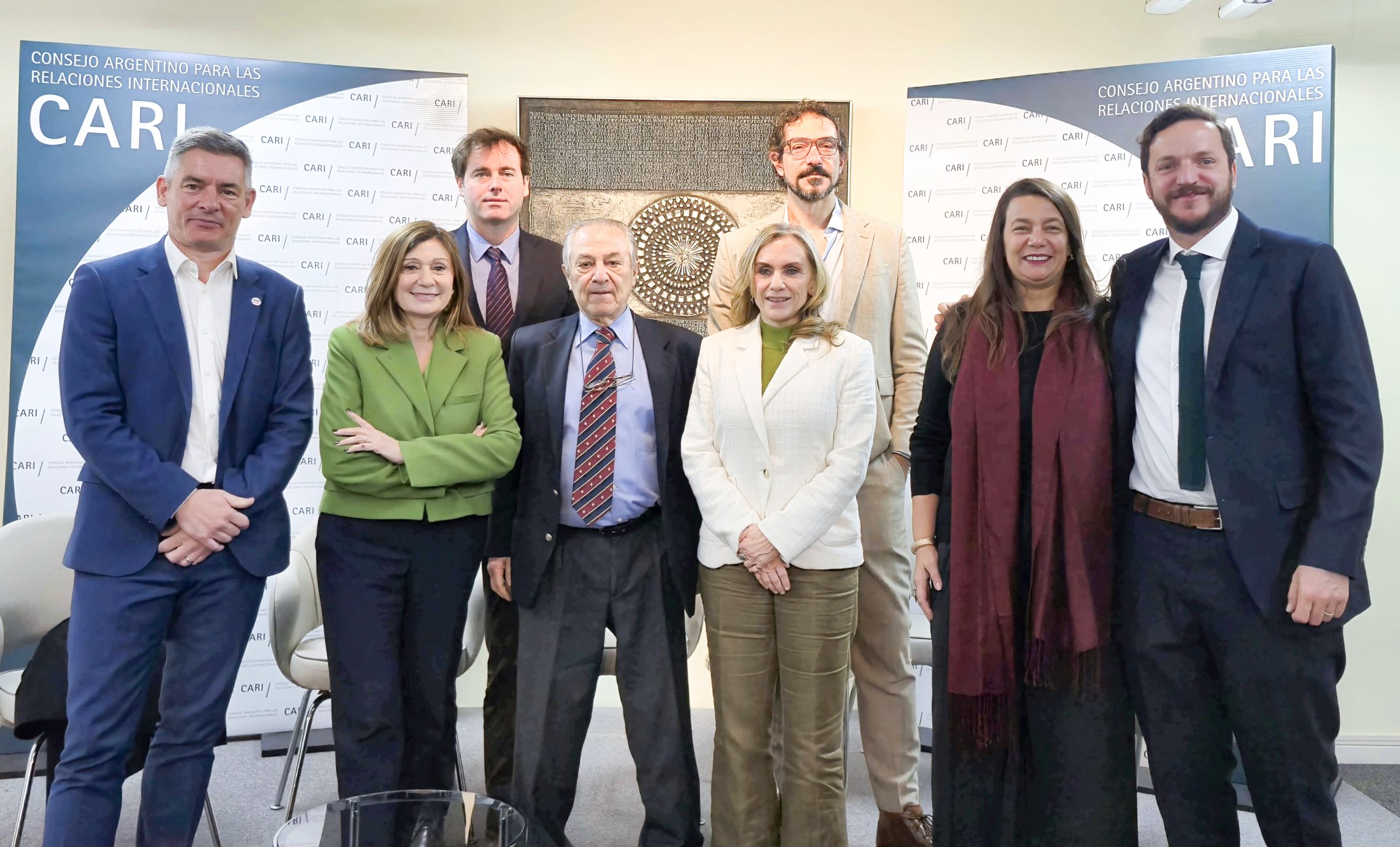
OLACDE and CARI launched the series “Latin America and the New Energy Geopolitics” in Buenos Aires, with the first session focusing on opportunities for regional energy integration. Public- and private-sector leaders, regional organizations and energy experts examined the Southern Cone’s evolving energy landscape, the challenges of expanding cross-border energy trade, and the potential for stronger regional cooperation.
The Latin American and Caribbean Energy Organization (OLACDE) and the Argentine Council for International Relations (CARI) launched the series “Latin America and the New Energy Geopolitics: Transitions, Integration and Strategic Positioning” in Buenos Aires. The joint initiative seeks to bring energy to the forefront of the international relations agenda and explore how Latin America and the Caribbean can strengthen their strategic position as the global energy system undergoes profound transformation.
The first session, “Opportunities for Regional Energy Integration,” brought together representatives from the public and private sectors, regional organizations and energy experts. Discussions focused on a region endowed with diverse and complementary energy resources, yet still facing the challenge of turning these advantages into deeper integration, sustainable development and a stronger position in the global energy landscape.
Opening remarks were delivered by Guido Maiulini, Head of Strategic Advisory at OLACDE, and Francisco de Santibañes, President of CARI.
Maiulini stated: “Geopolitics is now one of the key frameworks shaping not only our countries’ international relations, but also the development and expansion of their energy networks. It is therefore no coincidence that we are launching this series with a discussion on integration. Beyond its political value, regional integration offers significant opportunities to improve efficiency and generate greater prosperity, provided we are able to build effective regional policies.”
For his part, De Santibañes said: “We see a major opportunity for regional integration. Regardless of political relations between governments, technical teams and specialists continue to work very effectively on integration projects. I believe that the economic incentives for deeper energy integration can also contribute to greater political integration and stronger regional dialogue.”
Esteban Kiper, Natural Gas Expert at OLACDE, then presented the main findings of the MERCOSUR and Chile Regional Gas Integration Project, led by OLACDE and CAF.
The presentation examined the transformation of the Southern Cone’s gas landscape, driven by the expansion of Vaca Muerta and Brazil’s pre-salt production, declining gas output in Bolivia, and the growing penetration of renewable energy and LNG. Against this backdrop, Kiper presented the routes assessed to make better use of existing infrastructure and develop new connections that could expand cross-border gas flows throughout the region.
He noted that one of the main challenges is to expand transportation capacity from the Neuquén Basin and establish the conditions required to supply neighboring markets reliably and competitively. “Today, regional integration must deliver efficiency and competitiveness, as well as security of supply. If we can overcome the technical and regulatory barriers, the potential is significant: regional gas trade could reach between 60 and 70 million cubic meters per day, representing between USD 4 billion and USD 5 billion annually,” he explained.
The event continued with a panel discussion on regional energy integration opportunities, moderated by Ignacio Argonz, OLACDE Consultant, with the participation of Gabriela Aguilar, President of the Argentina-Texas Chamber of Commerce (ATCC); Luciano Rojas, Commercial Director of Total Austral, a TotalEnergies subsidiary in Argentina; and Griselda Lambertini, Second Member of the Board of Directors of Argentina’s National Gas and Electricity Regulatory Authority (ENRGE).
Panelists agreed that the region is entering a new window of opportunity to deepen energy trade, supported by abundant resources, regulatory progress in recent years and infrastructure that has already enabled the resumption of gas flows between Argentina and neighboring markets. They also emphasized that the next step will require moving beyond seasonal or interruptible exchanges toward long-term agreements capable of supporting new infrastructure investment while providing competitive and predictable conditions for producers and consumers.
Lambertini highlighted the regulatory changes implemented in Argentina to facilitate exports and promote greater alignment between domestic and international market conditions. She noted that deeper coordination among countries will now be essential. “Liberalizing the domestic regulatory framework is not enough. We need to continue working with other countries on regulatory and operational harmonization in order to move toward strategic agreements that can provide a solid foundation for regional integration,” she said.
Rojas emphasized that the region has already made tangible progress, including recent exports to Chile, Brazil and Uruguay. However, he noted that taking regional energy trade to the next level will require additional infrastructure and conditions that enable long-term commercial commitments. “The main objective is to secure contracts that provide predictability, enable infrastructure development and establish stable supply relationships. To achieve this, we must first build trust and demonstrate that we see these markets as long-term destinations,” he said.
Aguilar focused on the opportunities that the changing international landscape creates for Argentine gas, both within regional markets and through LNG exports. She noted that the availability of Vaca Muerta resources now coincides with growing global demand for energy security and supply diversification, as well as a more favorable environment for long-term investment. “Argentina has a major opportunity: it has the resources and the conditions to supply regional markets through pipelines, while also reaching global markets through LNG. The challenge is to seize this opportunity and become increasingly competitive,” she said.
The discussion also highlighted the importance of addressing technical and operational issues that, while sometimes perceived as secondary, can directly affect project viability. These include gas quality standards, tariff structures, operating schedules and cross-border transit conditions. Participants stressed the importance of sustained dialogue among governments, regulators, companies and regional organizations to turn the region’s resource potential into concrete energy integration projects.
Closing remarks were delivered by Raúl Parisi, Director of CARI’s Energy Affairs Committee, who emphasized the importance of approaching energy integration from both a historical and strategic perspective. He noted that progress depends not only on the availability of resources and infrastructure, but also on the political, economic and regulatory decisions that shape their development.
“Argentina has sufficient resources to supply the region and the conditions to do so competitively. The challenge is to create the conditions needed to transform that potential into energy integration on a much larger scale,” he said.
The series will continue with further sessions aimed at deepening the debate on Latin America’s role in the new global energy geopolitics and on Argentina’s capacity to transform its energy resources into economic development and stronger international positioning.