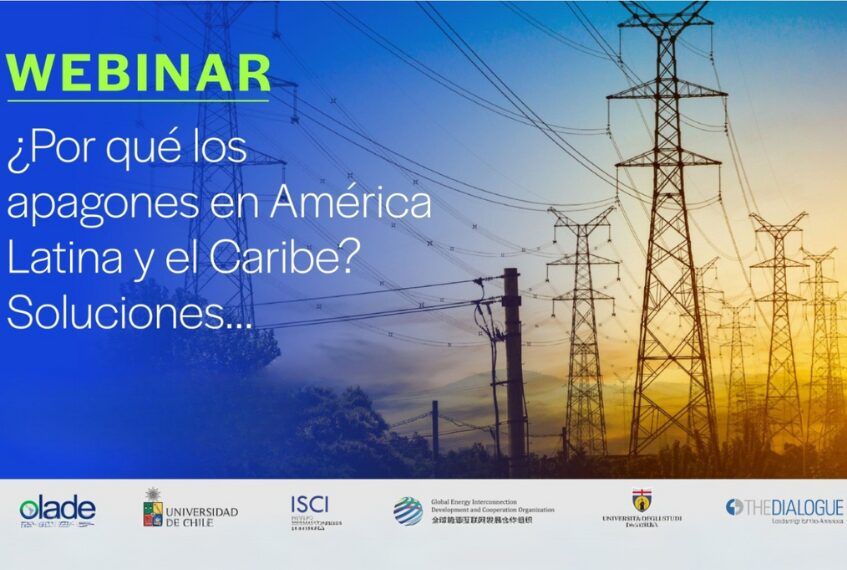
The Latin American and Caribbean Energy Organization (OLACDE) organized the webinar “Why the Blackouts in Latin America? Solutions…”, a high-level technical forum that brought together international experts to analyze the causes of recent power outages in the region and promote resilient, sustainable, and regionally integrated strategies.
The virtual event featured representatives from the Global Energy Interconnection Development and Cooperation Organization (GEIDCO), the University of Chile, the University of Genoa, the Inter-American Dialogue, and energy authorities from across the region. During the event, it became clear that blackouts in Latin America and the Caribbean are not isolated incidents, but rather the result of critical factors such as a lack of investment in transmission, climate vulnerability, outdated infrastructure, and lagging regulatory frameworks.
Andrés Rebolledo, OLACDE’s Executive Secretary, noted that the event aims to foster technical reflection and coordinated action: “We are living through a crucial moment between the transition to clean energy and an urgent energy security agenda. The region needs to exchange experiences and collectively build solutions.”
In his opening remarks, Fitzgerald Cantero, OLACDE’s Director of Studies, Projects, and Information, emphasized: “Blackouts should be understood not only as a technical problem, but as a structural challenge that affects quality of life, economic development, and the security of millions of people.”
Dr. Cheng, GEIDCO’s Executive Secretary, stressed that grid resilience is an urgent necessity, highlighting the importance of moving toward digital, smart, and regionally interconnected grids capable of responding to extreme events. GEIDCO shared simulations of recent blackouts in Chile, Argentina, Panama, and Cuba, identifying root causes and presenting concrete solutions.
Professor Rodrigo Moreno of the Institute of Complex Engineering Systems at the University of Chile emphasized that “There is no such thing as 100% reliable electricity supply. Failures are inevitable, and their impact can paralyze everything from transportation and communications to commerce and political stability.”
Daniele Mestriner, a researcher at the University of Genoa, shared the European and Italian experience in managing massive blackouts and restoring power systems, highlighting technological solutions such as HVDC links, regional coordination, and hybrid restart protocols. He noted that the Italian model, based on control centers, autonomous plants, and international cooperation, can serve as a reference for strengthening the resilience and modernization of power grids in Latin America and the Caribbean.
For his part, Alfonso Blanco of the Inter-American Dialogue warned of a growing gap between the expansion of electrification and available infrastructure: “Electrification is advancing faster than infrastructure. We need adaptive regulatory frameworks, in-depth planning, and greater investment in transmission to address climate change.”
The event is part of a series of OLACDE initiatives aimed at strengthening regional energy resilience.
Full webinar at the following link:
ESP: https://www.youtube.com/watch?v=xTvRQb0fbyk
ENG: https://www.youtube.com/watch?v=vA7Y0XZBQN0