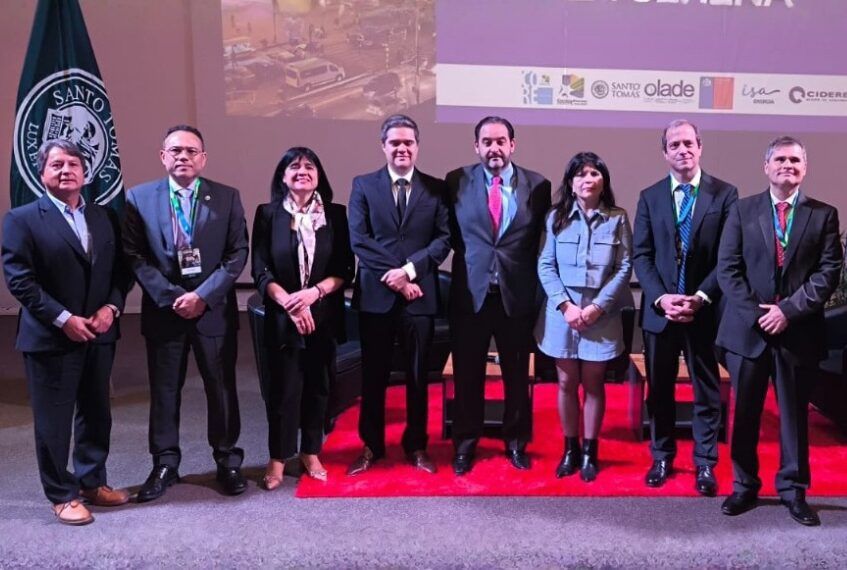
La Serena hosted the international academic gathering “Connecting Minds, Energizing the Future,” an initiative that resulted from the joint work of OLACDE, the Ministry of Energy of Chile, Santo Tomás institutions, ISA Energía, CIDERE Coquimbo, and the Regional Government of Coquimbo. The gathering focused on the role of higher and technical-professional education in promoting innovation, technology transfer, and human capital development for an inclusive energy transition. It brought together academic leaders, experts, authorities, and representatives of the energy sector from Latin America and the Caribbean to discuss the challenges and opportunities of the energy transition.
The event, held at Universidad Santo Tomás, featured the participation of national and regional authorities, academics, and specialists. Chile’s Undersecretary of Energy, Luis Felipe Ramos, together with the rector of Universidad Santo Tomás, Pablo Pinto, highlighted the value of bringing an international event linking academia with the energy sector to La Serena for the first time.
Rector Pablo Pinto noted: “We are pleased that OLACDE, for the first time, is coming to a region of a host country, in this case La Serena, bringing together academic, business, public, and private sector stakeholders in a business and academic gathering. To bring this event to the region, we met with OLACDE, ISA Energía, and the Regional Government, in order to showcase how attractive it is to invest in the energy sector and, from there, generate development opportunities through an international event of this kind.”
Luis Llano, General Manager of ISA Energía, underscored the contribution of the various stakeholders: “To the extent that we unite goodwill and experience, we can guarantee an energy system that delivers security and confidence to the entire country. Sharing the knowledge that each of the stakeholders has at the Latin American level is essential for moving toward regional energy integration, a shared challenge that requires addressing common obstacles across all countries.”
For his part, Undersecretary of Energy Luis Felipe Ramos stated: “As the Ministry and host country of this important Latin American gathering, we are pleased to kick off this Energy Week in La Serena, a demonstration of the effort to decentralize the energy dialogue. We are delighted to see how stakeholders from academia and industry from different countries in the region come together to create knowledge and coordination. We know the energy sector will require numerous new jobs focused on renewable energy, sustainability, and data intelligence. That is why strengthening capacity building and professional specialization is crucial for our region to move forward in an aligned way toward the energy transition.”
OLACDE’s Executive Secretary, Andrés Rebolledo Smitmans, noted: “This gathering represents a step toward consolidating a regional energy agenda that combines education, innovation, and sustainability. Bringing together academic leaders, authorities, and sector experts will make it possible to build strategic alliances and strengthen the capacities that Latin America and the Caribbean need to accelerate a just, inclusive energy transition aligned with our climate goals.”
As part of the event, OLACDE and the Santo Tomás Technical Training Center and Professional Institute formalized a strategic alliance to promote technical and academic cooperation on sustainability, climate change, and a just energy transition. The agreement was signed by Andrés Rebolledo and Juan Pablo Guzmán, regional rector of Santo Tomás, and includes joint programs, exchanges of specialists, and projects aimed at strengthening regional energy integration.
The event’s agenda included panels on women and STEM, energy education, public policy and academia, climate change, innovation with artificial intelligence and new technologies, as well as a roundtable on research applied to regional integration. Representatives from universities in Chile, Argentina, Paraguay, the Dominican Republic, Uruguay, Ecuador, and Brazil took part, along with leaders from the energy sector and regional organizations.
The event concluded with a commitment to strengthen ties between academia, governments, and the private sector to advance toward a just, inclusive, and sustainable energy transition in Latin America and the Caribbean.