Bolivia has begun a new phase in its energy strategy with the launch of the Useful Energy Balance (BEU). This project seeks not only to quantify national consumption, but also to assess how much energy is actually put to use by households, industries, businesses, and transportation. The initiative is backed by the Ministry of Hydrocarbons and Energy, the Latin American Energy Organization (OLADE), the European Union’s Euroclima program, and the Spanish Agency for International Development Cooperation (AECID).
Unlike a traditional balance — which only measures overall supply and consumption — the BEU analyzes what proportion of energy is converted into final services such as lighting, heat, refrigeration, or mobility. This approach marks a milestone in the country’s planning: it is not enough to know how much is consumed; how efficiently it is used also matters. By revealing losses and technological gaps, the information gathered will provide the basis for designing public policies on energy efficiency, economic diversification, emissions reduction, and energy security.
The BEU will make it possible to precisely identify the sectors with the greatest potential for optimization, facilitating the prioritization of investments and the adoption of new technologies. The project also incorporates criteria of sustainability, territorial equity, and gender perspective to fairly reflect the different conditions of energy access and use across Bolivian territory.
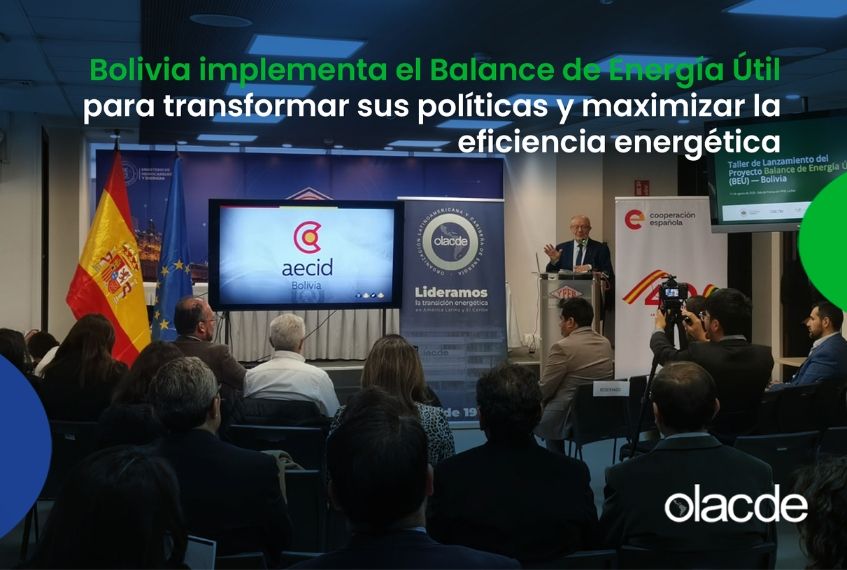
The inaugural workshop was held at the facilities of Yacimientos Petrolíferos Fiscales Bolivianos (YPFB) in La Paz. It was attended by Jorge Luis Gumucio, Vice Minister of Energy Planning and Development; Andrés Rebolledo, Executive Secretary of OLADE; as well as representatives from the public and private sectors, academia, and cooperation agencies. During the session, the methodology, implementation timeline, and information requirements for the study were defined.
With the development of the Useful Energy Balance, Bolivia is moving firmly toward a more competitive and sustainable energy system, ensuring that data on actual efficiency guides the country’s strategic decisions and investments.