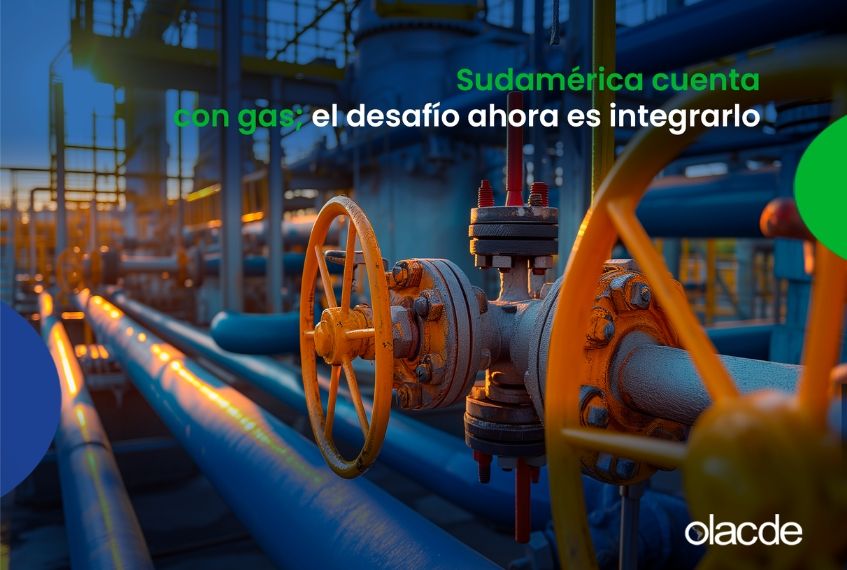
South America Has the Gas; the Challenge Now Is Integrating It

South America is at a crucial stage in its energy evolution. After years of concern over the availability of natural gas, the situation has changed dramatically. Today, the main challenge lies in building an integrated regional market that maximizes available resources, strengthens energy security, and turns energy into a driver of competitiveness and development for Latin America and the Caribbean.

This was the core message delivered by Guido Maiulini, Head of Strategic Advisory at the Latin American and Caribbean Energy Organization (OLACDE), during the webinar Toward a Regional Natural Gas Market, organized by the Mercado Electrónico de Gas (MEGSA). In his presentation, he detailed the key findings of the gas integration study that OLACDE is conducting in collaboration with CAF–Development Bank of Latin America and the Caribbean, research that redefines the possibilities for energy cooperation among MERCOSUR countries and Chile.

“The real challenge is no longer gas availability, but building a regional market,” Maiulini emphasized in summarizing the new energy reality facing South America.

The analysis conducted by OLACDE highlights that the region currently has unprecedented conditions for advancing toward deeper energy integration. Vaca Muerta’s resources could meet regional demand well beyond 2050, while Brazilian production is expected to triple by 2040 thanks to the development of the Pré-sal fields. At the same time, the gradual decline in Bolivian production is reshaping supply flows and creating an opportunity to reorganize the regional market on new cooperative foundations.

An economic opportunity for the entire region

The study’s projections indicate that greater integration could significantly increase energy trade among nations. According to OLACDE, a fully integrated regional market could move between 60 and 70 million cubic meters of natural gas per day, generate between USD 4 billion and USD 5 billion annually in trade, and displace approximately USD 2.4 billion a year in fuel imports, reducing external dependence and strengthening regional energy resilience.

For the organization, these findings show that energy integration is no longer just a technical goal; it has become a strategic policy aimed at promoting economic growth, improving industrial competitiveness, and increasing supply security.

Integration for more resilient development

OLACDE stresses that integrating countries’ energy systems is essential to reducing their vulnerability to international crises, supply disruptions, and instability in global energy markets.

As part of this strategy, OLACDE is working with MERCOSUR’s Working Subgroup No. 9 on a convergent regulatory agenda aimed at harmonizing technical standards, contracts, tariffs, crisis management mechanisms, and the exchange of energy information among member states.

Wrapping up his presentation, Maiulini stated that the true value of energy integration goes far beyond gas trade alone. “Today, energy has the potential to be one of the fundamental pillars for addressing Latin America’s long-standing development challenges,” he said, noting that a more cohesive regional market will help improve productivity, attract new investment, expand economic opportunities, and thereby raise the quality of life for millions across Latin America.

Through this proposal, OLACDE reaffirms its commitment to driving energy integration based on regional cooperation, supply security, and more efficient markets capable of turning South America’s energy resources into pillars of sustainable development and shared prosperity.
Share this news

South America Has the Gas; the Challenge Now Is Integrating It

Newsletter summary

South America is at a crucial stage in its energy evolution. After years of concern over the availability of natural gas, the situation has changed dramatically. Today, the main challenge lies in building an integrated regional market that maximizes available resources, strengthens energy security, and turns energy into a driver of competitiveness and development for […]

Knowledge and Training

We promote advanced technical training programs that facilitate the exchange of experiences, as well as the development of the human and institutional capacities needed to support the energy transformations in our region.

Our academic offering includes executive programs, postgraduate diplomas, master’s degrees, and innovative initiatives focused on topics such as energy transition, conventional energy, renewable energy, e-mobility, and regional integration.

OLACDE creates a regional network focused on energy knowledge that connects governments, young professionals, academics, and sector experts to drive collaborative solutions through technical cooperation and talent development to address future energy and climate challenges.

Technical cooperation and financing

We strengthen South-South and triangular cooperation ties as drivers to accelerate energy transitions in Latin America and the Caribbean. OLACDE brings together efforts among governments, multilateral organizations, academic institutions, and the private sector to mobilize financing, technical capacities, and innovative solutions tailored to our regional reality.

We promote strategic initiatives aimed at directing resources toward projects focused on decarbonization, conventional energy, renewable energy, and energy justice, with the objective of establishing a more efficient, inclusive, and sustainable regional cooperation architecture.

Regional Energy Community

We are building a regional energy community with a global outlook that seeks to position Latin America and the Caribbean as a key player on the international stage. OLACDE strengthens its representation in major multilateral forums related to energy, trade, and climate by fostering strategic alliances and promoting international cooperation.

Through events such as Energy Week, together with new spaces for international dialogue, we promote a collective voice that helps attract financial investment and create new opportunities for sustainable development across our region.

Energy Transition and Strategic Projects

We drive an energy transition based on principles of sustainability, energy security, and social inclusion. OLACDE supports countries in adopting new technologies related to energy efficiency, energy storage, green hydrogen, electromobility, and grid digitalization to accelerate the sector’s decarbonization process.

Our approach also includes promoting strategic projects that strengthen energy resilience at the regional level, contributing to emission reductions while consolidating a cleaner and more competitive energy infrastructure. Initiatives such as OEMLAC position our region as a leading reference in climate innovation and sustainable energy transition.

Energy information and data

We develop regional platforms dedicated to energy information, technical analysis, and strategic data systems that strengthen both public and private decision-making in the sector. OLACDE promotes the digital transformation of the sector through the use of artificial intelligence, georeferencing, and advanced tools for regional energy analysis.

The integration of systems such as SieLAC, together with new regional platforms, allows for the consolidation of reliable and up-to-date technical information, facilitating modern, interoperable, and evidence-based energy planning.

Regional Energy Integration

We promote cooperation in the regional energy sector, focused on collaboration, infrastructure development, and regulatory harmonization, with the objective of strengthening energy security in Latin America and the Caribbean. OLACDE coordinates projects related to electrical interconnection, gas integration, and regional energy planning, seeking to create efficient and sustainable partnerships.

Through cooperation with the governments of our 27 member countries, regional blocs, multilateral institutions, and both public and private stakeholders, we drive strategic initiatives that promote regulatory harmonization and new energy exchange mechanisms, in order to enhance national capacities and accelerate an integrated energy transition at the regional level.