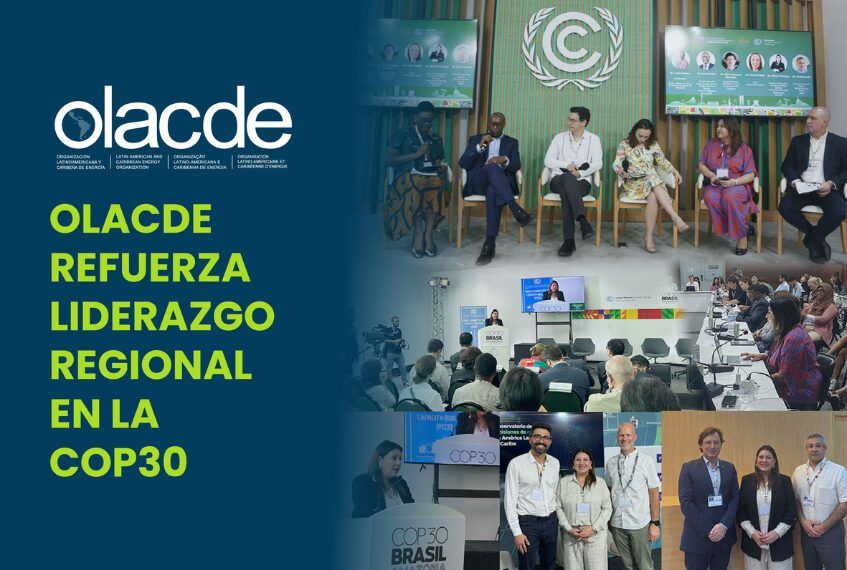
The Latin American and Caribbean Energy Organization (OLACDE) had a prominent presence at COP30, a summit considered historic for Latin America and the Caribbean as it was held for the first time in the Brazilian Amazon, at a decisive moment for accelerating global climate action.
In this setting, OLACDE reinforced the region’s strategic energy role, with Gloria Alvarenga, Director of Integration, Access and Energy Security, taking part in multiple high-level forums. Throughout her agenda at the conference, Alvarenga represented OLACDE’s 27 member countries before ministers, multilateral organizations, development finance institutions, and global energy sector stakeholders, highlighting the relevance of the Latin American and Caribbean bloc as one of the regions with the greatest renewable energy potential in the world, and with a strategic role in meeting international climate commitments.
At the event “Energy Interconnection: Promoting Global Emissions Reduction and Collaborative Development,” organized by GEIDCO together with Brazil’s Ministry of Mines and Energy, the UNFCCC, and the UNDP, Alvarenga advocated for regional energy interconnection as an essential tool for strengthening climate resilience and accelerating decarbonization. She noted that Latin America and the Caribbean have one of the cleanest electricity generation profiles on the planet and can become a driving axis of the transition toward safer, more efficient, low-emission electricity systems. “Energy integration is essential for reducing emissions and fully harnessing our region’s renewable potential,” she stressed.
During the High-Level Dialogue “EU-LAC High Level Dialogue on Energy Transition,” Gloria Alvarenga emphasized that the partnership between the European Union and OLACDE marks the shift “from intention to action,” recognizing Latin America and the Caribbean as a key region for the global energy transformation. She highlighted the regional electricity interconnection study that OLACDE is advancing with support from EUROCLIMA and GIZ, as well as the EU’s incorporation as an observer member of OLACDE, as concrete examples of structural cooperation aimed at building clean, equitable value chains, where energy is understood as a global public good and a driver of development with social justice. For OLACDE, this joint agenda with the European Union reflects the recognition of Latin America and the Caribbean as a key region in the global energy transformation.
At the forum “Strengthening Capacity Building for the Energy Transition,” she noted that capacity building is a decisive factor for the region to consolidate its leadership in the global energy transition. She presented the CAPEVLAC platform, created by OLACDE, which has trained more than 30,000 professionals across its 27 member countries, democratizing access to energy knowledge and driving regional planning. “Closing technical training gaps and strengthening institutions is essential for advancing toward a just and inclusive transition. Regional cooperation turns potential into concrete results,” she stated.
Throughout her remarks at the event “Novel Approaches to Transition Away from Fossil Fuels (TAFF), from ‘What’ to ‘How'” on new strategies for moving away from fossil fuels, Gloria Alvarenga highlighted that 20 OLACDE member countries adopted the Ministerial Declaration “No New Coal-Fired Power Plants in Latin America and the Caribbean” in 2024, an unprecedented regional commitment to accelerate the phase-out of coal while safeguarding energy security. She recalled the case of Chile as an emblematic example, where coal’s share of electricity generation fell from 40% to 15% in just four years thanks to a transparent market and the rapid adoption of renewable energy. She stressed that the transition must be just and people-centered, which is why OLACDE is promoting the Ministerial Decision on Energy and Labor to support productive reconversion, build capacity, and protect the livelihoods of communities historically dependent on coal.
Alvarenga also took part in the event “Building a Common Framework for Methane Emissions in Latin America and the Caribbean,” where she stressed that methane mitigation must be urgently integrated into the regional energy agenda. She stated that the transition does not mean an immediate abandonment of hydrocarbons, but rather the transformation of their production through stricter standards, innovative technologies, and transparent management. She highlighted the regional roadmap for low-emission natural gas standards and the creation of the Community of Practice on Methane (COEMLAC) as examples of OLACDE’s technical and political commitment.
In parallel, the organization held a strategic meeting with Portugal’s National Energy Agency (ADENE) to advance implementation of the Memorandum of Understanding signed earlier this year. Both entities agreed to strengthen cooperation on energy efficiency, capacity building, and technical assistance, in order to offer advanced tools and training programs to OLACDE’s member countries. Alvarenga also took part in an interview with CAF —Latin America and the Caribbean’s development bank— where she emphasized that COP30 represents “a historic opportunity for the region to consolidate its climate and energy leadership, capitalizing on its clean energy mix and renewable potential.” “The opportunity Latin America and the Caribbean has at this COP is unique, and we must back our region, the greenest on the planet,” she said.
Through its active participation at COP30, OLACDE reaffirms its commitment to regional energy integration, energy security, and the promotion of sustainable development based on cooperation. The organization continues to drive coordinated solutions that support Latin American and Caribbean countries in meeting their climate goals and consolidating a just, inclusive, and long-term-oriented energy transition.