OLACDE Presents Key Findings on Clean Cooking at High-Level Regional Webinar

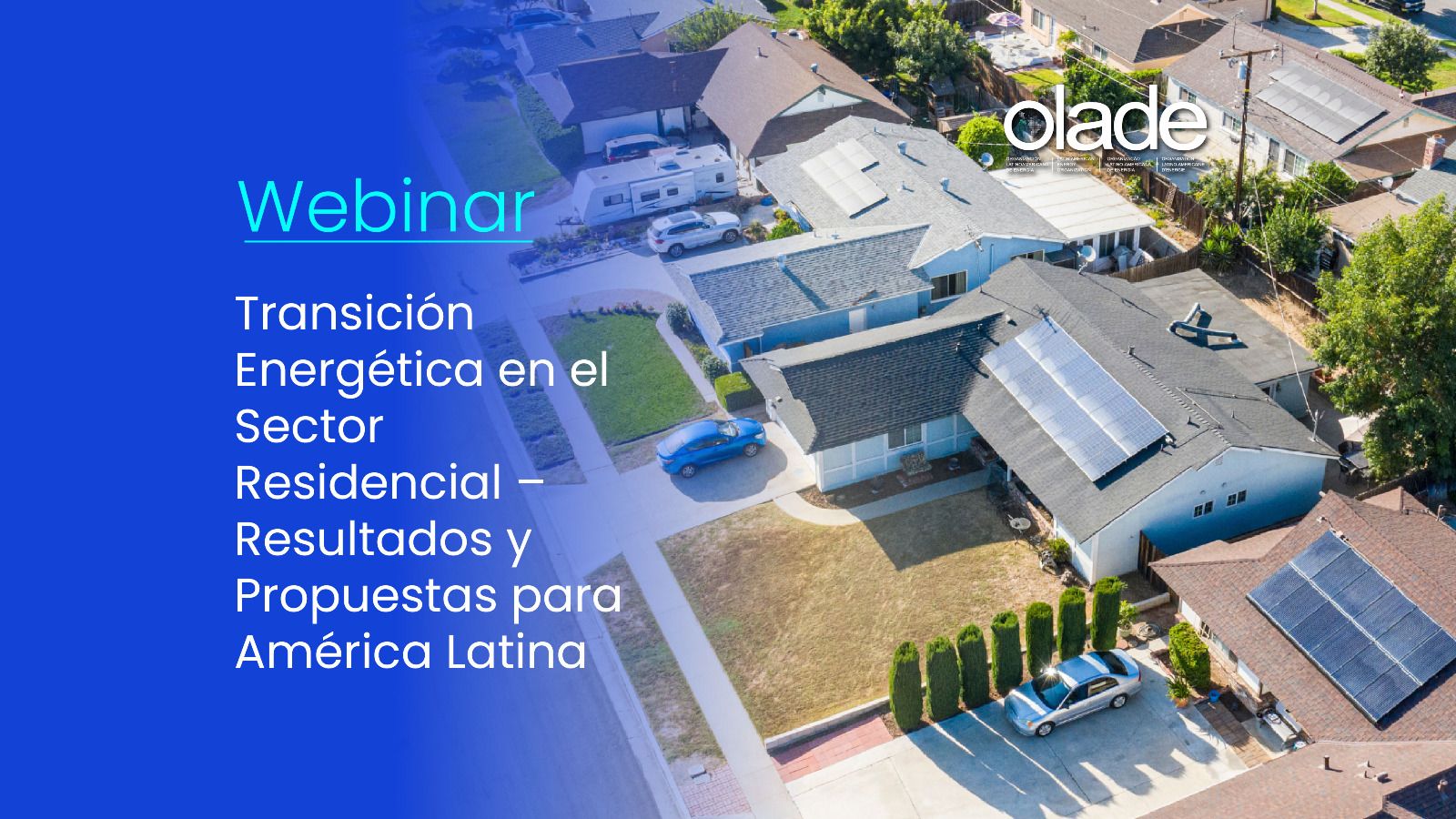
The Latin American and Caribbean Energy Organization (OLACDE) held the webinar “Energy Transition in the Residential Sector – Results and Proposals for Latin America”, at which the main findings of the regional study on energy transition in the residential sector were presented. This activity was carried out under the ETRELA project, with support from the International Climate Initiative (IKI) of the Government of Germany, EBP Chile, Universidad Mayor, and the Fundación Futuro Latinoamericano.

During the opening remarks, Gloria Alvarenga, OLACDE’s Director of Integration, Access and Energy Security, warned that “burning biomass not only affects the health of women, children, and older adults, but also contributes to deforestation and climate change.” In this regard, she urged progress toward clean technological solutions such as electrification and the use of biogas.

For his part, OLACDE’s Executive Secretary, Andrés Rebolledo, emphasized that the energy transition in households goes beyond access to energy and requires coordination with public health, housing, and social protection policies. “It’s not just about energy,” he stated, announcing that OLACDE is driving a roadmap with its 27 member countries to reach a regional political commitment on clean cooking in 2025.

During the event, Nicola Borregaard, General Manager of EBP Chile, presented the results of a study conducted together with institutions from Brazil, Colombia, Chile, and the United States, which shows the residential sector lagging behind in national decarbonization strategies. As she highlighted, electrifying the sector is urgent given its positive effects on public health and emissions mitigation.

The technical report notes that the residential sector accounts for between 11% and 19% of final energy demand in the countries analyzed, with intensive use of firewood and gas for cooking and heating:

  • In Colombia, 70% of residential consumption goes to cooking, with high reliance on firewood.
  • In Brazil, this share ranges between 51% and 62%, with gas use predominating.
  • In Chile, firewood used for heating generates 22% of national CO₂ emissions.

Although electricity coverage exceeds 90% in most areas, deficiencies persist in infrastructure and service quality, especially in rural areas. The study also identifies regulatory gaps and the need to harmonize metrics and public policy instruments.

Paola Valencia, of EBP Chile, shared unprecedented findings on fugitive methane emissions from household stoves:

  • In Bogotá, 70% of methane comes from leaks when the stove is off.
  • In Chile, these emissions exceed 50% of total residential emissions.
  • In Brazil, methane emissions from stoves were up to 10 times higher than official IPCC estimates.

In addition, nitrogen oxides, carbon monoxide, and benzene were measured, revealing significant health impacts. Data was collected on-site, taking into account altitude, stove type, and local conditions.

Cristóbal Galbán, a researcher at Universidad Mayor, presented experiments conducted in Chile and Colombia that confirmed continuous methane emissions even with burners turned off. He proposed using country-specific Tier 2-level emission factors, replacing the generic IPCC Tier 1 factors, to improve national greenhouse gas inventories.

Finally, Maryangel García, of the Fundación Futuro Latinoamericano, presented the communication strategy implemented to turn technical data into messages that are understandable to the general public, media, and decision-makers. “What is not communicated does not exist. And if it is not measured, it cannot be improved,” she concluded.
Share this news

OLACDE Presents Key Findings on Clean Cooking at High-Level Regional Webinar

Newsletter summary

The Latin American and Caribbean Energy Organization (OLACDE) held the webinar “Energy Transition in the Residential Sector – Results and Proposals for Latin America”, at which the main findings of the regional study on energy transition in the residential sector were presented. This activity was carried out under the ETRELA project, with support from the […]

Capacity building & knowledge

We advance high-level technical training programs that foster experience-sharing and develop the human and institutional capacities required to drive energy transformations across our region.

Our academic programs offer executive courses, postgraduate diplomas, master’s degrees, and innovative initiatives focused on key areas such as the energy transition, conventional and renewable energy, electromobility, and regional integration.

OLACDE builds a regional network of energy expertise, connecting governments, young professionals, academics, and industry experts to foster collaborative solutions through technical cooperation and talent development to address future energy and climate challenges.

Technical cooperation & climate finance

We strengthen South-South and triangular cooperation as key drivers to accelerate energy transitions across Latin America and the Caribbean. OLACDE unites efforts among governments, multilateral organizations, academic institutions, and the private sector to mobilize financing, technical expertise, and innovative solutions tailored to our regional context.

We advance strategic initiatives aimed at directing resources toward decarbonization, conventional energy, renewables, and energy justice projects—building a more efficient, inclusive, and sustainable regional cooperation architecture.

Regional energy community

We are building a regional energy community with a global outlook, positioning Latin America and the Caribbean as a pivotal player on the international stage. OLACDE amplifies regional representation in key multilateral energy, trade, and climate forums by fostering strategic alliances and international cooperation.

Through flagship events such as Energy Week and new spaces for high-level dialogue, we champion a collective voice that attracts investment, drives technical partnerships, and unlocks sustainable development opportunities across our region

Energy transition & strategic projects

We foster a regional energy transition built on sustainability, energy security, and social inclusion. OLACDE supports Member Countries in adopting emerging technologies—such as energy efficiency, storage solutions, green hydrogen, electromobility, and grid digitalization—to accelerate the sector’s decarbonization.

Our approach promotes strategic projects that strengthen energy resilience across Latin America and the Caribbean, reducing emissions while building a cleaner, more competitive energy infrastructure. Key regional initiatives, including OEMLAC, position our region as a benchmark for climate innovation and sustainable energy development.

Energy information and data

We develop regional platforms dedicated to energy intelligence, technical analysis, and strategic data systems that empower both public and private decision-making across the sector. OLACDE drives digital transformation in energy by leveraging artificial intelligence, georeferencing, and advanced analytical tools to map regional energy trends.

The integration of systems such as SieLAC, along with new regional digital platforms, consolidates reliable, up-to-date technical data—enabling modern, interoperable, and evidence-based energy planning.

Regional energy integration

We foster cooperation across the regional energy sector by prioritizing infrastructure development, cross-border collaboration, and regulatory alignment to enhance energy security in Latin America and the Caribbean. OLACDE coordinates strategic projects in power grid interconnections, natural gas integration, and joint energy planning to build resilient, sustainable partnerships.

Working alongside the governments of our 27 Member States, regional blocs, multilateral institutions, and key public and private stakeholders, we drive initiatives that introduce innovative energy exchange mechanisms, strengthen national capacities, and accelerate a unified regional energy transition.