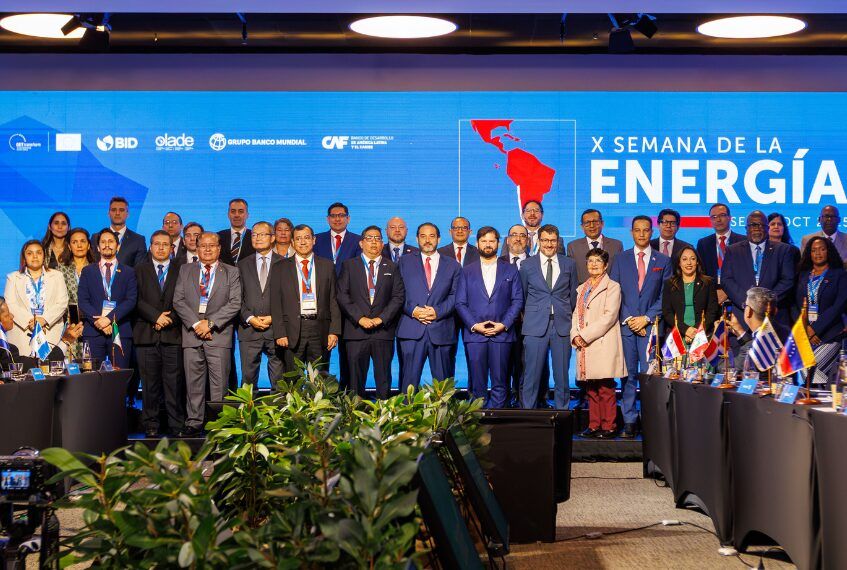
With more than 2,500 participants from 49 countries, 220 panelists, and 160 international organizations, the 10th Energy Week concluded in Santiago, Chile, cementing its place as the most influential forum for the energy sector in Latin America and the Caribbean. Organized by the Latin American and Caribbean Energy Organization (OLACDE), Chile’s Ministry of Energy, the Inter-American Development Bank (IDB), the Development Bank of Latin America and the Caribbean (CAF), the World Bank, and GET.transform, the tenth edition brought together, over four days, ministers of Energy, business leaders, representatives of multilateral organizations, experts, academia, young people, and civil society to discuss regional energy integration, a just transition, and energy resilience in the face of climate change.
The LV Annual Meeting of OLACDE Ministers of Energy, held within the framework of the Week, reached key agreements for the future of the sector. Member countries approved Ministerial Decisions on four core pillars: energy and labor, dialogue toward regional regulatory convergence, a just energy transition with communities near projects, and electricity storage, a pillar of flexibility for the region’s power systems. A regional target was also adopted to achieve 95% coverage of clean cooking in Latin America and the Caribbean, with the vision that each country will advance according to its sovereignty and its own economic, social, and cultural circumstances.
In the same session, member countries re-elected Chilean economist Andrés Rebolledo Smitmans as OLACDE’s Executive Secretary for the 2026–2029 term, and the OLACDE Presidency was formally handed over to Belize, strengthening Caribbean representation in regional energy governance.
The opening ceremony of the LV Ministerial Meeting was led by the President of the Republic of Chile, Gabriel Boric Font, who highlighted energy’s role as a driver of regional development and a symbol of cooperation. “Energy is to the 21st century what trains were to the 19th. We have so much to move forward together on. OLACDE shows that we can improve our citizens’ quality of life beyond rhetoric,” said the Chilean president, stressing that energy collaboration can translate into concrete progress for Latin American peoples. Boric also praised OLACDE’s leadership in regional integration.
Over the four days of discussions, more than 60 hours of technical sessions, keynote addresses, and policy dialogue took place, covering topics such as electricity and gas interconnection, a just energy transition, storage and grid modernization, green hydrogen and fuels of the future, energy efficiency, education and gender, and climate resilience. Featured sessions included: “Connecting LAC: How to Achieve a Regional Energy Market?”, “Transforming Consumption: Strategies for Decarbonizing Demand”, “The Regional Energy Landscape: Keys to Planning Resilient, Connected Systems”, “Strategic Value Chains for the Transition”, and “Smart Consumption: The Future of Electricity Demand in Latin America and the Caribbean”, among others.
One of the central themes of the event was the promotion of the regional portfolio of electricity and gas interconnection projects, as well as the consolidation of a regional resilience and emergency response agenda with multilateral protocols. In parallel, public-private cooperation spaces were held, such as the III Business Council, the III Regulators’ Forum, and closed-door dialogues focused on strategic mining, transportation, industry, natural gas, hydrocarbons, and power generation and transmission.
Among the most notable milestones, the 2025 White Paper on Sustainable Mobility was presented, offering a comprehensive view of progress and prospects for sustainable mobility in the region, along with the White Paper on Energy Storage in Latin America and the Caribbean, a technical publication by OLACDE that analyzes the role of storage as a strategic pillar for achieving a sustainable and inclusive transition, covering technologies such as batteries, pumped hydro, thermal storage, and green hydrogen. The official launch of the Latin American and Caribbean Network of Women in Energy (RedLACME) also took place, a collaborative space bringing together more than 1,200 women from the region and founded together with national associations from Argentina, Uruguay, the Dominican Republic, and Chile, aimed at strengthening women’s representation in the energy sector and contributing to a just and inclusive transition.
Another major announcement was the creation of the Latin American and Caribbean Energy Center – ENLACE, an initiative led by OLACDE and the University of Chile, conceived as a regional knowledge and technical assistance hub that will foster dialogue among governments, academia, multilateral organizations, and the private sector to accelerate the energy transition.
As part of the Week, the second edition of the 2025 OLACDE Award for Energy Excellence was also held, reaching a record 104 applications from 15 countries. The ceremony recognized innovative projects in energy efficiency, renewable energy, education, and decarbonization, underscoring the region’s commitment to innovation and sustainability.
“It has been a very productive week, in which the energy agenda of Latin America and the Caribbean was discussed, addressing fundamental issues such as grid modernization, storage, demand decarbonization, green hydrogen, and the fuels of the future. Renewable energy will continue to be the mainstay of the region’s energy development,” said Andrés Rebolledo, OLACDE’s Executive Secretary.
With its closing in Santiago, Chile, the 10th Energy Week reaffirmed that Latin America and the Caribbean are moving forward together toward a more sustainable, inclusive, and integrated energy future, and announced that the 11th Energy Week will be held in the Dominican Republic in October 2026, continuing this regional cooperation platform that drives the continent’s energy transformation.