Global Value Chains in the Energy Transition and the New Geopolitics

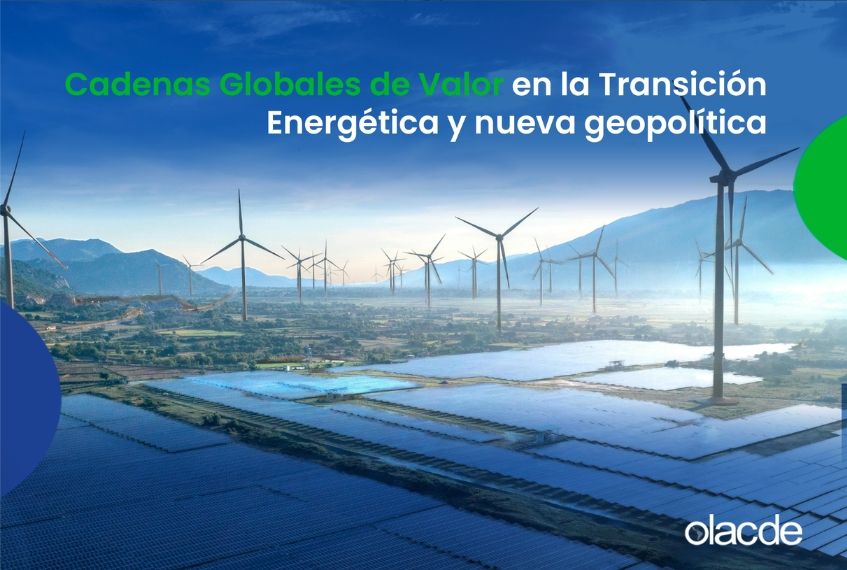
The energy transition is rapidly transforming the global economy, at a pace comparable to past industrial revolutions. However, for Latin America and the Caribbean, the main challenge is not limited to supplying critical minerals or clean energy to the rest of the world; it is essential to define what role the region will play in the new global value chains: whether as a supplier of raw materials or as a strategic player in the new industrial economy.

This is the central conclusion of the new working paper titled “Global Value Chains in the Energy Transition amid a New Geopolitics,” developed jointly by the Latin American and Caribbean Energy Organization (OLACDE) and the Georgetown Americas Institute (GAI). The analysis argues that the energy transition involves far more than a decarbonization process; it represents a structural transformation of economic, technological, and geopolitical power worldwide.

The study argues that technologies such as solar, wind, batteries, electric mobility, smart grids, and clean hydrogen are redefining global production chains. In this context, knowledge, innovation, and advanced manufacturing are capturing a growing share of the economic value generated.

Strategic resources, uncertain development

Latin America and the Caribbean is well positioned within this new energy geopolitics. The region holds significant reserves of lithium, copper, and other critical minerals, in addition to having one of the world’s greatest potentials for renewable energy. However, the report warns that this comparative advantage does not automatically guarantee progress toward higher-value economic development.

The document points to a historical paradox: countries rich in natural resources often fail to capture the greatest economic benefits because they tend to concentrate on the early stages of the production process. Meanwhile, the most profitable activities tend to be found in areas such as research, innovation, and advanced manufacturing.

Geopolitics is reshaping supply chains

According to the analysis presented, international competition is no longer based solely on low costs. Factors such as economic security, supply chain resilience, strategic autonomy, and diversification are now crucial elements shaping global decisions on investment and production.

Trends such as nearshoring and friend-shoring seek to reconfigure production processes based more on geopolitical and institutional considerations than on economic factors alone.

For OLACDE, this environment presents a significant opportunity for Latin America and the Caribbean, provided the region manages to develop the industrial and technological capabilities needed to move into higher value-added sectors.

A public agenda to capture value

Given this challenging outlook, the document proposes a comprehensive strategy to boost regional competitiveness through sustainable public policies. Its priorities include:

  • Developing national strategies for effective integration into global chains.
  • Unifying industrial, trade, and energy policies.
  • Investing adequately in logistics, energy, and digital infrastructure.
  • Strengthening specialized human capital together with STEM education.
  • Fostering systems geared toward applied innovation.
  • Promoting regional integration to increase production scale.
  • Establishing stable regulatory frameworks that attract investment.
  • Moving beyond extraction alone toward the processing and industrialization of critical minerals.

The report concludes that the energy transition represents an unprecedented economic opportunity for Latin America and the Caribbean in decades; however, it also poses one of the most complex strategic challenges for the region’s current development model. According to the working paper, it is essential to transform, today, the region’s existing natural advantages into strong industrial capabilities that support a new sustainable model.

The decisions made now will determine whether Latin America and the Caribbean become key players in the global energy economy or continue to be limited to their traditional role as suppliers of raw materials alone.

View the full document at the following link: https://www.olacde.org/publicaciones/cadenas_valor_esp/
Share this news

Global Value Chains in the Energy Transition and the New Geopolitics

Newsletter summary

The energy transition is rapidly transforming the global economy, at a pace comparable to past industrial revolutions. However, for Latin America and the Caribbean, the main challenge is not limited to supplying critical minerals or clean energy to the rest of the world; it is essential to define what role the region will play in […]

Capacity building & knowledge

We advance high-level technical training programs that foster experience-sharing and develop the human and institutional capacities required to drive energy transformations across our region.

Our academic programs offer executive courses, postgraduate diplomas, master’s degrees, and innovative initiatives focused on key areas such as the energy transition, conventional and renewable energy, electromobility, and regional integration.

OLACDE builds a regional network of energy expertise, connecting governments, young professionals, academics, and industry experts to foster collaborative solutions through technical cooperation and talent development to address future energy and climate challenges.

Technical cooperation & climate finance

We strengthen South-South and triangular cooperation as key drivers to accelerate energy transitions across Latin America and the Caribbean. OLACDE unites efforts among governments, multilateral organizations, academic institutions, and the private sector to mobilize financing, technical expertise, and innovative solutions tailored to our regional context.

We advance strategic initiatives aimed at directing resources toward decarbonization, conventional energy, renewables, and energy justice projects—building a more efficient, inclusive, and sustainable regional cooperation architecture.

Regional energy community

We are building a regional energy community with a global outlook, positioning Latin America and the Caribbean as a pivotal player on the international stage. OLACDE amplifies regional representation in key multilateral energy, trade, and climate forums by fostering strategic alliances and international cooperation.

Through flagship events such as Energy Week and new spaces for high-level dialogue, we champion a collective voice that attracts investment, drives technical partnerships, and unlocks sustainable development opportunities across our region

Energy transition & strategic projects

We foster a regional energy transition built on sustainability, energy security, and social inclusion. OLACDE supports Member Countries in adopting emerging technologies—such as energy efficiency, storage solutions, green hydrogen, electromobility, and grid digitalization—to accelerate the sector’s decarbonization.

Our approach promotes strategic projects that strengthen energy resilience across Latin America and the Caribbean, reducing emissions while building a cleaner, more competitive energy infrastructure. Key regional initiatives, including OEMLAC, position our region as a benchmark for climate innovation and sustainable energy development.

Energy information and data

We develop regional platforms dedicated to energy intelligence, technical analysis, and strategic data systems that empower both public and private decision-making across the sector. OLACDE drives digital transformation in energy by leveraging artificial intelligence, georeferencing, and advanced analytical tools to map regional energy trends.

The integration of systems such as SieLAC, along with new regional digital platforms, consolidates reliable, up-to-date technical data—enabling modern, interoperable, and evidence-based energy planning.

Regional energy integration

We foster cooperation across the regional energy sector by prioritizing infrastructure development, cross-border collaboration, and regulatory alignment to enhance energy security in Latin America and the Caribbean. OLACDE coordinates strategic projects in power grid interconnections, natural gas integration, and joint energy planning to build resilient, sustainable partnerships.

Working alongside the governments of our 27 Member States, regional blocs, multilateral institutions, and key public and private stakeholders, we drive initiatives that introduce innovative energy exchange mechanisms, strengthen national capacities, and accelerate a unified regional energy transition.