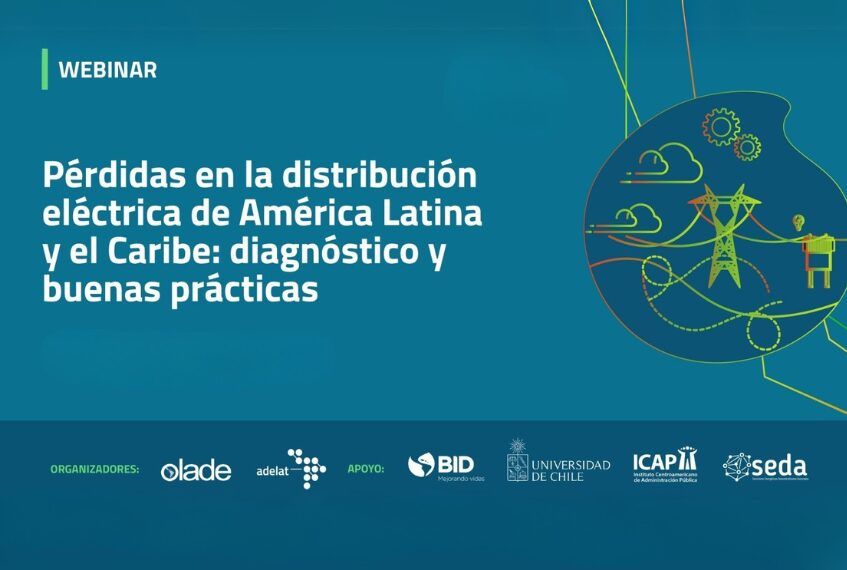
The Association of Latin American Electric Energy Distributors (ADELAT), the Latin American and Caribbean Energy Organization (OLACDE), and the Inter-American Development Bank (IDB) successfully held the webinar “Losses in Electricity Distribution in Latin America and the Caribbean: Diagnosis and Best Practices.”
The event was a great opportunity to create a space for analysis and exchange on this issue together with leading figures in the electricity sector, regulators, and distribution companies. During the meeting, its causes, impacts, and mitigation strategies were discussed, based on the study published by the IDB, “The Economics of Electricity Losses in Latin America and the Caribbean.”
The opening was led by Fitzgerald Cantero Piali, OLACDE’s director of Studies, Projects, and Information, who highlighted the urgency of addressing this challenge from a comprehensive perspective: “It is important to understand electricity losses not only from a technical standpoint, but also from an economic and social one.” He also noted: “This space was created to put the issue on the table, share diagnoses and best practices, and build a menu of solutions.”
Then, OLACDE’s Executive Secretary, Andrés Rebolledo, noted that “electricity losses reach 15% of the annual supply in Latin America and the Caribbean, a figure equivalent to the region’s entire current wind and solar energy production”. He also proposed considering a “regional target” as a “political driver” to mobilize regulatory and technical changes.
On behalf of ADELAT, Alessandra Amaral, executive president, emphasized the importance of regional collaboration. “Losses drain resources essential for the energy transition”, she stated, adding: “We need to pool knowledge and best practices to overcome them and ensure a sustainable energy future.”
The meeting continued with a special presentation by IDB experts Rigoberto Ariel Yepez-Garcia and Raúl Jiménez Mori. They explained that reducing electricity losses requires a stable political environment that guarantees long-term continuity and support; effective communication about the economic, social, and service-quality benefits; aligned incentives to improve efficiency and recover costs; and strategic planning incorporating modern technologies.
Afterward, Rodrigo Palma, academic at the SEDA Center – University of Chile, moderated the panel “Experiences in Reducing and Controlling Electricity Losses,” made up of:
- Giovanni Salazar and Jaime Mercar Chonay, from the Inspection, Losses, and Measurement Department of EEGSA – EPM Guatemala.
- Manuel Antonio Barboza Chacón, coordinator of Comprehensive Loss Management at ICE Electricidad.
- Germán Noez, Market Discipline manager at Edenor.
- Aldo Pessanha, chairman of ADELAT’s board of directors and director of Generation and Strategy at Enel Brasil.
- Ariel Ramírez, from the Central American Institute of Public Administration.
The professionals from EEGSA – EPM Guatemala detailed their “Energizados” project, which incorporates artificial intelligence to predict electricity fraud. Among the benefits highlighted were: comprehensive customer analysis, optimization of the inspection process, automation of fraud assessment, automatic report generation, easier decision-making, detection of equipment failures, and the model’s scalability.
Barboza Chacón reviewed the evolution of losses at ICE Costa Rica: “At our company we had 8.05% losses in 2024, which represents about 64 million dollars.” He noted that “there are many actors involved in the chain” and that work continues to reduce them through technological improvements and migration to more efficient meters.
For his part, Noez shared progress on Edenor’s plan, launched in 2019, to install self-managed meters, which today has around 246,000 customers. He noted that this initiative enabled a “progressive reduction in energy losses” and favored “customer loyalty in inactive and clandestine accounts.”
Finally, Aldo Pessanha presented Enel Brasil’s strategies to combat energy theft in Rio de Janeiro. He listed the corrective actions taken in 2024, such as field inspections, a network cleanup project in high-recurrence areas, regularization of clandestine connections, the BT Zero project, protection of customers with remote metering, and integrated management of critical areas, in coordination with police and initiatives to promote responsible consumption.
Electricity losses are one of the main challenges for the region because they affect the efficiency, sustainability, and quality of distribution service. Through interinstitutional collaboration, Latin America and the Caribbean can move toward a more resilient electricity system committed to a sustainable energy future.