The 11th Energy Week presented new findings from the Regional Gas Integration Project, led by OLACDE and CAF. The analysis confirms that there is potential to expand gas trade in the Southern Cone: under a scenario of increased demand and regulatory adjustments, gas flows could reach approximately 60 million m³ per day.
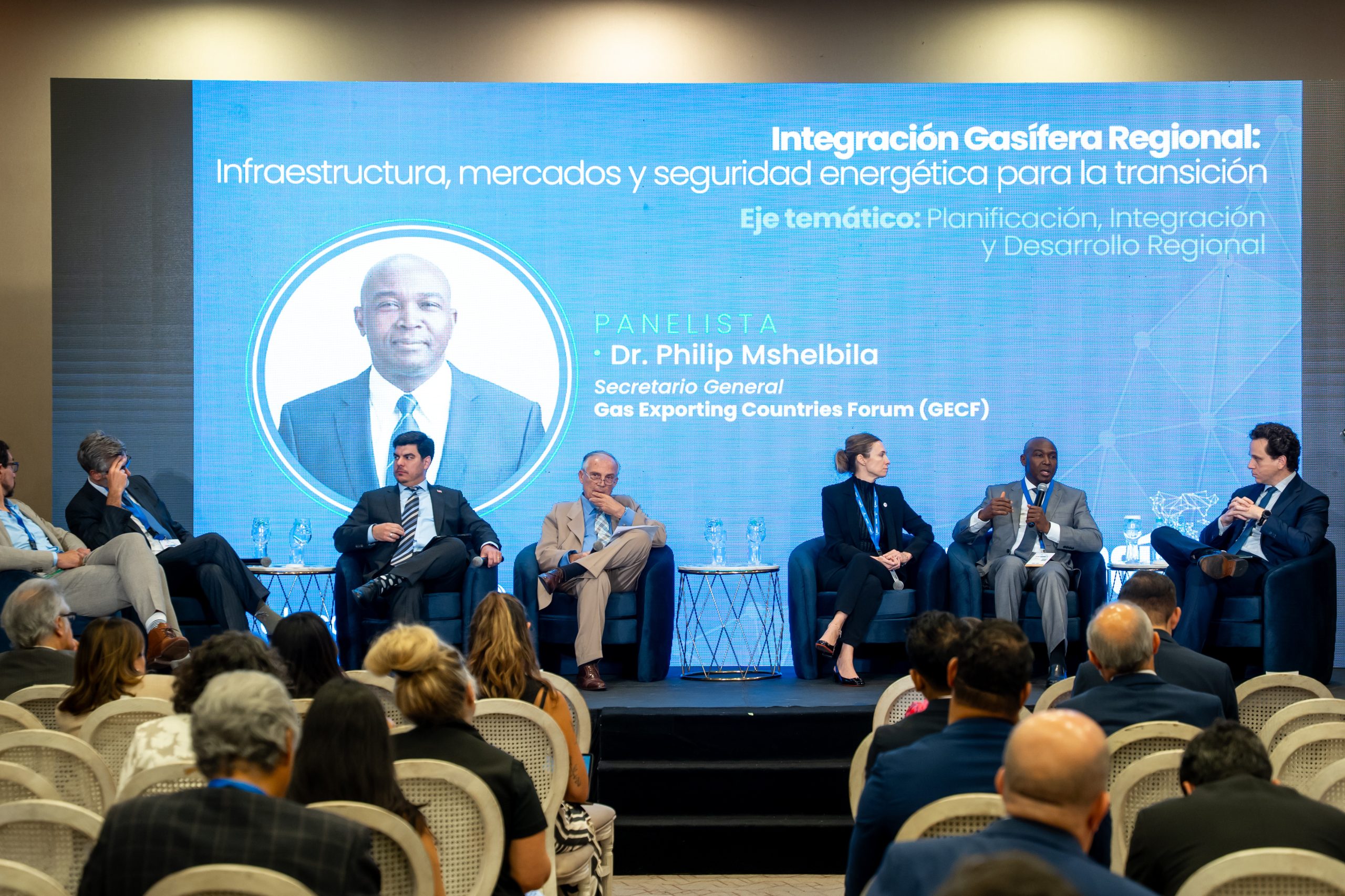
Santo Domingo, October 2026. The session “Regional Gas Integration: Infrastructure, Markets, and Energy Security for the Transition” brought together representatives from the private sector, international organizations, and financial institutions to discuss how to harness available resources, expand markets, and strengthen energy security amid the energy transition and increasing electrification.
The findings were presented by Esteban Kiper from OLACDE, who explained that the central challenge is not the availability of natural gas, but rather the conditions needed to transport it and develop firm demand. The study highlights strong production growth in Vaca Muerta and Brazil’s pre-salt fields, alongside declining production in Bolivia, and identifies concrete opportunities in Chile, Brazil, Paraguay, and Uruguay.
“Argentine natural gas can competitively reach markets such as southern Brazil, central and northern Chile, Uruguay, and potentially Paraguay,” Kiper stated, emphasizing that integration requires infrastructure, regulatory adjustments, and firm long-term contracts. Under a scenario of increased demand and regulatory changes, regional gas trade could reach approximately 60 million m³ per day.
The analysis also identifies distinct economic benefits across the region: increased exports and import substitution for Argentina, lower costs through the replacement of liquefied natural gas (LNG) in Chile, more competitively priced energy for Brazilian industry, and transit revenues for Bolivia. It also shows that, with higher demand, Vaca Muerta and Brazil’s pre-salt fields can be developed simultaneously, avoiding a zero-sum competition between the two gas-producing basins.
Following the presentation, Ivo Nacucchio from OLACDE moderated a discussion on the main challenges of putting regional gas integration into practice: energy security, long-term contracts, financing, institutional quality, supply flexibility, and complementarity between regional natural gas, liquefied natural gas (LNG), and electricity.
Soledad Lysak, from TotalEnergies, emphasized the importance of offering customers alternatives and flexibility. In April 2025, the company carried out its first export of natural gas from Vaca Muerta to Brazil via Bolivia, an experience that, she explained, demonstrated the potential for trade volumes to grow as regulatory and commercial conditions become more firmly established.
Representing the Gas Exporting Countries Forum (GECF), Philip Mshelbila stated that “we need long-term contracts, but more flexible long-term contracts,” explaining that producers and buyers must share risks more effectively and ensure predictability in the face of geopolitical and price shocks.
Carlos Garibaldi, Executive Secretary of ARPEL, emphasized the importance of institutional quality, regulatory stability, and access to financing. He warned that while the region has abundant resources, it must seize a window of opportunity that will not remain open indefinitely.
For his part, Manuel Luengo, Lead Energy Specialist for Latin America and the Caribbean at the World Bank, noted that the World Bank Group sees opportunities in gas transportation infrastructure, pipelines, liquefied natural gas (LNG) terminals, distribution networks, and guarantees for complex projects, with energy security becoming an increasingly important criterion in the evaluation of new investments.
Representing Wärtsilä, Juan Ignacio Alarcón explained that the role of natural gas is evolving with the growth of renewable energy and battery storage: “Integration will be complete when a country can rely on its neighbor’s gas supply on the worst day of the year, not just on the best.”
In his closing remarks, Guido Maiulini, Head of Strategic Advisory at OLACDE, stated that the evolving geopolitical landscape is once again positioning natural gas as a key energy source for the energy transition. He highlighted the complementarity between regional natural gas, liquefied natural gas (LNG), and electricity, and affirmed that OLACDE will continue working toward the development of a regional energy market capable of enhancing competitiveness, reducing costs, and strengthening energy security.