OLACDE’s Head of Strategic Advisory participated in ROG.e 2026, where he presented scenarios for Argentine gas supplies to Brazil and highlighted the contribution that greater regional gas integration could make to energy security and productive development.
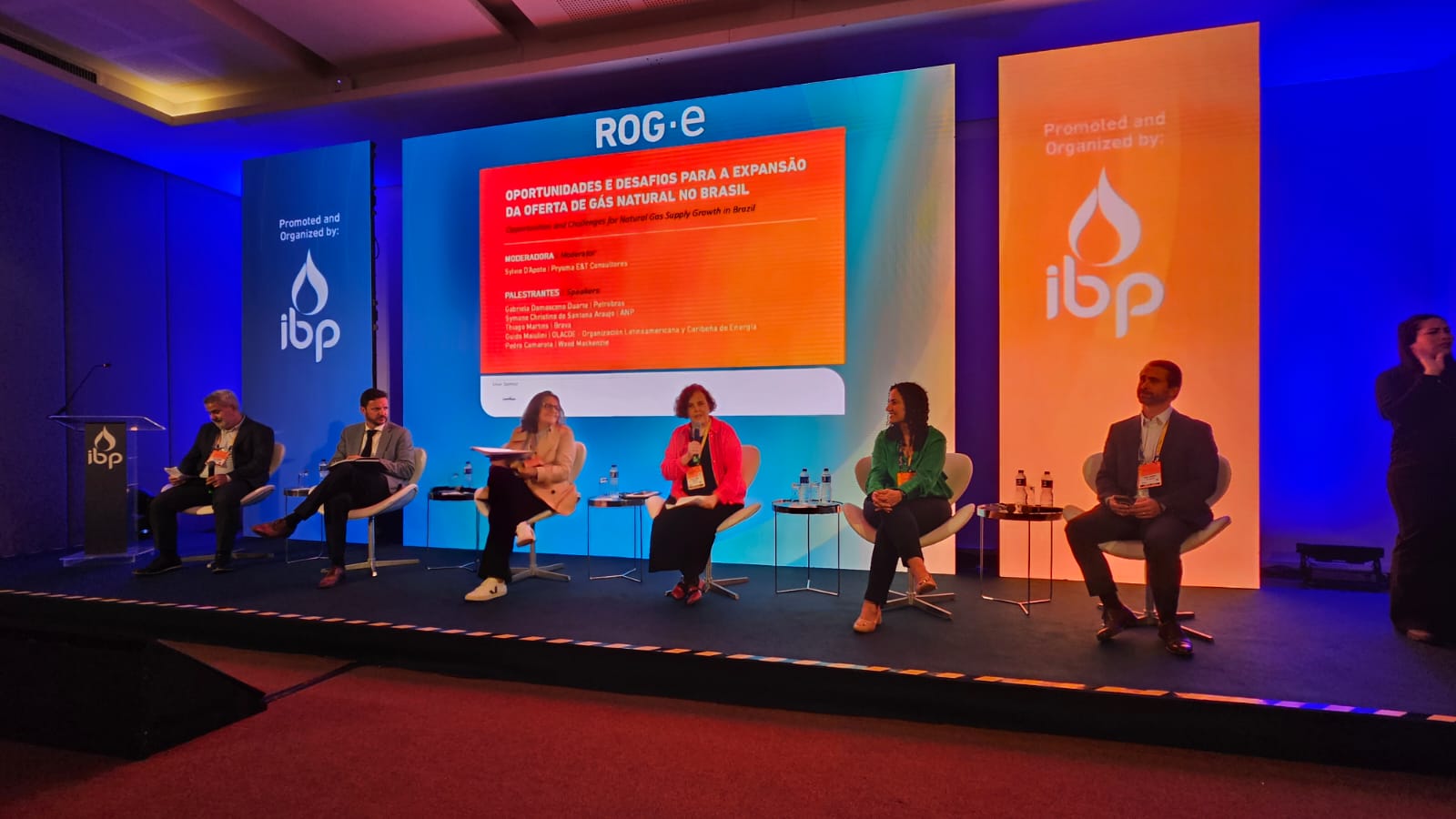
Guido Maiulini, Head of Strategic Advisory at OLACDE, participated this week in ROG.e 2026, during the special session “Opportunities and Challenges for Expanding Natural Gas Supply in Brazil.”
The panel addressed the economic, regulatory, and contractual factors affecting both investment in expanding domestic gas production and the feasibility of imports from neighboring countries. In this context, Maiulini presented different scenarios for Argentine gas supplies to Brazil and how these flows could evolve in the coming years.
Argentina can currently carry out interruptible gas exchanges of up to 3 million m³/day through Bolivia during the summer period, without the need for new infrastructure, he explained. To move toward a first firm supply tranche of 10 million m³/day starting in 2029–2030, it will be necessary to expand the Tratayén–Cochicó–La Carlota gas pipeline and increase the capacity of the Northern Gas Pipeline, requiring investments exceeding USD 2 billion.
Developing these gas flows will also require progress on a regulatory, tax, and tariff agenda involving Argentina, Bolivia, and Brazil. In the current interruptible market, one of the main challenges is adapting the transportation products offered in Brazil, whose current design generates additional costs for this type of transaction. Other factors include YPFB’s aggregation and transportation costs in Bolivia, export duties and metering-related issues in Argentina, as well as the structure and level of tariffs in Brazil.
These conditions will also affect the competitiveness of the first firm supply tranche. Eliminating export duties in Argentina and reducing aggregation and transportation costs in Bolivia could allow these 10 million m³/day to enter Brazil at approximately USD 6.3/MMBtu. Making this supply a reality would also require firm contracts with industrial consumers, gas marketers, and thermal power plants.
Maiulini explained that Argentine supply could expand progressively. An additional 10 million m³/day could be added to the initial 10 million through Bolivia, which would require further infrastructure in Argentina, including completion of the Northeast Argentine Gas Pipeline (GNEA). A second route could add up to 12 million m³/day through Uruguaiana, supported by the construction of the Uruguaiana–Triunfo gas pipeline in Brazil. Under a scenario of strong growth in Brazilian demand, total potential supply could reach approximately 32 million m³/day: 20 million through Bolivia and 12 million through Uruguaiana.
He also noted that Brazil is moving forward with new projects to expand domestic production, including Raia and SEAP. However, if demand were to remain at current levels, even the first 10 million m³/day tranche of Argentine gas would compete with these new volumes.
“Demand growth will be essential to complement the expansion of Brazilian production with increased supply from Argentina,” Maiulini said.
Expanding demand, he noted, will require more than a lower-cost gas molecule. High transportation and distribution costs increase the final price of gas and reduce its attractiveness for expanding gas use across industry and in freight and passenger transportation.
“Advancing greater gas integration among our countries can strengthen energy security and contribute to greater productive development across the region,” he concluded.
The session also featured Gabriela Damasceno Duarte (Petrobras), Symone Christine de Santana Araujo (ANP), Pedro Camarota (Wood Mackenzie), and Thiago Martins (Brava), and was moderated by Sylvie D’Apote (Prysma E&T Consultores).
ROG.e 2026, organized by the Instituto Brasileiro de Petróleo, Gás e Biocombustíveis (IBP), is one of the region’s leading energy industry events. Held in Rio de Janeiro, the event brings together business leaders, government authorities, and experts from different countries to discuss transformations in the sector, market outlooks, and the issues shaping the global energy agenda.