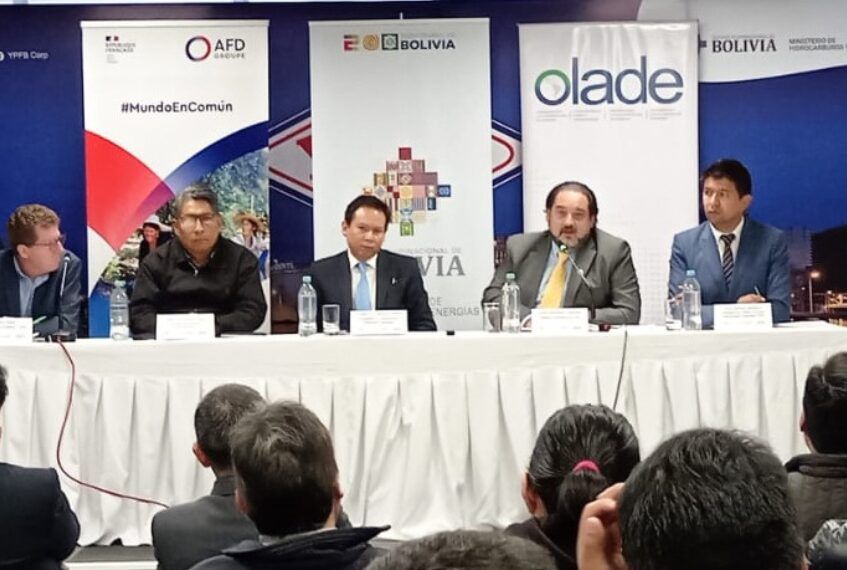
Bolivia’s Ministry of Hydrocarbons and Energy, the Latin American and Caribbean Energy Organization (OLACDE), and with technical and financial support from the French Development Agency (AFD), launched the Bolivia Energy Information System Implementation Project (sieBolivia), a digital tool that seeks to modernize, bring transparency to, and strengthen the country’s energy planning.
During the launch event, OLACDE’s Executive Secretary, Andrés Rebolledo, highlighted the importance of having official, systematized data with permanent access for public policy decision-making. “Latin America and the Caribbean is going through a promising moment: countries are transforming their energy matrices, integrating renewables, and moving toward sustainable models, although they also face immediate challenges in terms of energy security,” he said.
The system has already been implemented in 11 countries in the region, which has made it possible to consolidate the Latin American and Caribbean Energy Information System (sieLAC), a regional platform developed by OLACDE. Bolivia thus joins this network, committing to interconnection and technical cooperation, strategic pillars of the organization for more than five decades.
The Vice Minister of Energy Planning and Development, Fredy Velásquez, emphasized that the project represents “a firm step toward more efficient, modern, and transparent management of our energy resources.” He added that access to reliable and timely data is key to driving economic growth and social well-being, and that sieBolivia will directly contribute to improving the population’s quality of life.
For his part, Marco Yujato, OLACDE Associate Specialist, explained that the system is based on methodologies and technical tools designed to facilitate the collection, processing, and analysis of energy statistics. “sieBolivia has been designed in line with the structure of the national energy matrix, integrating functionalities that allow for the management, analysis, and publication of data from a single digital environment accessible to authorities, businesses, and the general public,” he stated.
During the official presentation, a dynamic view of the system’s general framework and its main features was shown, including remote access to key energy sector data.
With this initiative, Bolivia reinforces its commitment to institutional modernization, transparency, and sustainability in the management of its energy resources.