OLACDE Took Part in Regional Political Dialogue on Climate Action and Just Transition

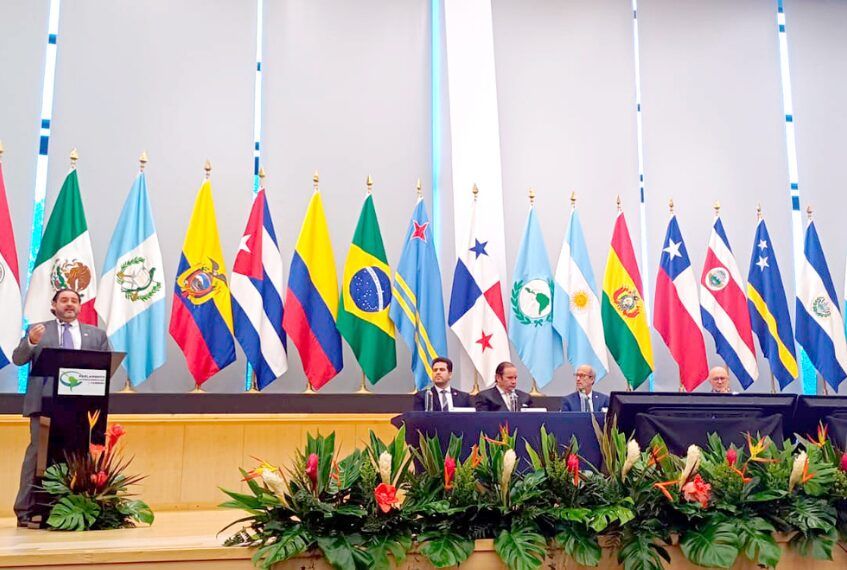
The Latin American and Caribbean Energy Organization (OLACDE) took part in the event “Parliaments in Climate Action and Just Transition,” organized by the Latin American and Caribbean Parliament in Panama, within the framework of the Parliamentary Alliance for Climate Action and Just Transition (APACTJ). The gathering brought together legislative leaders from the region to strengthen the role of parliaments in responding to climate change from a social justice perspective.

During the opening, OLACDE’s Executive Secretary, Andrés Rebolledo, noted that Latin America and the Caribbean generate 70% of their electricity from renewable sources, yet only a fraction of the region’s potential has been harnessed: 16% of wind resources, 30% of hydroelectric potential, and just 2% of solar potential. He also highlighted the region’s strategic position in the global energy transition, producing 27% of the world’s biofuels, 25% of critical minerals, and 10% of the world’s oil.

Unlike other regions, less than 4% of greenhouse gas (GHG) emissions in Latin America and the Caribbean come from the energy sector, compared to the global average of 65%. “Latin America and the Caribbean is a solution region,” said Rebolledo, who urged legislators to work toward a common energy agenda based on a just transition, regional integration, sustainable investment, and shared planning.

He also proposed moving toward a regional energy integration treaty, optimizing the use of electricity interconnections currently utilized at only 25%, and modernizing regulatory frameworks so they drive innovation and equity. “Legal frameworks must stop being reactive and become drivers of change. We need laws with an anticipatory, strategic, and sustainable vision,” he emphasized.

On the panel “Political Dialogue on Climate Action and Just Transition,” OLACDE’s Director of Studies, Projects, and Information, Fitzgerald Cantero, reinforced the need for modern, representative legal frameworks as an essential condition for advancing toward a fair, secure, and sustainable energy system.

Cantero stressed that the energy transition requires laws adapted to the pace of innovation, effective parliamentary oversight, and genuine coordination among governments, legislatures, and citizens. “Energy isn’t valued until there’s a blackout. Investment needs certainty. And people need representation. The transition will happen with social license, or it won’t happen at all,” he concluded.

OLACDE reaffirms its commitment to regional energy governance based on equity, sustainability, and cooperation.

Share this news

OLACDE Took Part in Regional Political Dialogue on Climate Action and Just Transition

Newsletter summary

The Latin American and Caribbean Energy Organization (OLACDE) took part in the event “Parliaments in Climate Action and Just Transition,” organized by the Latin American and Caribbean Parliament in Panama, within the framework of the Parliamentary Alliance for Climate Action and Just Transition (APACTJ). The gathering brought together legislative leaders from the region to strengthen […]

Capacity building & knowledge

We advance high-level technical training programs that foster experience-sharing and develop the human and institutional capacities required to drive energy transformations across our region.

Our academic programs offer executive courses, postgraduate diplomas, master’s degrees, and innovative initiatives focused on key areas such as the energy transition, conventional and renewable energy, electromobility, and regional integration.

OLACDE builds a regional network of energy expertise, connecting governments, young professionals, academics, and industry experts to foster collaborative solutions through technical cooperation and talent development to address future energy and climate challenges.

Technical cooperation & climate finance

We strengthen South-South and triangular cooperation as key drivers to accelerate energy transitions across Latin America and the Caribbean. OLACDE unites efforts among governments, multilateral organizations, academic institutions, and the private sector to mobilize financing, technical expertise, and innovative solutions tailored to our regional context.

We advance strategic initiatives aimed at directing resources toward decarbonization, conventional energy, renewables, and energy justice projects—building a more efficient, inclusive, and sustainable regional cooperation architecture.

Regional energy community

We are building a regional energy community with a global outlook, positioning Latin America and the Caribbean as a pivotal player on the international stage. OLACDE amplifies regional representation in key multilateral energy, trade, and climate forums by fostering strategic alliances and international cooperation.

Through flagship events such as Energy Week and new spaces for high-level dialogue, we champion a collective voice that attracts investment, drives technical partnerships, and unlocks sustainable development opportunities across our region

Energy transition & strategic projects

We foster a regional energy transition built on sustainability, energy security, and social inclusion. OLACDE supports Member Countries in adopting emerging technologies—such as energy efficiency, storage solutions, green hydrogen, electromobility, and grid digitalization—to accelerate the sector’s decarbonization.

Our approach promotes strategic projects that strengthen energy resilience across Latin America and the Caribbean, reducing emissions while building a cleaner, more competitive energy infrastructure. Key regional initiatives, including OEMLAC, position our region as a benchmark for climate innovation and sustainable energy development.

Energy information and data

We develop regional platforms dedicated to energy intelligence, technical analysis, and strategic data systems that empower both public and private decision-making across the sector. OLACDE drives digital transformation in energy by leveraging artificial intelligence, georeferencing, and advanced analytical tools to map regional energy trends.

The integration of systems such as SieLAC, along with new regional digital platforms, consolidates reliable, up-to-date technical data—enabling modern, interoperable, and evidence-based energy planning.

Regional energy integration

We foster cooperation across the regional energy sector by prioritizing infrastructure development, cross-border collaboration, and regulatory alignment to enhance energy security in Latin America and the Caribbean. OLACDE coordinates strategic projects in power grid interconnections, natural gas integration, and joint energy planning to build resilient, sustainable partnerships.

Working alongside the governments of our 27 Member States, regional blocs, multilateral institutions, and key public and private stakeholders, we drive initiatives that introduce innovative energy exchange mechanisms, strengthen national capacities, and accelerate a unified regional energy transition.