Energy transitions and economic development: OLACDE at the XV International Economics Week

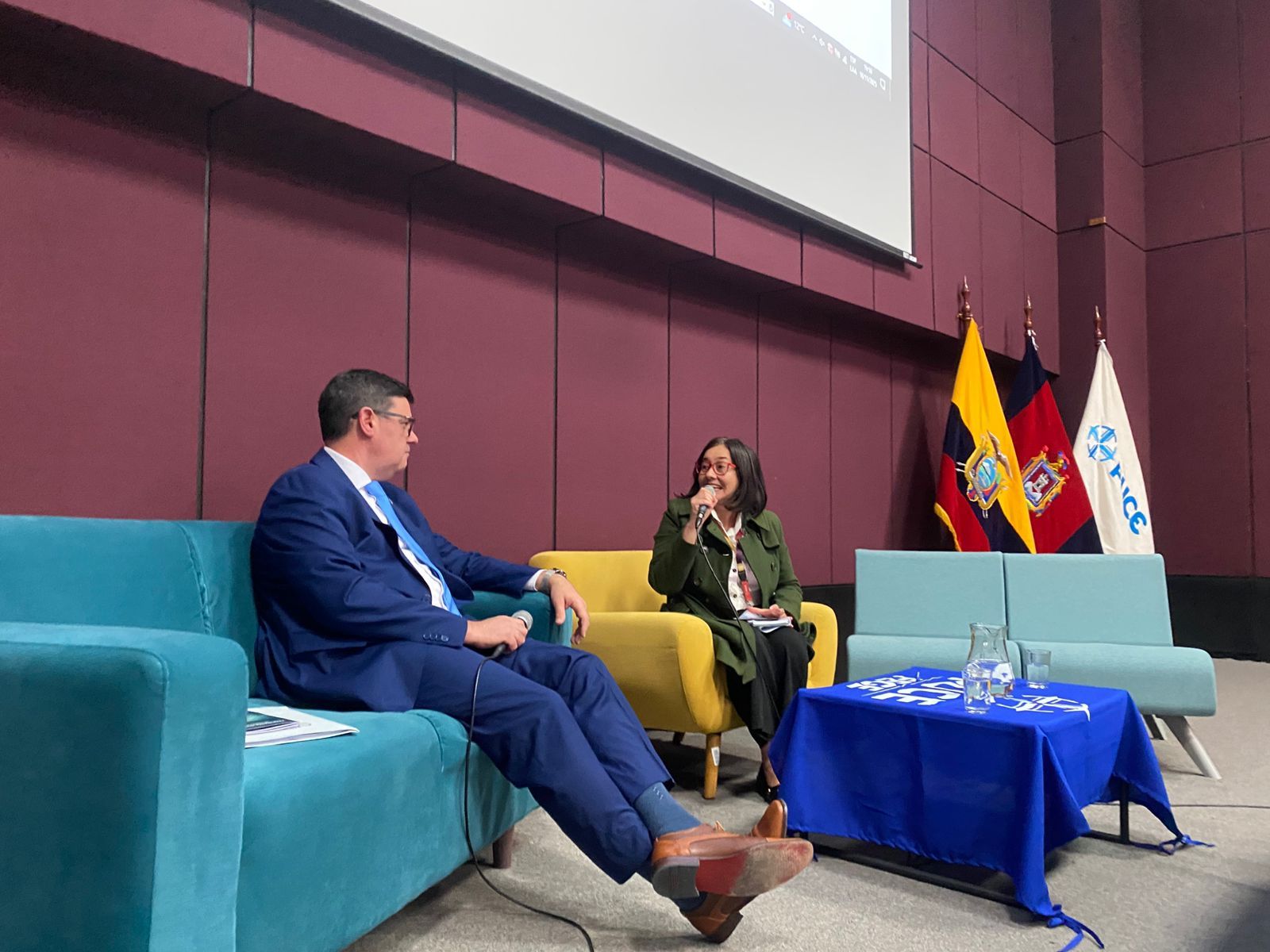
The Director of Studies, Projects and Information of the Latin American and Caribbean Energy Organization (OLACDE), Fitzgerald Cantero, spoke at the XV International Economics Week, held at the Pontifical Catholic University of Ecuador (PUCE) in Quito. His presentation focused on analyzing energy transitions and the opportunities the energy sector offers for addressing economic challenges in Latin America and the Caribbean.

During his remarks, Cantero emphasized that the region holds enormous renewable energy potential, positioning it favorably to move toward a more sustainable, competitive, and resilient energy model. However, he stressed that the energy transition requires political consensus, significant investment, and active private-sector participation for effective implementation.

He also addressed key topics such as promoting electric mobility, the importance of meeting the regional clean cooking access target, and the need to strengthen energy storage to prevent generation losses. In this regard, he noted that curtailed energy in 2024 represented losses of approximately 7 billion dollars, underscoring the urgency of incorporating storage solutions into regional planning.

OLACDE’s participation in this academic setting reaffirms its commitment to disseminating knowledge, building capacity, and promoting policies that advance a more sustainable and inclusive energy future for Latin America and the Caribbean.
Share this news

Energy transitions and economic development: OLACDE at the XV International Economics Week

Newsletter summary

The Director of Studies, Projects and Information of the Latin American and Caribbean Energy Organization (OLACDE), Fitzgerald Cantero, spoke at the XV International Economics Week, held at the Pontifical Catholic University of Ecuador (PUCE) in Quito. His presentation focused on analyzing energy transitions and the opportunities the energy sector offers for addressing economic challenges in […]

Knowledge and Training

We promote advanced technical training programs that facilitate the exchange of experiences, as well as the development of the human and institutional capacities needed to support the energy transformations in our region.

Our academic offering includes executive programs, postgraduate diplomas, master’s degrees, and innovative initiatives focused on topics such as energy transition, conventional energy, renewable energy, e-mobility, and regional integration.

OLACDE creates a regional network focused on energy knowledge that connects governments, young professionals, academics, and sector experts to drive collaborative solutions through technical cooperation and talent development to address future energy and climate challenges.

Technical cooperation and financing

We strengthen South-South and triangular cooperation ties as drivers to accelerate energy transitions in Latin America and the Caribbean. OLACDE brings together efforts among governments, multilateral organizations, academic institutions, and the private sector to mobilize financing, technical capacities, and innovative solutions tailored to our regional reality.

We promote strategic initiatives aimed at directing resources toward projects focused on decarbonization, conventional energy, renewable energy, and energy justice, with the objective of establishing a more efficient, inclusive, and sustainable regional cooperation architecture.

Regional Energy Community

We are building a regional energy community with a global outlook that seeks to position Latin America and the Caribbean as a key player on the international stage. OLACDE strengthens its representation in major multilateral forums related to energy, trade, and climate by fostering strategic alliances and promoting international cooperation.

Through events such as Energy Week, together with new spaces for international dialogue, we promote a collective voice that helps attract financial investment and create new opportunities for sustainable development across our region.

Energy Transition and Strategic Projects

We drive an energy transition based on principles of sustainability, energy security, and social inclusion. OLACDE supports countries in adopting new technologies related to energy efficiency, energy storage, green hydrogen, electromobility, and grid digitalization to accelerate the sector’s decarbonization process.

Our approach also includes promoting strategic projects that strengthen energy resilience at the regional level, contributing to emission reductions while consolidating a cleaner and more competitive energy infrastructure. Initiatives such as OEMLAC position our region as a leading reference in climate innovation and sustainable energy transition.

Energy information and data

We develop regional platforms dedicated to energy information, technical analysis, and strategic data systems that strengthen both public and private decision-making in the sector. OLACDE promotes the digital transformation of the sector through the use of artificial intelligence, georeferencing, and advanced tools for regional energy analysis.

The integration of systems such as SieLAC, together with new regional platforms, allows for the consolidation of reliable and up-to-date technical information, facilitating modern, interoperable, and evidence-based energy planning.

Regional Energy Integration

We promote cooperation in the regional energy sector, focused on collaboration, infrastructure development, and regulatory harmonization, with the objective of strengthening energy security in Latin America and the Caribbean. OLACDE coordinates projects related to electrical interconnection, gas integration, and regional energy planning, seeking to create efficient and sustainable partnerships.

Through cooperation with the governments of our 27 member countries, regional blocs, multilateral institutions, and both public and private stakeholders, we drive strategic initiatives that promote regulatory harmonization and new energy exchange mechanisms, in order to enhance national capacities and accelerate an integrated energy transition at the regional level.