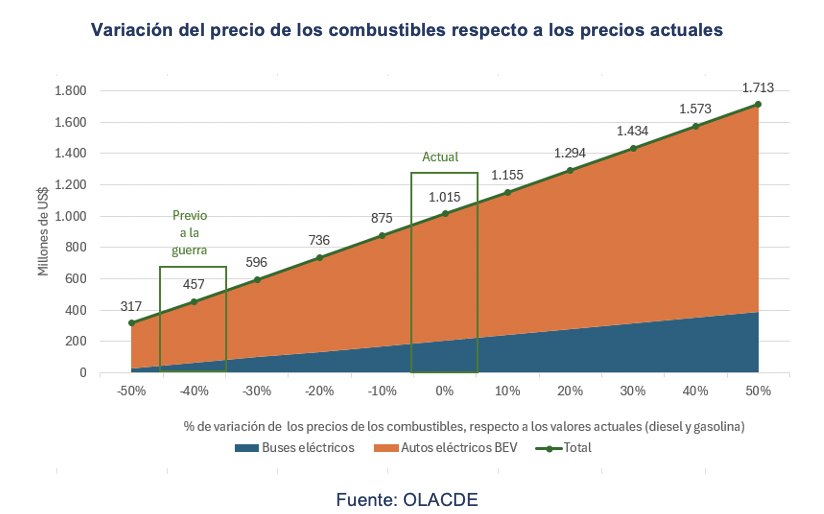
The volatility of the global energy market, driven by tensions in the Middle East, has placed Latin America and the Caribbean (LAC) at a strategic crossroads. While diesel and gasoline prices climb to averages of USD 1.30 per liter, the region has found financial shelter in electric power. According to the latest technical data from the sector, the current electric fleet in LAC is already generating direct energy consumption savings of USD 1 billion a year, equivalent to avoiding USD 2.7 million in fossil fuel spending every day.
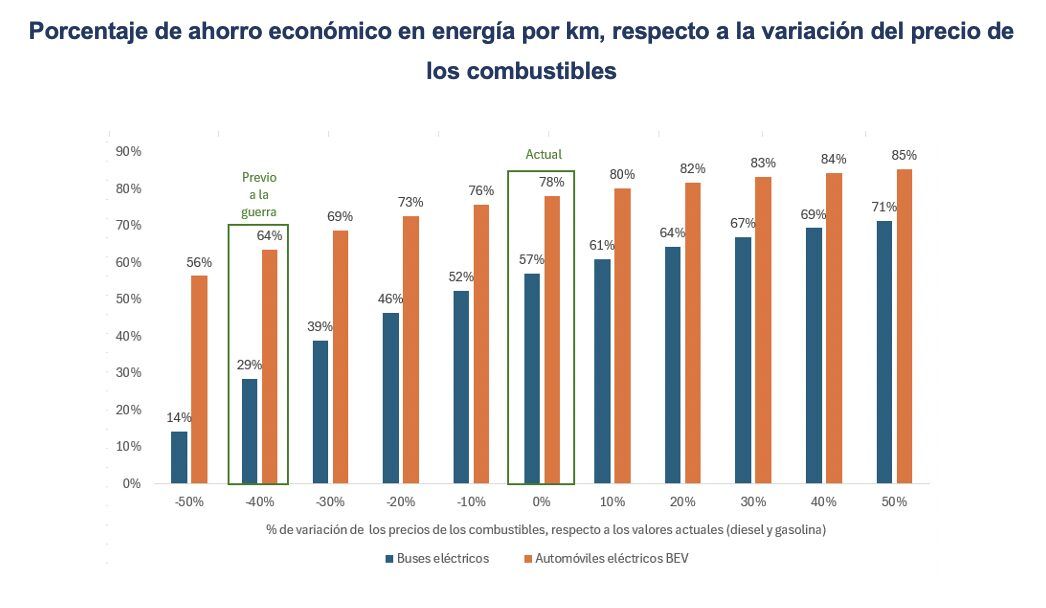
Operational efficiency is the driving force behind this profitability. An electric vehicle is up to five times more efficient than its combustion counterpart, allowing a light-duty car to achieve savings of 81% per kilometer traveled at current prices. In nominal terms, running an electric car today is USD 2,018 cheaper per year than a gasoline one; a gap that widens dramatically if oil prices keep rising: with a 50% increase in fuel prices, this annual savings would climb to USD 3,308.
Key figure: “The current average price of electricity remains as follows: for charging an electric bus, 0.13 USD/kWh, and for charging a light electric vehicle, 0.15 USD/kWh.”
The mass public transit segment shows the most disruptive figures for state and municipal budgets. A single electric bus delivers annual savings of USD 26,000 compared to a diesel one. However, profitability is exponential amid the crisis: if fuel prices rise 50%, the annual savings per unit soars to USD 48,750, practically doubling the economic benefit and cementing electric buses as the most resilient asset for urban infrastructure.
With a fleet of 8,000 electric buses and 400,000 light-duty electric cars on the road, the region has managed to have a 40% rise in fuel prices amplify the economic benefit of the transition, boosting regional savings by 122%. This phenomenon shows that electromobility is not just a decarbonization goal, but an energy-saving strategy against dependence on hydrocarbon imports.
Investment in electric mobility in LAC is no longer a bet on the future but has become a tool for immediate stability. Of the total savings, 80% comes from the light-duty vehicle fleet, showing that the end consumer is capitalizing on the greater efficiency of the electric motor. By keeping electricity costs stable (USD 0.15/kWh average), the external shocks that today are squeezing oil-dependent economies are cushioned.
In conclusion, the geopolitical climate is accelerating the return on investment for those who bet on the electric grid. The shift toward zero-emission mobility is positioning itself as the best insurance against energy inflation, where every kilometer traveled on electricity protects regional capital and strengthens the economic resilience of Latin America and the Caribbean.
For more information contact:
Diana Soriano, Communications Manager