
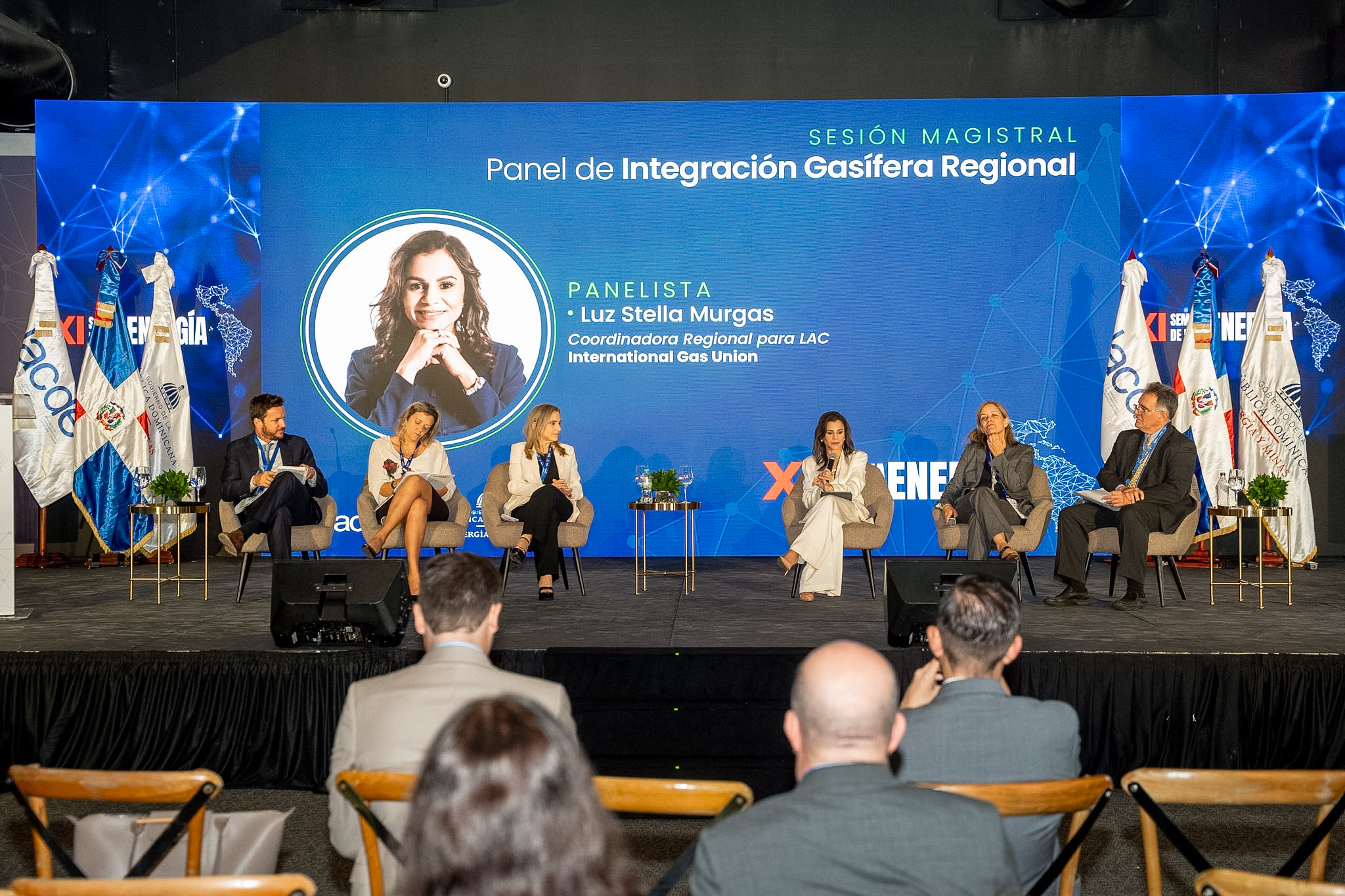
Gas Integration: Energy Security and Competitiveness for Regional Development

The first High-Level Session of the 11th Energy Week focused on regional gas integration as one of its key themes. The discussion began with a shared understanding: Latin America and the Caribbean have abundant energy resources, but harnessing their potential requires expanded infrastructure and demand, greater investment, regulatory harmonization, and long-term planning.

Energy sector leaders agreed that greater gas integration can strengthen energy security, reduce costs, and drive productive development across Latin America and the Caribbean. Such integration would enable countries to better leverage their complementary strengths, diversify energy supplies, and respond more resiliently to disruptions in international markets. To realize this potential, they emphasized the need to coordinate production, demand, and infrastructure through regional planning, harmonized regulatory frameworks, and long-term political agreements that provide investment certainty and support energy transitions.

“We are advancing a Latin American and Caribbean strategy that connects our gas-producing basins with regional demand and enables the development of gas markets with common rules and long-term predictability,” stated Guido Maiulini, Head of Strategic Advisory at OLACDE and moderator of the panel.

For Griselda Lambertini, Director at Argentina’s National Gas and Electricity Regulatory Authority, the Southern Cone’s experience offered a key lesson: “We need a strategic agreement that ensures interconnection also translates into integration.” Looking ahead, she called for regional technical and regulatory coordination capable of organizing cross-border energy exchanges and anticipating emergency situations.

For her part, Heloisa Borges Bastos Esteves, from FGV Energia, highlighted Brazil’s role as a large-scale market: “Brazil can provide the demand needed to drive the region forward while also benefiting from competitively priced natural gas.” To make progress, she emphasized the value of establishing a multilateral forum to jointly address regulatory, contractual, fiscal, and technical issues.

Luz Estella Murgas Maya, Regional Coordinator for Latin America at the International Gas Union (IGU), warned that “the problem in Latin America and the Caribbean is not a lack of resources; the problem lies in delays in implementing projects to harness them.” In this regard, she suggested drawing on policy instruments that provide stability, investment incentives, and mechanisms to accelerate strategic projects.

Meanwhile, Juan Ríos, Principal Executive of the Energy, Gas, and Strategic Mining Division at CAF, emphasized that “integration is one of the Bank’s founding principles” and envisioned a region “supplied by its own resources,” supported by planning that leverages the complementary strengths of countries across the region.

“The doors are open,” stated Marcela Silva, Regional Director of Infrastructure for Latin America and the Caribbean at the World Bank, referring to support for infrastructure projects related to gas transportation, processing, and distribution. She also emphasized that aggregating demand and sharing infrastructure can transform projects that are unviable at the national level into bankable projects at the regional level.

Share this news

Gas Integration: Energy Security and Competitiveness for Regional Development

Newsletter summary

The first High-Level Session of the 11th Energy Week focused on regional gas integration as one of its key themes. The discussion began with a shared understanding: Latin America and the Caribbean have abundant energy resources, but harnessing their potential requires expanded infrastructure and demand, greater investment, regulatory harmonization, and long-term planning.

Capacity building & knowledge

We advance high-level technical training programs that foster experience-sharing and develop the human and institutional capacities required to drive energy transformations across our region.

Our academic programs offer executive courses, postgraduate diplomas, master’s degrees, and innovative initiatives focused on key areas such as the energy transition, conventional and renewable energy, electromobility, and regional integration.

OLACDE builds a regional network of energy expertise, connecting governments, young professionals, academics, and industry experts to foster collaborative solutions through technical cooperation and talent development to address future energy and climate challenges.

Technical cooperation & climate finance

We strengthen South-South and triangular cooperation as key drivers to accelerate energy transitions across Latin America and the Caribbean. OLACDE unites efforts among governments, multilateral organizations, academic institutions, and the private sector to mobilize financing, technical expertise, and innovative solutions tailored to our regional context.

We advance strategic initiatives aimed at directing resources toward decarbonization, conventional energy, renewables, and energy justice projects—building a more efficient, inclusive, and sustainable regional cooperation architecture.

Regional energy community

We are building a regional energy community with a global outlook, positioning Latin America and the Caribbean as a pivotal player on the international stage. OLACDE amplifies regional representation in key multilateral energy, trade, and climate forums by fostering strategic alliances and international cooperation.

Through flagship events such as Energy Week and new spaces for high-level dialogue, we champion a collective voice that attracts investment, drives technical partnerships, and unlocks sustainable development opportunities across our region

Energy transition & strategic projects

We foster a regional energy transition built on sustainability, energy security, and social inclusion. OLACDE supports Member Countries in adopting emerging technologies—such as energy efficiency, storage solutions, green hydrogen, electromobility, and grid digitalization—to accelerate the sector’s decarbonization.

Our approach promotes strategic projects that strengthen energy resilience across Latin America and the Caribbean, reducing emissions while building a cleaner, more competitive energy infrastructure. Key regional initiatives, including OEMLAC, position our region as a benchmark for climate innovation and sustainable energy development.

Energy information and data

We develop regional platforms dedicated to energy intelligence, technical analysis, and strategic data systems that empower both public and private decision-making across the sector. OLACDE drives digital transformation in energy by leveraging artificial intelligence, georeferencing, and advanced analytical tools to map regional energy trends.

The integration of systems such as SieLAC, along with new regional digital platforms, consolidates reliable, up-to-date technical data—enabling modern, interoperable, and evidence-based energy planning.

Regional energy integration

We foster cooperation across the regional energy sector by prioritizing infrastructure development, cross-border collaboration, and regulatory alignment to enhance energy security in Latin America and the Caribbean. OLACDE coordinates strategic projects in power grid interconnections, natural gas integration, and joint energy planning to build resilient, sustainable partnerships.

Working alongside the governments of our 27 Member States, regional blocs, multilateral institutions, and key public and private stakeholders, we drive initiatives that introduce innovative energy exchange mechanisms, strengthen national capacities, and accelerate a unified regional energy transition.