According to OLACDE, in January 2025 monthly energy inflation in LAC was 0.26%, with an annual rate of 2.08%
The Latin American and Caribbean Energy Organization (OLACDE) has today published its Energy Inflation Indicator for Latin America and the Caribbean (IE-LAC) for January 2025. This report offers a detailed analysis of energy trends in the region, which is crucial for understanding how energy markets are behaving and their impact on the economy and sustainability of the countries of Latin America and the Caribbean (LAC).
Monthly energy inflation rose from 0.20% in December 2024 to 0.26% in January 2025. This increase is mainly attributed to an 8.9% rise in international oil prices compared to December 2024, which is reflected in higher fuel prices. Fuels account for between 60% and 70% of the energy basket.
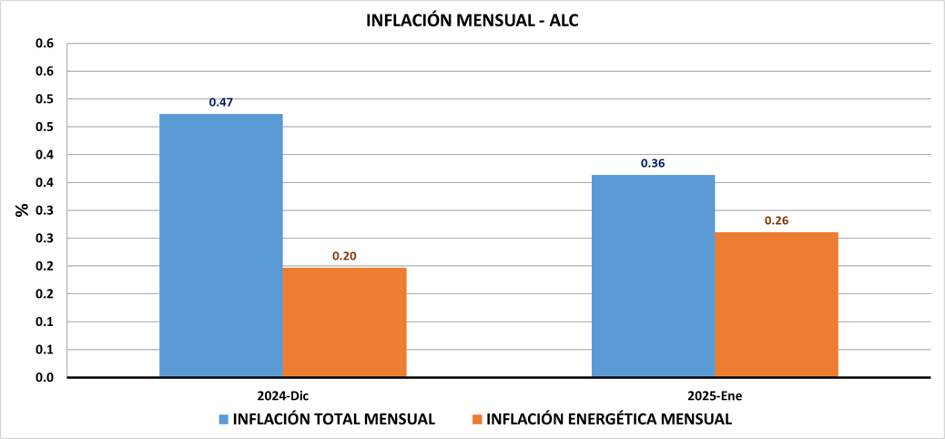
Source: OLACDE, prepared using information published by the Institutes of Statistics and Census and the Central Banks of OLACDE Member Countries.
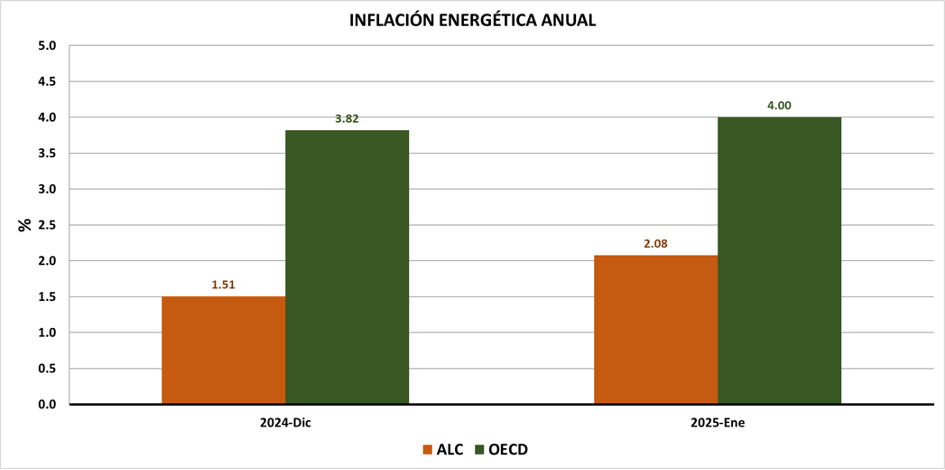
In January 2025, annual energy inflation in Latin America and the Caribbean, compared to January 2024, stood at 2.08%. This figure is lower than overall inflation, which reached 3.93%. At the start of 2025, energy sector prices in the region have maintained the same pattern as the previous year—that is, a level below that of prices for the regional economy as a whole.
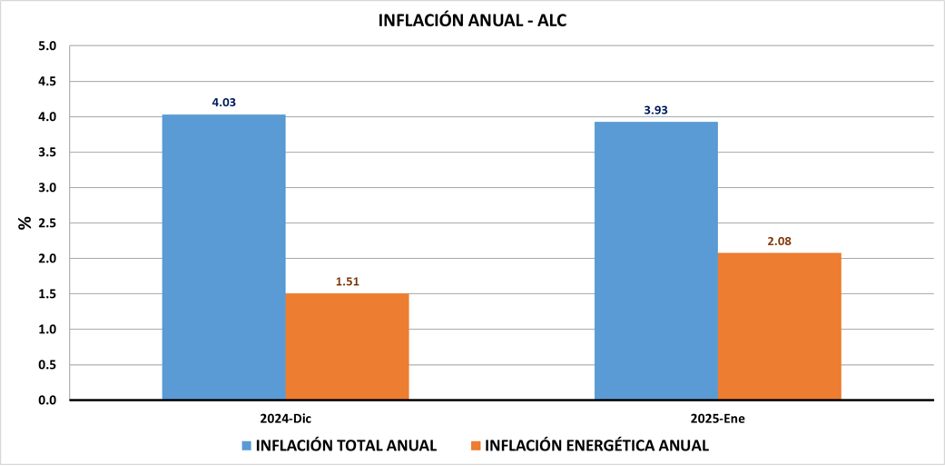
Source: OLACDE, prepared using information published by the Institutes of Statistics and Census and the Central Banks of OLACDE Member Countries.
Energy inflation in OECD countries rose slightly to 4.0% in January 2025, up from 3.8% in December 2024, with a mixed picture across countries, ranging between -12% and 40%. LAC has maintained lower energy inflation than the OECD for the third consecutive month.