Mercosur Countries and Chile Move Toward a New Gas Transport Model to Optimize Costs

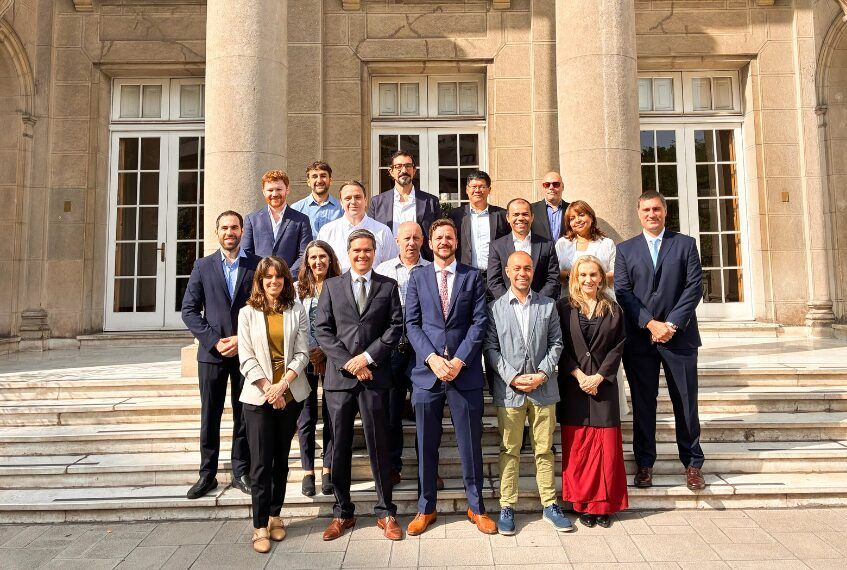
OLACDE and CAF held the closing workshop for Phase IV of the Regional Gas Integration Project in Santiago, Chile, carried out at the Faculty of Engineering of the University of Chile and attended by authorities, national delegations, and technical teams from the Mercosur countries and Chile.

The meeting focused on the presentation and analysis of the new regional gas transport model developed by OLACDE based on information provided by the countries. The tool seeks to optimize the use of existing infrastructure, identify more efficient routes, and project cost reductions under different operating scenarios.

The opening remarks were given by Guido Maiulini, Head of Strategic Advisory at OLACDE; Luis Felipe Ramos, Undersecretary of Energy of Chile; and Mercedes Pedreira, Executive at CAF’s Directorate of Integration, Trade and Investments, who highlighted the importance of this stage in deepening regional cooperation and promoting a more efficient and complementary gas system.

Guido Maiulini noted: “Since we began this process in 2023 we have achieved very significant progress, and the strength of this work reflects both the commitment of the MERCOSUR countries and Chile to resume discussions on gas integration strategies and the meticulous work of their agencies and the essential involvement of multilateral organizations such as MERCOSUR and CAF.” He added: “During this time we have been able to build an alliance with clear programmatic direction and create joint technical working spaces that allow us to develop the tools needed to advance toward regional energy integration, as demonstrated by today’s meeting devoted to analyzing a new regional gas transport model.”

Meanwhile, Luis Felipe Ramos stated: “For the Government of Chile, energy and gas integration is essential, because it contributes to security, resilience, and the fulfillment of our environmental goals. From the Ministry of Energy we are moving forward with concrete actions such as updating regulations and our active participation in this process to ensure that integration becomes an effective pillar of the energy transition and of the country’s decarbonization objective.”

For her part, Mercedes Pedreira stated: “At CAF we appreciate the time and dedication that each delegation has put into this study, which aligns with our commitment to regional integration and a just energy transition. The alliance with OLACDE that gave rise to this work is a fundamental tool for addressing the challenges our countries face today.”

During the workshop, the delegations made progress in validating the hypotheses and data provided by the countries, reviewed the topology of the regional transport system, and analyzed the operational and planning constraints identified at the national level. Real-time simulations were also carried out to assess how the model behaves under variations in transport, production, and demand costs, and to observe their effects on flow allocation and the system’s economic efficiency.

Within this framework, findings emerged that include the need to expand evacuation capacity from Neuquén, strengthen intermediate infrastructure to meet potential demand from Paraguay and northern Uruguay, and adapt the model to the changes Brazil will implement in its transport system in the coming years.

The open-source model, which is under continuous adjustment, makes it possible to identify more competitive transport routes, minimize costs, and estimate indicators of interest to the countries, such as the final price of gas at each node, over short- and medium-term horizons, under different configurations and scenarios the countries consider possible.

With this work, OLACDE and CAF are consolidating a tool to optimize gas transport costs and strengthening joint planning to advance toward regional energy integration.
 

Share this news

Mercosur Countries and Chile Move Toward a New Gas Transport Model to Optimize Costs

Newsletter summary

OLACDE and CAF held the closing workshop for Phase IV of the Regional Gas Integration Project in Santiago, Chile, carried out at the Faculty of Engineering of the University of Chile and attended by authorities, national delegations, and technical teams from the Mercosur countries and Chile. The meeting focused on the presentation and analysis of […]

Knowledge and Training

We promote advanced technical training programs that facilitate the exchange of experiences, as well as the development of the human and institutional capacities needed to support the energy transformations in our region.

Our academic offering includes executive programs, postgraduate diplomas, master’s degrees, and innovative initiatives focused on topics such as energy transition, conventional energy, renewable energy, e-mobility, and regional integration.

OLACDE creates a regional network focused on energy knowledge that connects governments, young professionals, academics, and sector experts to drive collaborative solutions through technical cooperation and talent development to address future energy and climate challenges.

Technical cooperation and financing

We strengthen South-South and triangular cooperation ties as drivers to accelerate energy transitions in Latin America and the Caribbean. OLACDE brings together efforts among governments, multilateral organizations, academic institutions, and the private sector to mobilize financing, technical capacities, and innovative solutions tailored to our regional reality.

We promote strategic initiatives aimed at directing resources toward projects focused on decarbonization, conventional energy, renewable energy, and energy justice, with the objective of establishing a more efficient, inclusive, and sustainable regional cooperation architecture.

Regional Energy Community

We are building a regional energy community with a global outlook that seeks to position Latin America and the Caribbean as a key player on the international stage. OLACDE strengthens its representation in major multilateral forums related to energy, trade, and climate by fostering strategic alliances and promoting international cooperation.

Through events such as Energy Week, together with new spaces for international dialogue, we promote a collective voice that helps attract financial investment and create new opportunities for sustainable development across our region.

Energy Transition and Strategic Projects

We drive an energy transition based on principles of sustainability, energy security, and social inclusion. OLACDE supports countries in adopting new technologies related to energy efficiency, energy storage, green hydrogen, electromobility, and grid digitalization to accelerate the sector’s decarbonization process.

Our approach also includes promoting strategic projects that strengthen energy resilience at the regional level, contributing to emission reductions while consolidating a cleaner and more competitive energy infrastructure. Initiatives such as OEMLAC position our region as a leading reference in climate innovation and sustainable energy transition.

Energy information and data

We develop regional platforms dedicated to energy information, technical analysis, and strategic data systems that strengthen both public and private decision-making in the sector. OLACDE promotes the digital transformation of the sector through the use of artificial intelligence, georeferencing, and advanced tools for regional energy analysis.

The integration of systems such as SieLAC, together with new regional platforms, allows for the consolidation of reliable and up-to-date technical information, facilitating modern, interoperable, and evidence-based energy planning.

Regional Energy Integration

We promote cooperation in the regional energy sector, focused on collaboration, infrastructure development, and regulatory harmonization, with the objective of strengthening energy security in Latin America and the Caribbean. OLACDE coordinates projects related to electrical interconnection, gas integration, and regional energy planning, seeking to create efficient and sustainable partnerships.

Through cooperation with the governments of our 27 member countries, regional blocs, multilateral institutions, and both public and private stakeholders, we drive strategic initiatives that promote regulatory harmonization and new energy exchange mechanisms, in order to enhance national capacities and accelerate an integrated energy transition at the regional level.