Women leaders drive a just energy transition in Latin America and the Caribbean

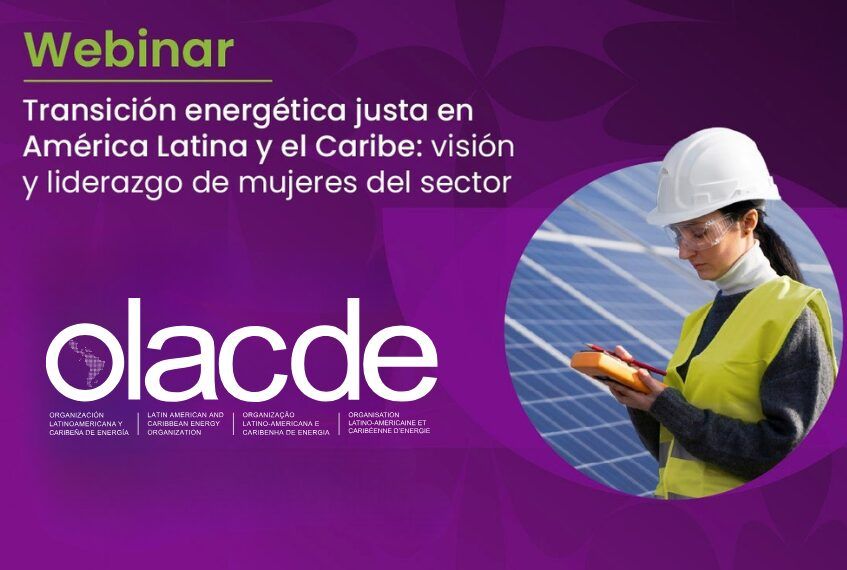
The Latin American and Caribbean Energy Organization (OLACDE), through the Latin American and Caribbean Women in Energy Network (RedLACME), held the webinar “Just Energy Transition and Women’s Leadership in the Region: Vision and Leadership of Women in the Sector,” a regional forum that brought together prominent professionals from the energy field to reflect on the progress, challenges and opportunities of building more inclusive, sustainable and equitable energy systems.

This high-level dialogue addressed the sector’s current transformations, the importance of incorporating a gender perspective into the energy transition, and the strategic role of women’s leadership in the region’s sustainable development.

The panel featured representatives from the associations that make up RedLACME: Paola Pimentel, of Women in Energy of the Dominican Republic (MER RD); Marcela Zulantay, of the Women in Energy Association of Chile (AME); Verónica Geese, of the Association of Women in Sustainable Energy of Argentina (AMES); and Cecilia San Román, of the Uruguayan Association of Women in Energy (AUME).

During the event, participants noted that an energy transition that does not fully integrate women’s capabilities and skills loses out on innovation, decision-making quality and talent that is key to the sector’s development. They also pointed out that gender gaps in energy stem from structural, multifactorial and territorial factors, including inequalities between rural and urban areas, segmentation between the public and private sectors, the male-dominated nature of STEM careers, wage gaps and cultural barriers.

The panelists agreed that the lack of visible role models limits women’s entry, retention and access to leadership positions in the energy sector. In this context, they stressed that the energy transition represents a historic opportunity to promote greater participation by women, especially in areas such as renewable energy, digitalization, distributed generation and local energy projects.

The webinar concluded with a call to shift the paradigm: women should not be seen merely as a group to be included, but as key actors and central architects of a just, social and sustainable energy transition in Latin America and the Caribbean.

During the dialogue, the panelists shared reflections on the importance of women’s leadership in transforming the energy sector. Verónica Geese noted that “when an activity does not integrate women’s capabilities, it loses innovation, decision-making quality and talent that is key to the energy transition.” For her part, Cecilia San Román emphasized that “the energy transition will not be just as long as technical and leadership roles remain male-dominated and wage gaps persist.” Along the same lines, Marcela Zulantay stated that “making women’s leadership visible is not symbolic: it means creating real mirrors so that more women can see themselves and envision their future in the energy sector.” Finally, Paola Pimentel emphasized that “energy is not just a technical issue: it is education, health, autonomy and social justice; that is why a gender perspective must be present from the design stage.”

This regional forum reaffirms OLACDE’s and RedLACME’s commitment to promoting gender equality and strengthening women’s leadership as a fundamental element for advancing toward fairer, more inclusive and sustainable energy systems in the region.

Watch the webinar at the following link: https://youtu.be/bSnbOgfY5aU
Share this news

Women leaders drive a just energy transition in Latin America and the Caribbean

Newsletter summary

The Latin American and Caribbean Energy Organization (OLACDE), through the Latin American and Caribbean Women in Energy Network (RedLACME), held the webinar “Just Energy Transition and Women’s Leadership in the Region: Vision and Leadership of Women in the Sector,” a regional forum that brought together prominent professionals from the energy field to reflect on the […]

Knowledge and Training

We promote advanced technical training programs that facilitate the exchange of experiences, as well as the development of the human and institutional capacities needed to support the energy transformations in our region.

Our academic offering includes executive programs, postgraduate diplomas, master’s degrees, and innovative initiatives focused on topics such as energy transition, conventional energy, renewable energy, e-mobility, and regional integration.

OLACDE creates a regional network focused on energy knowledge that connects governments, young professionals, academics, and sector experts to drive collaborative solutions through technical cooperation and talent development to address future energy and climate challenges.

Technical cooperation and financing

We strengthen South-South and triangular cooperation ties as drivers to accelerate energy transitions in Latin America and the Caribbean. OLACDE brings together efforts among governments, multilateral organizations, academic institutions, and the private sector to mobilize financing, technical capacities, and innovative solutions tailored to our regional reality.

We promote strategic initiatives aimed at directing resources toward projects focused on decarbonization, conventional energy, renewable energy, and energy justice, with the objective of establishing a more efficient, inclusive, and sustainable regional cooperation architecture.

Regional Energy Community

We are building a regional energy community with a global outlook that seeks to position Latin America and the Caribbean as a key player on the international stage. OLACDE strengthens its representation in major multilateral forums related to energy, trade, and climate by fostering strategic alliances and promoting international cooperation.

Through events such as Energy Week, together with new spaces for international dialogue, we promote a collective voice that helps attract financial investment and create new opportunities for sustainable development across our region.

Energy Transition and Strategic Projects

We drive an energy transition based on principles of sustainability, energy security, and social inclusion. OLACDE supports countries in adopting new technologies related to energy efficiency, energy storage, green hydrogen, electromobility, and grid digitalization to accelerate the sector’s decarbonization process.

Our approach also includes promoting strategic projects that strengthen energy resilience at the regional level, contributing to emission reductions while consolidating a cleaner and more competitive energy infrastructure. Initiatives such as OEMLAC position our region as a leading reference in climate innovation and sustainable energy transition.

Energy information and data

We develop regional platforms dedicated to energy information, technical analysis, and strategic data systems that strengthen both public and private decision-making in the sector. OLACDE promotes the digital transformation of the sector through the use of artificial intelligence, georeferencing, and advanced tools for regional energy analysis.

The integration of systems such as SieLAC, together with new regional platforms, allows for the consolidation of reliable and up-to-date technical information, facilitating modern, interoperable, and evidence-based energy planning.

Regional Energy Integration

We promote cooperation in the regional energy sector, focused on collaboration, infrastructure development, and regulatory harmonization, with the objective of strengthening energy security in Latin America and the Caribbean. OLACDE coordinates projects related to electrical interconnection, gas integration, and regional energy planning, seeking to create efficient and sustainable partnerships.

Through cooperation with the governments of our 27 member countries, regional blocs, multilateral institutions, and both public and private stakeholders, we drive strategic initiatives that promote regulatory harmonization and new energy exchange mechanisms, in order to enhance national capacities and accelerate an integrated energy transition at the regional level.