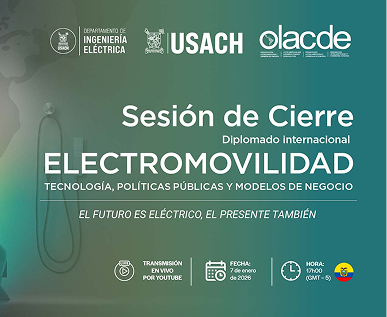
International Diploma in Electromobility: Technology, Public Policy, and Business Models

Diploma

A program designed to provide fundamental knowledge on the operation of electric vehicles, charging infrastructure systems, public policies, and public-private business models. Its primary focus is the training of advanced human capital capable of leading the transformation of the transport sector toward efficient energy use and the reduction of environmental impact.

Aimed at professionals interested in promoting initiatives and policies linked to the electromobility ecosystem.

The diploma's curriculum integrates a multidimensional vision that begins with an in-depth analysis of public policies, regulations, and market players in Latin America, along with a technical introduction to the fundamentals of electricity applied to mobility. The modules progress toward a detailed study of electric vehicle technology, covering operating principles, motors, converters, solar vehicle innovation, retrofit processes, and the comprehensive management of battery storage and reuse systems. It also addresses charging infrastructure and Smart Grids, including the regulatory and technical design of charging stations, along with the management of sustainable mobility projects in both public and private sectors. Finally, the program links this knowledge with the development of strategic business models for fleets and infrastructure, exploring cutting-edge technologies such as hydrogen and the Vehicle-to-Everything (V2X) system, all complemented by in-person practical workshops ranging from technical diagnostics to second-life battery charging.


Various, coordinated by the University of Santiago, Chile

Upon completion, participants will be qualified to understand the operating principles of electric vehicles (batteries, motors, and charging), evaluate electric fleets, and propose incentive schemes and business models applied to the regional industrial reality.

This diploma program is open to the general public and requires a fee. Prior registration is required.

Please provide your details to register

TBC - September 2026

Hybrid
3 months

International Diploma in Electromobility: Technology, Public Policy, and Business Models

Newsletter summary

A program designed to provide fundamental knowledge on the operation of electric vehicles, charging infrastructure systems, public policies, and public-private business models. Its primary focus is the training of advanced human capital capable of leading the transformation of the transport sector toward efficient energy use and the reduction of environmental impact.

Knowledge and Training

We promote advanced technical training programs that facilitate the exchange of experiences, as well as the development of the human and institutional capacities needed to support the energy transformations in our region.

Our academic offering includes executive programs, postgraduate diplomas, master’s degrees, and innovative initiatives focused on topics such as energy transition, conventional energy, renewable energy, e-mobility, and regional integration.

OLACDE creates a regional network focused on energy knowledge that connects governments, young professionals, academics, and sector experts to drive collaborative solutions through technical cooperation and talent development to address future energy and climate challenges.

Technical cooperation and financing

We strengthen South-South and triangular cooperation ties as drivers to accelerate energy transitions in Latin America and the Caribbean. OLACDE brings together efforts among governments, multilateral organizations, academic institutions, and the private sector to mobilize financing, technical capacities, and innovative solutions tailored to our regional reality.

We promote strategic initiatives aimed at directing resources toward projects focused on decarbonization, conventional energy, renewable energy, and energy justice, with the objective of establishing a more efficient, inclusive, and sustainable regional cooperation architecture.

Regional Energy Community

We are building a regional energy community with a global outlook that seeks to position Latin America and the Caribbean as a key player on the international stage. OLACDE strengthens its representation in major multilateral forums related to energy, trade, and climate by fostering strategic alliances and promoting international cooperation.

Through events such as Energy Week, together with new spaces for international dialogue, we promote a collective voice that helps attract financial investment and create new opportunities for sustainable development across our region.

Energy Transition and Strategic Projects

We drive an energy transition based on principles of sustainability, energy security, and social inclusion. OLACDE supports countries in adopting new technologies related to energy efficiency, energy storage, green hydrogen, electromobility, and grid digitalization to accelerate the sector’s decarbonization process.

Our approach also includes promoting strategic projects that strengthen energy resilience at the regional level, contributing to emission reductions while consolidating a cleaner and more competitive energy infrastructure. Initiatives such as OEMLAC position our region as a leading reference in climate innovation and sustainable energy transition.

Energy information and data

We develop regional platforms dedicated to energy information, technical analysis, and strategic data systems that strengthen both public and private decision-making in the sector. OLACDE promotes the digital transformation of the sector through the use of artificial intelligence, georeferencing, and advanced tools for regional energy analysis.

The integration of systems such as SieLAC, together with new regional platforms, allows for the consolidation of reliable and up-to-date technical information, facilitating modern, interoperable, and evidence-based energy planning.

Regional Energy Integration

We promote cooperation in the regional energy sector, focused on collaboration, infrastructure development, and regulatory harmonization, with the objective of strengthening energy security in Latin America and the Caribbean. OLACDE coordinates projects related to electrical interconnection, gas integration, and regional energy planning, seeking to create efficient and sustainable partnerships.

Through cooperation with the governments of our 27 member countries, regional blocs, multilateral institutions, and both public and private stakeholders, we drive strategic initiatives that promote regulatory harmonization and new energy exchange mechanisms, in order to enhance national capacities and accelerate an integrated energy transition at the regional level.